When you watch Japanese period dramas, you often see local law enforcement officers in the streets of Edo, the city that is now Tokyo.
Samurai and ninja are well known around the world. However, how much do people know about the people who worked closer to ordinary citizens in old Japan?
Even in Japanese period dramas, relatively few stories focus mainly on the people responsible for maintaining order in Edo’s neighborhoods.
Yet, the city’s security depended not only on the officials themselves but also on the people who worked under them. These included lower-ranking samurai known as doshin, who were sometimes called Hatchobori, and civilian assistants known as okappiki and shita-ppiki.
However, when we look at history, we can also find a darker side to this system.
What were these people really like?
Characters
Mike: A 12-year-old American boy who is interested in Japan.
John: Mike’s father. He sometimes travels to Japan on business.
Kelly: Mike’s mother. She is good at cooking.
Nobu: A Japanese exchange student.
Prologue
One day, Mike was watching a Japanese period drama when something caught his attention.
He was surprised to see samurai walking around Edo wearing kimono and swords but no hakama, the wide-legged trousers commonly associated with samurai.
He was also curious about the men who appeared to work under these officials. They carried small metal weapons that were not swords. Mike had never seen ninja carrying anything quite like them, either.
Even stranger, some of these men seemed to show their weapons off to ordinary townspeople, almost as if they were saying, “Look what I’ve got!”
It was a rather strange sight.
Just then, Nobu arrived.
The Local Law Enforcement Officers of Edo
Nobu: “Hello!”
Mike: “Hi! You’re just in time. I wanted to ask you something.”
Nobu: “What is it?”
Mike: “It’s about this period drama. Some of the people in it look rather unusual. First, there are the samurai who aren’t wearing hakama. I thought samurai normally wore them over their kimono and carried swords. But these men aren’t wearing them.”
Nobu: “Ah, those are lower-ranking samurai who worked in law enforcement in Edo. They were more like police officers than the samurai you usually imagine. They were called doshin. Since many of them lived in an area called Hatchobori, people also used that place name to refer to them.”
Mike: “Hatchobori? It’s interesting that they were called by the name of the place where they lived.”
John: “I see. Then what about the men who seem to work under them? They don’t carry swords, and they look like ordinary townspeople. But they have small, hook-like metal weapons, which they seem to show off. It’s almost as if they’re saying, ‘Don’t mess with me. I’ve got this!'”
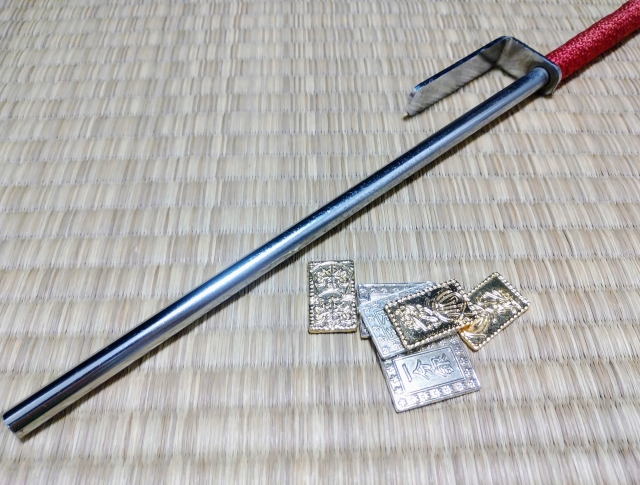
Nobu: “Those men are called okappiki and shita-ppiki. They were townspeople rather than official samurai, but they assisted law enforcement officers with their work. The metal weapon they’re carrying is called a jitte. It doesn’t have a cutting blade like a sword, so you can’t slash someone with it. However, it could be useful for restraining and capturing suspects.”
Mike: “A jitte! That’s interesting.”
Nobu: “But remember, this is a television drama. The real situation was apparently different. In particular, the jitte wasn’t necessarily something these men would openly show off to everyone as they do on television.”
Edo’s Local Police and the Okappiki
Kelly: “Wait a minute. The okappiki weren’t actually government officials, were they? They were ordinary townspeople. So why could they act so important?”
Nobu: “That’s another part of the story where television dramas take some liberties. Okappiki were generally civilian assistants used by law enforcement officers, sometimes on a private basis.”
“At the time, Edo was a huge city, with a population estimated at around one million. The officials couldn’t handle every situation by themselves. They needed help from other people, so civilian assistants became an important part of their work.”
Kelly: “So they really were ordinary townspeople. That explains why they look like them.”
Mike: “By the way, in this drama, the okappiki defeats bad guys by throwing coins at them. Did they really throw money at criminals?”
Nobu: “Ah, you’re watching Zenigata Heiji! It was an extremely popular Japanese period drama. Some children who watched it wanted a jitte of their own. Toy swords were available, but toy jitte weren’t easy to find. I remember wishing I had one, too.”
Kelly: “But you didn’t throw coins at people?”
Nobu: “I didn’t have much pocket money, and my parents would have been furious if I had played with real money.”
Kelly: “That makes sense!”
Were Okappiki and Shita-ppiki Really Heroes of Justice Like in Japanese Period Dramas?
John: “When I watch period dramas, the okappiki seem to catch criminals so skillfully. Could ordinary townspeople really become that good at fighting?”
Nobu: “Well, that’s part of the entertainment. Japanese period dramas have action specialists called tate-shi, who help choreograph fight scenes. Their guidance makes those impressive action sequences possible.”
John: “That makes sense. In a real fight, it’s hard to imagine people moving around so dramatically.”
Nobu: “Exactly. And there’s another question worth asking: Were the okappiki and shita-ppiki really heroes of justice?”
Mike: “What do you mean? They look so cool!”
Nobu: “In period dramas, okappiki are often portrayed as courageous men with a strong sense of justice. They care about ordinary people, have a good reputation, and never let evil go unpunished.”
“But the historical picture was more complicated. Okappiki often received little financial support for their work. Some relied on other sources of income, and some took improper payments or abused their position.”
Kelly: “Bribes?!”
Nobu: “Yes, although we shouldn’t assume that every okappiki was corrupt. The important point is that their work could create opportunities for abuse, especially when they had influence over ordinary townspeople.”
John: “I suppose they had to make a living somehow. But that doesn’t make abusing their position acceptable.”
Nobu: “That’s right. We need to distinguish between the people who genuinely helped maintain public order and those who took advantage of their position.”
Mike: “By the way, I was wondering about the jitte they carried. Was there a special way to use it? I’m curious because it wasn’t a cutting weapon like a sword.”
Nobu: “That’s a good question. A jitte wasn’t primarily intended to kill an opponent. It could be used to defend against attacks, strike an opponent, or help restrain someone.”
“Once a suspect was under control, ropes could be used to tie them up and prevent them from escaping.”
Kelly: “I like the idea of capturing someone without having to kill them.”
Nobu: “Rope techniques were also an important part of traditional Japanese restraint methods. They involved more than simply tying a person up. And Japan had martial arts such as jujutsu, which included techniques for controlling an opponent without relying entirely on a sword.”
Mike: “It’s amazing that they used ropes as part of their techniques, too!”
John: “I see. So capturing a criminal involved more than simply swinging a weapon around.”
Mike: “But I’m a little disappointed.”
Kelly: “Why?”
Mike: “Because the okappiki in period dramas looked so cool. Now that I know some of them may have taken bribes or abused their position, they don’t seem quite as heroic.”
Nobu: “Well, that’s television for you.”
The End
From My Own Experience with Japanese Period Dramas
I used to watch Japanese period dramas quite often, too. One of my favorites was the Hissatsu Shigotonin series.
One of its memorable characters was Nakamura Mondo, a low-ranking official sometimes associated with the name Hatchobori. During the day, he was portrayed as an incompetent official who was looked down on by the people around him. But when it came time to carry out his secret work, he became a remarkably skilled swordsman.
He was cool!
Japanese period dramas also had a certain kind of shibusa—a quiet, mature charm that is difficult to describe in a single English word.
Even actors who might not have been considered handsome could create a powerful impression through their expressions, gestures, and presence. Then, at the end of the story, the hero would draw his sword and defeat the villains.
I found those stories deeply moving.
These days, I sometimes feel that it’s harder to find period dramas with quite the same kind of shibusa. Of course, tastes change, and there are many different styles of historical drama today.
If you’re interested, I recommend looking for older Japanese period dramas online. They offer a glimpse into a style of Japanese television that many people in Japan grew up watching.
Conclusion
Japanese period dramas can provide an interesting introduction to Japan’s past.
They offer entertaining ways to learn about the society of the Edo period, the samurai who served the shogunate, and even the world of the ninja during the turbulent Sengoku period.
However, these programs are still television entertainment. Even when the creators make an effort to research history, dramatic effects and fictional elements are often added to make the stories more exciting.
It’s worth watching them while keeping the historical facts in mind.
But be careful. Sometimes, knowing too much about the real history can spoil the fun.
After all, who wants to imagine Zenigata Heiji—the hero who defeats criminals by throwing coins at them—taking bribes?
I’d rather keep that image out of my head!
Related Article
Want to know how much truth is behind these samurai and town policing stories? Discover the facts in How Historically Accurate Are Japanese Jidaigeki Dramas?
Read the article →