Japanese is sometimes considered a difficult language for people from other countries. One reason is that the same pronunciation can have different meanings. Japanese also has many words formed by combining two or more words.
One example is kushiyaki (串焼き), a popular type of Japanese food. Interestingly, kushiyaki is sometimes confused with yakitori (焼き鳥).
What is the difference between these two terms? And what kind of food does each one refer to?
Characters
Mike: A 12-year-old American boy who is interested in Japan.
John: Mike’s father. He sometimes travels to Japan on business.
Kelly: Mike’s mother. She is good at cooking.
Nobu: A Japanese exchange student.
Prologue
John is a businessman who frequently visits Japan. When he travels there, he sometimes has dinner with his Japanese colleagues.
During his latest business trip, a Japanese colleague asked him what he would like to eat for dinner. John replied that he wanted to try a yakitori (焼き鳥) restaurant.
His colleague happily agreed and took him to a kushiyaki (串焼き) restaurant.
John initially thought they had gone to the wrong place. However, when the food arrived, he found that it was yakitori.
He wondered, “Why are they serving yakitori at a kushiyaki restaurant?”
He returned to the United States with this question still on his mind.
Today, he is telling Mike and Kelly about the experience. Just then, Nobu arrives.
Nobu: Hello!
John: Hi! We were just talking about the difference between kushiyaki and yakitori.
Mike: That’s right. John wanted to visit a yakitori restaurant, but his Japanese colleague took him to a kushiyaki restaurant. Then they served him yakitori. He found it confusing.
Kelly: I understand that yakitori is grilled chicken, but what kind of meat is kushiyaki made from?
Nobu: I see. Perhaps it would be best to start with the meanings of the words.
John: Please explain!
What Does “Kushiyaki (串焼き)” Mean?
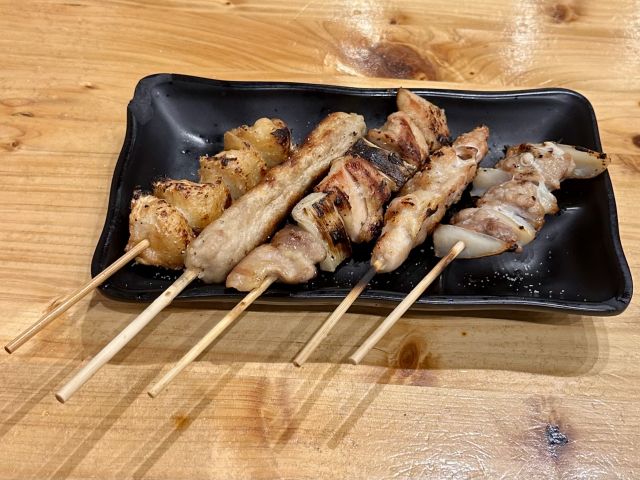
Nobu: Let’s start with the word kushiyaki (串焼き). It is actually made up of two Japanese words: kushi (串) and yaki (焼き).
Mike: What does kushi mean?
Nobu: Kushi (串) means a long, pointed stick or skewer. It is somewhat like a spear. For example, the Japanese word kushizashi (串刺し) means piercing something with a pointed object or skewer.
Kelly: Then what does yaki mean?
Nobu: Yaki (焼き) refers to cooking something with heat, especially by grilling or roasting. It is the same word used in yakitori.
Mike: So, does kushiyaki mean heating something like a spear? That sounds strange.
Nobu: There is one important point to understand. In kushiyaki, the kushi is a small skewer used to hold pieces of food.
Small pieces of meat or other ingredients are placed on a pointed bamboo or metal skewer and then cooked over heat. The finished dish is called kushiyaki.
Kelly: So kushiyaki is food made by putting small pieces of ingredients on skewers and grilling them.
Nobu: Exactly!
What Does “Yakitori (焼き鳥)” Mean?
John: Then what about yakitori?
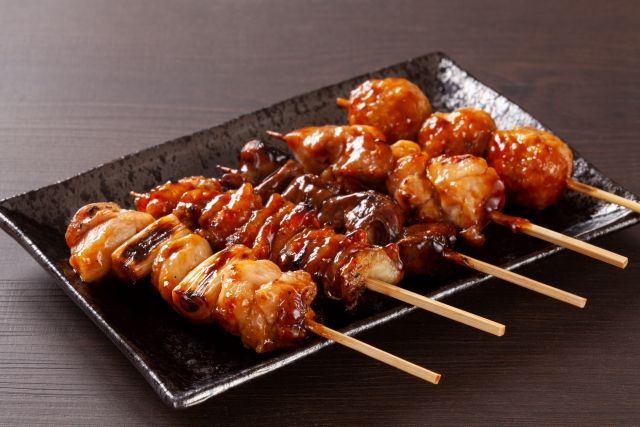
Nobu: Yakitori (焼き鳥) generally means grilled chicken. As I mentioned earlier, yaki (焼き) refers to cooking with heat, while tori (鳥) means bird. In this food-related context, it refers to chicken.
However, yakitori is not simply chicken cooked in a frying pan, like grilled chicken breast. It usually consists of small pieces of chicken placed on skewers and grilled.
Mike: That sounds quite similar to kushiyaki.
Nobu: That’s right. Both are dishes in which ingredients are placed on skewers and grilled. Kushiyaki covers several types of skewered grilled food, and yakitori is one of its categories.
John: So that’s why my colleague took me to a kushiyaki restaurant when I asked for yakitori. They served yakitori because it was one of the dishes available there.
Nobu: Exactly.
Kelly: By the way, how many different dishes can you find at a kushiyaki restaurant? If they serve more than just yakitori, I imagine there must be quite a variety.
Nobu: That’s right. In addition to chicken, many restaurants serve grilled pork on skewers. Some also offer grilled organ meats, such as liver and other internal organs. However, there is something worth noting.
John: What do you mean?
Nobu: Many yakitori restaurants also serve other types of kushiyaki. In fact, you may enter a restaurant expecting it to serve only yakitori and discover that its menu includes many other kinds of skewered grilled food.
John: So it depends on the restaurant and its menu.
Nobu: Exactly.
Examples of Kushiyaki and Yakitori Menu Items
Kelly: Then what kinds of dishes can we find on the menu?
Nobu: Here are some typical examples.
Examples of Kushiyaki (串焼き)
- Butabara (豚バラ): Pork belly
- Kashira (カシラ): Pork cheek or temple meat
- Shiro (シロ): Pork intestines
- Tan (タン): Pork tongue
- Hatsu (ハツ): Pork heart
- Asparagus Bacon (アスパラベーコン): Asparagus wrapped in bacon
- Shiitake (しいたけ): Grilled shiitake mushrooms
Examples of Yakitori (焼き鳥)
- Negima (ねぎま): Chicken and green onion
- Tsukune (つくね): Japanese-style chicken meatballs
- Momo (もも): Chicken thigh
- Kawa (かわ): Chicken skin
- Sunagimo (砂ぎも): Chicken gizzard
- Reba (レバー): Chicken liver
These are just some examples. The selection varies from restaurant to restaurant.
What Kind of Kushiyaki Restaurant Should You Visit?
Kelly: So there really are many varieties. What kind of restaurant would you recommend?
Nobu: There are many types of restaurants serving kushiyaki. Some are large establishments, while others are very small. There are major restaurant chains as well as independently operated restaurants.
Mike: Then perhaps a large restaurant would be better. It would probably have a wider selection of dishes.
Nobu: Not necessarily. The taste of kushiyaki can vary depending on how it is grilled.
John: What do you mean by that?
Nobu: There are two common methods: grilling with gas and grilling over charcoal. Many Japanese people particularly enjoy charcoal-grilled food.
Charcoal grilling can create a nicely browned, crisp surface and a distinctive smoky aroma. These qualities are part of its appeal.
Mike: So even small, independently operated restaurants can serve delicious charcoal-grilled kushiyaki?
Nobu: Absolutely. Another important factor is the sauce. Some small, independently operated restaurants have their own distinctive sauces. You may even discover a sauce that you consider the best you have ever tasted.
John: I see. Choosing a restaurant is not as simple as I thought!
Can You Communicate in English at These Restaurants?
Kelly: By the way, can customers communicate in English at these restaurants?
Nobu: That may be difficult in some places. Large restaurant chains sometimes provide menus in English, but you should not always expect English descriptions at smaller restaurants.
Even at large chains, the staff may not necessarily speak English, so you might experience some language difficulties.
Mike: Then a translation app on a smartphone would be useful.
Nobu: That might be a good idea. If you have a way to translate the menu or communicate basic requests, you should be able to manage.
The End
From My Personal Experience
I live in Tokyo and occasionally visit kushiyaki restaurants.
One day, I had an opportunity to meet a traveler from the United Kingdom. I learned that it was his first visit to Japan and that he had never been to a kushiyaki restaurant before.
Naturally, he did not understand Japanese, so I helped him by providing some simple translation.
Fortunately, the restaurant had an English menu. I explained what the different dishes were as we enjoyed our meal.
The restaurant offered quite a wide selection of food in addition to kushiyaki. It also served standard Japanese pub dishes such as edamame (枝豆), or boiled green soybeans.
The yakitori cost approximately 80 yen per skewer at the time. It was a remarkably inexpensive restaurant. I think the visitors ate around 30 yakitori skewers in total!
They seemed very satisfied with the meal.
As a Japanese person, I was happy to see them enjoying Japanese food culture.
Incidentally, the restaurant was located near a relatively small railway station in Tokyo. Even if you are not near one of Tokyo’s major stations, you can still find restaurants serving kushiyaki.
If you visit Tokyo, why not try one?
Conclusion
In this article, we started by looking at the meaning of the word kushiyaki (串焼き) and then explained how it differs from yakitori (焼き鳥).
We also introduced some typical kushiyaki and yakitori menu items.
Perhaps you have gained a new appreciation of how Japanese words are formed and how they can sometimes be confusing.
In any case, learning these terms can help you discover delicious Japanese dishes and find interesting restaurants.
Learn a few useful Japanese food-related words and use them as clues when looking for a good place to eat in Japan!

