Tonkatsu is one of the most popular dishes in Japan. In fact, many websites introducing Japanese food culture to overseas readers feature articles about tonkatsu. These include not only restaurant guides but also recipes. This shows just how much people enjoy this dish.
There are also several variations of tonkatsu that may already be familiar to many people.
However, the origins of these dishes are perhaps less well known. Where did they come from?
Characters
Mike: A 12-year-old American boy who is interested in Japan.
John: Mike’s father. He sometimes travels to Japan on business.
Kelly: Mike’s mother. She is good at cooking.
Nobu: A Japanese exchange student.
Prologue
John is interested in Japanese history. His interests go beyond political and social history to include the history of Japanese food culture.
One day, he was researching Japanese tonkatsu. As he looked at various delicious dishes, including katsudon and katsu curry, he suddenly wondered where tonkatsu originally came from.
Just then, Nobu appeared.
Nobu: Hello!
John: Hi! I was just thinking about researching the origins of tonkatsu in Japan.
Nobu: Tonkatsu? That’s an interesting subject. It developed in Japan, but if we look for its roots, we have to go all the way back to Europe.
Kelly: Europe? That sounds interesting!
Nobu: Yes, it really is. Japan had restricted contact with most foreign countries during the Edo period. However, the country opened up toward the end of that period, and Western culture began to spread rapidly during the Meiji period. Japanese food culture changed considerably as a result.
John: I see. So the opening of Japan was an important turning point. There must be quite a fascinating history behind it.
Mike: But who actually introduced the cooking techniques? Did Japanese people travel to Europe and learn them, or did European chefs come to Japan?
Nobu: That’s an interesting question. We would also need to consider the history of pig farming in Japan. Traditionally, Japanese people ate a great deal of fish, and meat was not a major part of their everyday diet.
Kelly: Let’s save that subject for another time. Today, I want to hear about the origins of tonkatsu!
Nobu: Fair enough. Let’s start with tonkatsu.
The Origins of Tonkatsu
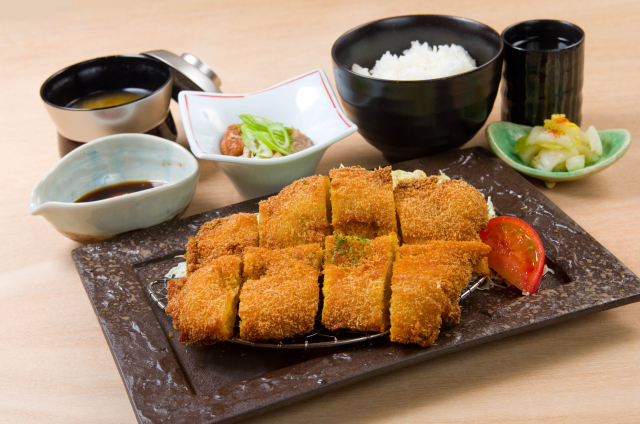
Nobu: First, let’s look at tonkatsu itself. Its roots can be traced to a European dish called côtelette de veau, a French-style veal cutlet.
Traditionally, this dish was coated with breadcrumbs and cooked in a frying pan with butter.
Mike: It’s a little difficult to imagine that a dish cooked with butter eventually became tonkatsu. After all, tonkatsu is deep-fried in oil!
Nobu: That’s right. The cooking method changed in Japan during the Meiji period. A Western-style restaurant in Tokyo called Rengatei developed a method of deep-frying breaded meat in plenty of hot oil. This dish was introduced in 1899 under the name pork cutlet, or pork katsuretsu.
The restaurant also adapted the breadcrumbs and other ingredients to suit Japanese tastes. In particular, it used pork instead of the more expensive veal.
Kelly: I see! That sounds much closer to the tonkatsu we know today.
Nobu: Exactly. However, the modern style of tonkatsu, made with a thick piece of pork that is deep-fried and then cut into smaller pieces, developed later in Japan.
Japanese Western-style restaurants continued to experiment with the dish, eventually establishing the familiar style of tonkatsu that we enjoy today.
John: So Japanese chefs didn’t simply copy a European dish. They developed it into something quite different.
Nobu: That’s right. Japanese cooking techniques and the creativity of restaurant chefs played an important role in its development.
John: And this eventually led to dishes such as katsudon and katsu curry, didn’t it?
Nobu: Yes. Those are also examples of how Japanese people adapted tonkatsu to create new dishes.
The Origins of Menchi Katsu
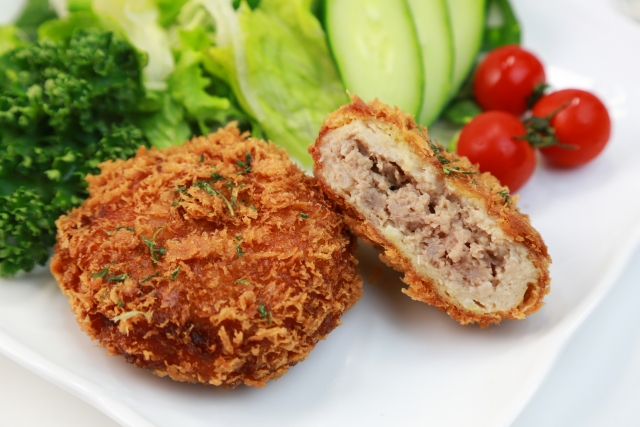
Kelly: There’s another dish that looks similar to tonkatsu called menchi katsu. What exactly is it?
Nobu: Menchi katsu is a deep-fried cutlet made from seasoned ground meat, usually beef, pork, or a mixture of the two. The meat is shaped into a patty, coated with flour, egg, and breadcrumbs, and then deep-fried.
Its exact origins are not entirely clear, but there are several explanations.
One theory is that it developed as a ground-meat version of tonkatsu. Another suggests that it came from the idea of breading and deep-frying a hamburger-style meat patty.
Kelly: So there are two possible explanations?
Nobu: Yes. Both ideas are quite understandable. The dish may have developed through experiments by Japanese Western-style chefs who wanted to create new dishes using ground meat.
Mike: That’s interesting. Even though the two dishes are similar, they may have come from different cooking ideas.
Nobu: That’s possible. In any case, menchi katsu is another good example of how Japanese chefs adapted Western-style cooking to create something new.
The Origins of Mille-Feuille Katsu
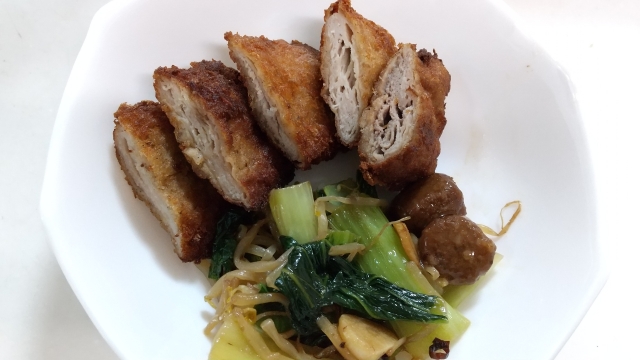
Kelly: There’s one more dish I’d like to know about. I’ve seen something called mille-feuille katsu. It looks like a variation of tonkatsu. Is that also a Japanese creation?
Nobu: Yes. Mille-feuille katsu is a Japanese-style variation.
One well-known version is made by stacking approximately 25 very thin slices of pork, each about one millimeter thick, before coating and deep-frying them.
Mike: Twenty-five layers! That’s quite a lot. The chef must have put a great deal of thought into making it.
For example, how thick should each slice of meat be? And how many layers should be stacked to make it easy to eat?
Nobu: That’s probably true. The creativity and ingenuity of chefs can be quite remarkable.
How These Dishes Spread and Developed
Kelly: What happened after these dishes were created? How did they become so popular?
Nobu: Tonkatsu, which first appeared during the Meiji period, eventually inspired other popular dishes, including katsudon and katsu curry.
There are various stories about their origins. Some say that students came up with the idea of katsudon, while other stories connect the creation of katsu curry with professional baseball players. In any case, these dishes are examples of Japanese creativity.
Mike: That’s impressive!
Nobu: Today, the internet also helps new cooking ideas spread quickly. For example, there are now variations designed with health in mind, including recipes that use less oil.
John: I see. So the way new food ideas spread has changed. In the past, restaurants and chefs played the main role, but today the internet also helps people share their ideas.
Nobu: Exactly!
The End
A Personal Note
Tonkatsu first appeared during the Meiji period, long before I was born. However, even during my childhood, it was something of a special treat.
There was also a wordplay tradition involving the word katsu, which sounds like the Japanese word for winning (katsu). Because of this association, some people ate tonkatsu on the day before an important competition or event, hoping it would bring them good luck.
As Japan became more economically prosperous, tonkatsu gradually became an everyday dish rather than something reserved for special occasions.
It also became a popular choice for boxed lunches, or bento. I often ate tonkatsu bento myself.
I first encountered mille-feuille katsu relatively recently. I remember seeing it on the menu at a bento shop. At the time, I thought it might be easier for older people to eat than a conventional thick pork cutlet.
Conclusion
In this article, we have explored the history of tonkatsu, as well as the origins of menchi katsu and mille-feuille katsu.
Some readers may be surprised to learn that these familiar Japanese dishes have relatively recent histories, with many of them developing during the modern era.
In any case, the creativity of Japanese chefs, particularly since the Meiji period, has made a remarkable contribution to Japanese food culture.
I am grateful for their ingenuity, and I think I’ll enjoy some tonkatsu again today!
Related Article
In this article, we explored the origins of tonkatsu.
By the way, did you know that the word “tonkatsu” has a special meaning?
In the next article, we will explain the meaning behind the word “tonkatsu.”
Read the article →