Have you ever tried nizakana, a traditional Japanese simmered fish dish?
When people think of Japanese fish dishes, sushi and sashimi are probably the first things that come to mind. However, Japan has many other ways of preparing fish, and simmered fish is one of the most popular.
But what is the best way to eat these dishes?
The answer may seem simple: using chopsticks is probably the most convenient way to enjoy Japanese fish dishes.
In this article, we will look at why chopsticks are so useful when eating fish, especially simmered fish and fish hot pots.
Characters
Mike: A 12-year-old American boy who is interested in Japan.
John: Mike’s father. He sometimes travels to Japan on business.
Kelly: Mike’s mother. She is good at cooking.
Nobu: A Japanese exchange student.
Prologue
John often visits Japan on business trips and enjoys Japanese food. Whenever he visits a sushi restaurant or other Japanese restaurants, he is usually delighted with his meals.
He has always admired Japanese fish-eating culture.
However, during his latest business trip, he stayed at a traditional Japanese inn in a regional town and encountered a dish that gave him some trouble: nizakana.
John could use chopsticks, but eating simmered fish was not as easy as he had expected. He had to separate the flesh from the bones while eating, which required a certain level of skill with chopsticks.
When he told his family about this experience, neither Mike nor Kelly understood why he had struggled. After all, they thought eating fish should be easy enough.
Just then, Nobu arrived.
Nobu: Hello, everyone!
John: Hi! I’m glad you came. I was just telling them about the trouble I had eating simmered fish during my business trip. You need some skill with chopsticks to eat it properly, don’t you?
Nobu: I see. Simmered fish, huh? I understand what you mean. Some types of simmered fish can certainly be difficult to eat, even with chopsticks.
John: Exactly! It can be surprisingly difficult.
Mike: But isn’t it just fish cooked in a seasoned broth? Shouldn’t it be easy to eat? It’s basically like eating a piece of sautéed fish with chopsticks.
Kelly: That’s what I thought, too. If it’s similar to sautéed fish, I don’t see why it should be difficult.
Nobu: Well, let’s take a closer look at Japanese simmered fish.
Fish Bones, Fish Trimmings, and Chopsticks
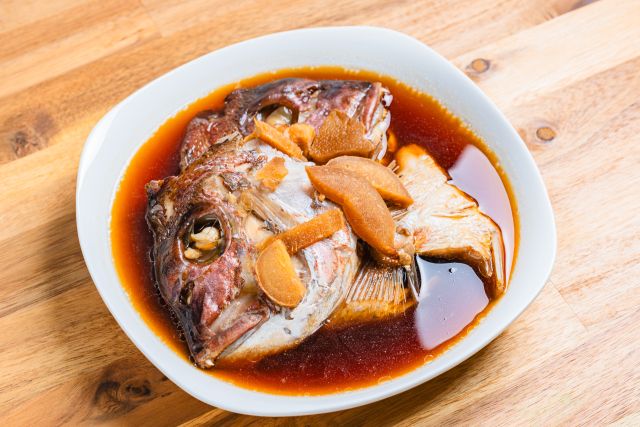
Nobu: As the name suggests, nizakana means fish that has been simmered. However, there are several ways to prepare it. For example, fish fillets can be simmered, an entire fish can be cooked this way, and even the head and bones can be used.
Kelly: Wait a minute. Do Japanese people actually cook and eat the head and bones, too?
Nobu: Yes. These parts are often called ara. They include the head, bones, and other portions left after the main cuts of fish have been prepared. They can be surprisingly delicious. In some cases, people even prefer them to the main portions of the fish.
Kelly: Really? The parts around the head and bones can taste better? That’s quite surprising!
Nobu: Anyway, simmered fish comes in several forms, and the difficulty of eating it with chopsticks depends on how it is prepared.
John: That’s exactly what I want to understand.
Nobu: One important point is that simmered fish is often served with the bones still attached.
Mike: Why do the bones make such a difference?
John: If the fish has already been deboned, eating it with chopsticks isn’t particularly difficult. You can simply break off a piece of flesh and pick it up.
Kelly: That makes sense.
Nobu: However, when the bones are still attached, you need to separate the flesh from them as you eat. Sometimes, you also need to pick out small bones with your chopsticks. This requires a certain amount of skill.
John: That’s exactly what happened to me. The fish served at the inn still had its bones. When I tried to remove the flesh, it broke apart into small pieces, and I had trouble eating it.
Nobu: Now I understand why you struggled!
Simmered Fish, Chopsticks, and Table Manners
Nobu: Fish trimmings, or ara, are not necessarily wasted. In fact, many supermarkets sell them separately, and they are used in a variety of Japanese dishes.
For example, sea bream is often sold as sashimi, but the head and bones can also be prepared as food.
John: That makes sense. There is no reason to waste parts of a fish if they can be eaten.
Nobu: Exactly. One popular dish is buri daikon, which is made by simmering yellowtail with Japanese daikon radish. The head and other bony parts of the fish are often used.
Kelly: So even the parts around the bones can become a proper dish!
Nobu: Yes. And chopsticks are especially useful when eating these parts. Fish heads and other trimmings contain many bones, often arranged in complicated shapes. Removing the edible flesh from around them requires some skill.
Kelly: That sounds quite challenging.
Nobu: It can be. In Japan, people generally appreciate eating fish neatly, without leaving too much edible flesh behind. Of course, visitors from other countries are not expected to be experts, especially if they are unfamiliar with these dishes. Still, learning how to use chopsticks can make the experience much more enjoyable.
Fish Hot Pots and Chopsticks
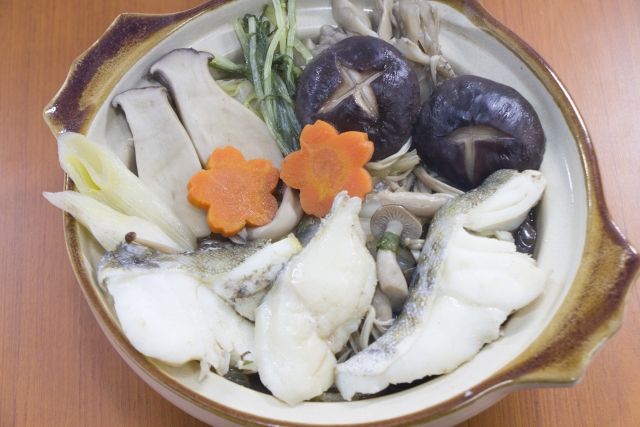
Nobu: By the way, have you ever tried a Japanese hot pot dish made with fish?
John: A hot pot with fish? I don’t think I’ve tried one yet.
Nobu: There are many Japanese hot pot dishes that use fish. The flesh can become delicate and fall apart easily during cooking. Handling it with chopsticks requires a slightly different technique from separating fish from its bones.
Kelly: I can imagine that. Japanese hot pots also contain ingredients such as tofu, don’t they? It might be embarrassing if I couldn’t pick them up properly with chopsticks!
John: Embarrassing, huh? I think I should practice using chopsticks before my next trip to Japan.
Nobu: That’s a good idea!
The End
My Personal Experience
Simmered fish has a texture that makes it easy to break apart. This makes it enjoyable even for people who do not have particularly strong teeth.
It also brings out the natural umami of fish and goes very well with steamed rice.
A bowl of freshly cooked rice makes the meal even better!
I used to buy sea bream trimmings quite often. The reason was simple: they were inexpensive and delicious.
Even when a package of sea bream sashimi cost 500 or 800 yen, I could sometimes buy the trimmings from an entire fish for just 200 yen.
All I had to do was simmer them, and they made a wonderful meal.
Incidentally, sea bream trimmings contain many delicious parts. The head has a pleasantly soft and gelatinous texture, while the belly area is rich in fat and especially tasty.
I often wondered why anyone would throw away such delicious parts!
Looking back, however, I realize that one reason I could enjoy these parts so much was that I was familiar with using chopsticks.
Eating the head and other trimmings of a sea bream with a knife and fork would probably be quite difficult.
The same applies to Japanese hot pot dishes. Chopsticks are also convenient when taking fish and other ingredients out of a shared cooking pot.
Of course, fish can fall apart if it is simmered for too long. But even that is not necessarily a problem.
Japanese hot pot meals often end with something called shime. This means adding rice or noodles to the remaining broth to make a final dish. One popular option is zosui, a type of Japanese rice porridge.
Any fish that has fallen apart during cooking can become part of this delicious final dish.
If you want to enjoy these meals while following Japanese table manners, getting used to chopsticks is certainly helpful.
Conclusion
In this article, we have looked at simmered fish and the usefulness of chopsticks. We have also introduced the delicious parts of fish known as ara, or fish trimmings.
Some readers may find it surprising that the head and bones of a fish can be used to prepare such delicious dishes. It may also be surprising that eating simmered fish can require a certain level of skill with chopsticks.
In any case, if you want to fully enjoy Japanese fish dishes, especially simmered fish and fish hot pots, learning to use chopsticks properly will make your experience much better.
So, keep practicing!