Have you ever heard of mille-feuille katsu?
It is a type of Japanese pork cutlet made by stacking several layers of thinly sliced meat and deep-frying them. The name comes from its resemblance to a mille-feuille pastry, which also consists of multiple layers.
Although it is a relatively modern variation of tonkatsu, it has become popular thanks to its distinctive texture and flavor.
Interestingly, mille-feuille katsu has an advantage over ordinary tonkatsu.
It can be easier for older adults to eat.
Why is that? Let’s take a closer look.
Characters
Mike: A 12-year-old American boy who is interested in Japan.
John: Mike’s father. He sometimes travels to Japan on business.
Kelly: Mike’s mother. She is good at cooking.
Nobu: A Japanese exchange student.
Prologue
Kelly has been studying Japanese food culture. Recently, she has become interested in tonkatsu and has been looking at various recipes.
One dish that caught her attention was mille-feuille katsu.
It is a type of tonkatsu, but instead of using a single thick piece of pork, it is made by stacking several thin slices of meat before frying them. Its texture is different from that of ordinary tonkatsu, and it is also different from menchi katsu, which is made with ground meat. That was what made Kelly curious about it.
Kelly was about to try making mille-feuille katsu when Nobu arrived.
Nobu: “Hello!”
Kelly: “Oh, welcome! I was just thinking about trying mille-feuille katsu. I found it online, and it looked quite interesting.”
John: “That’s right. I heard that it is a relatively recent variation of tonkatsu, so I’m looking forward to trying it.”
Mike: “It’s made differently from menchi katsu and hamburg steaks, too. That makes it interesting.”
Nobu: “I see. It sounds delicious. Well, let me tell you a little about mille-feuille katsu. It has an advantage that people don’t always notice.”
John: “An advantage people don’t notice? Now I’m curious.”
Mike: “Come on, tell us!”
Mille-Feuille Katsu: A Pork Cutlet That Can Be Easier for Older Adults to Eat
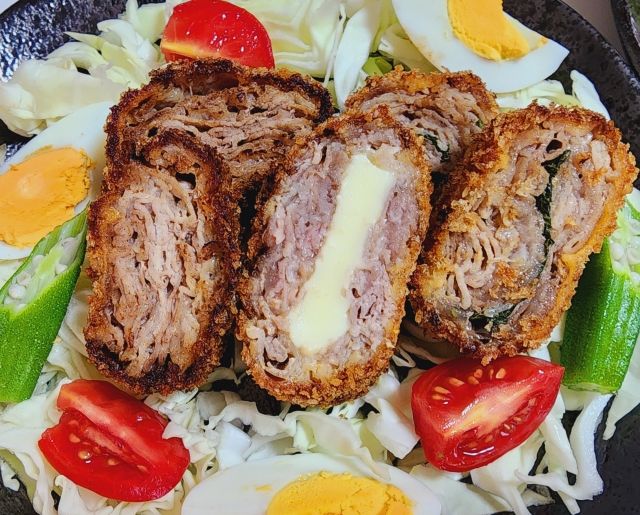
Nobu: “To put it simply, mille-feuille katsu can be a dish that is easier for older adults to eat.”
John: “Why is that?”
Nobu: “Because it can be easier to bite and chew.”
Why Mille-Feuille Katsu Can Be Easier for Older Adults to Eat
Kelly: “So, being easier to eat is what makes it suitable for older adults. That makes sense.”
Nobu: “Exactly. Mille-feuille katsu is made by stacking several layers of thinly sliced meat. This can make it easier to bite through than a thick piece of pork. That can be helpful for older adults who have difficulty chewing, including some people who wear dentures.”
“Another advantage is that you can adjust its thickness and texture quite easily. Using thinner slices of meat may make each layer easier to bite through. You can also reduce the number of layers to make a thinner cutlet.”
John: “Being able to adjust how easy it is to eat sounds appealing. If you can prepare it according to the person eating it, mealtimes could become more enjoyable.”
Enjoying a Different Texture from Menchi Katsu
Nobu: “You can also enjoy a different eating experience from menchi katsu. Menchi katsu can be modified by mixing ingredients such as tofu into the ground meat, making it easier to eat in some cases. However, its texture is still quite different from that of mille-feuille katsu.”
Mike: “I understand that the textures are different, but is that really such a big advantage?”
Nobu: “Of course. Enjoying food isn’t something that matters only to young people. If young people can enjoy their meals, older adults should be able to enjoy them, too. And I think that is very important for their everyday lives.”
Mike: “Why is it so important?”
Nobu: “Because enjoying food can encourage people to eat. Some people may feel that they haven’t really enjoyed a meal when everything is blended into a smooth paste. But if they can enjoy something with a satisfying texture and volume, such as tonkatsu, they may feel more motivated to eat. Getting enough food and nutrition can also help them maintain their energy and stay active.”
Mike: “I see.”
Swallowing Requires Special Attention
Nobu: “Mille-feuille katsu may be easier for some older adults to eat, but there is something important to keep in mind.”
Nobu: “Swallowing difficulties. Being able to bite through food easily and being able to swallow it safely are two different things. For older adults who have difficulty swallowing, mille-feuille katsu may not be an appropriate choice.”
John: “I see. So you’re talking about the ability to swallow food.”
Nobu: “Exactly. However, I don’t think that every meal needs to be completely blended. What matters is finding a suitable food texture while preserving as much enjoyment of eating as possible. Depending on the individual, serving food in a form they dislike may reduce their appetite.”
John: “That certainly makes things complicated.”
Ways to Make Mille-Feuille Katsu Easier for Older Adults to Eat
Mike: “Then, are there any ways to make it even easier for older adults to eat?”
Nobu: “Yes, there are. I mentioned some of these advantages earlier, but let me explain them in more detail.”
Use Thinner Slices of Meat
Nobu: “The first idea is to make the meat easier to bite through. I think using thinner slices of meat is a good approach. The important point is that each individual layer should be easy to bite through.”
Kelly: “That makes sense.”
Nobu: “Also, even when several layers are stacked together, it is important that they do not easily separate into individual pieces in the mouth. Adjusting the thickness and structure so that the meat can be chewed comfortably is another important consideration.”
Make the Entire Cutlet Thinner
Nobu: “Another point is that you can make the entire cutlet thinner. If the cutlet is too thick, the amount of food taken in with each bite may become too large, making it more difficult to chew and swallow. So, making the cutlet thinner may help.”
Mike: “How would you do that?”
Nobu: “For example, instead of stacking eight slices of meat, you could use four. That would make the cutlet roughly half as thick, making it potentially easier to eat.”
Add Tofu or Other Ingredients for a Lighter Flavor
Nobu: “Another idea is to put ingredients such as tofu between the layers of meat. This can create a lighter overall flavor, which may appeal to people who prefer milder dishes. It may also help reduce the calorie content if some of the meat is replaced with tofu.”
Kelly: “I see. So it can also be useful for people who are watching their calorie intake.”
Nobu: “That’s right. However, we should remember that it is still a deep-fried dish, so the overall calorie content needs to be considered.”
Add Japanese Ingredients Such as Ume Plum Paste
Nobu: “You can also put thin layers of other ingredients inside the cutlet. This makes it relatively easy to change the flavor.”
Kelly: “Change the flavor? What kind of ingredients could you use?”
Nobu: “For example, you could add ume plum paste or Japanese shiso leaves. There are many possibilities. If you make a cutlet with shiso leaves and serve it with a sauce made from soy sauce or miso, you can enjoy a distinctly Japanese flavor.”
Kelly: “I see. So it’s not only adaptable in terms of texture, but also offers plenty of ways to change the flavor.”
The End
Some Thoughts Based on My Personal Experience
Here, I would like to share some thoughts based on my own experiences.
I have quite a few opportunities to spend time with older adults in my private life, and those experiences have given me various things to think about. One of them is appetite.
Let me explain how I relate this to mille-feuille katsu.
Many Older Adults Experience Difficulties When Eating
I think this is something that many people working in elderly care would recognize, but I believe that quite a few older adults experience some difficulties when eating.
First, there are problems related to teeth.
Some older adults I know wear dentures. Even so, there are still certain foods that they find difficult to bite through. When such foods are served, they sometimes leave them uneaten. In other words, they experience difficulties with their meals.
I have also noticed that some of them feel bad about leaving food uneaten because someone has taken the time to prepare it for them.
Another issue is swallowing.
Some older adults have lost some of their ability to swallow food safely. For such people, even eating an ordinary meal can be difficult. This is a particularly difficult issue to think about.
Enjoying Food Can Help People Stay Active
So, what can we do to help people in these situations maintain a positive and active life?
I personally think that appetite and the enjoyment of eating are important factors.
When people enjoy their meals, they may become more willing to eat. This can help them maintain their energy and may encourage them to stay active. Enjoyable mealtimes can also bring more pleasure to everyday life and support emotional well-being.
That is why making food easier to eat is so important. Dishes such as mille-feuille katsu may offer another way to approach this challenge.
Incidentally, various efforts are already being made to adapt mille-feuille katsu in different ways. I hope that more ideas and improvements will continue to emerge in the future.
Conclusion
This article has introduced mille-feuille katsu and its possible applications.
It is a popular dish enjoyed by people of all ages, from children to adults. I believe it can also be a dish that older adults enjoy, provided that it is prepared in a way that suits their individual needs.
I also hope that the enjoyment of eating can help older adults maintain their energy and bring more happiness to their daily lives.
After all, delicious food makes life more enjoyable. I look forward to sharing meals with older adults who can enjoy eating and stay healthy.

