The style of cooking food at your table while eating may seem distinctive to visitors from overseas. This is especially true for people who are not familiar with restaurants where raw ingredients are brought directly to the table for customers to grill themselves.
Japan has several types of restaurants where customers cook their food at the table. One of the most popular examples is the yakiniku restaurant.
However, some yakiniku restaurants also serve seafood. As a result, visitors may wonder whether these restaurants are similar to seafood restaurants.
So, in this article, let’s compare yakiniku restaurants with Hamayaki restaurants, which specialize in grilled seafood.
Characters
Mike: A 12-year-old American boy who is interested in Japan.
John: Mike’s father. He sometimes travels to Japan on business.
Kelly: Mike’s mother. She is good at cooking.
Nobu: A Japanese exchange student.
Prologue
John’s company has offices in Japan, and many of his colleagues are American. Some of them are also quite familiar with restaurants in Tokyo.
One day, John receives an assignment to work in Japan. He is looking forward to enjoying the food in Tokyo.
He is particularly pleased to discover that some yakiniku restaurants also serve seafood.
Just then, Nobu appears.
Nobu: Hello!
John: Hi! I wanted to ask you something about Japanese yakiniku restaurants.
Nobu: Yakiniku restaurants? What would you like to know?
John: I heard that Japanese yakiniku restaurants also serve seafood. I’m interested in finding out what kinds of seafood they offer.
Mike: He was thinking that if yakiniku restaurants serve seafood too, he could enjoy both meat and seafood at the same restaurant.
Kelly: Japan has plenty of seafood, so I’m sure there must be some excellent choices!
Nobu: Wait a minute. Are you talking about seafood served at yakiniku restaurants?
Mike: Yes, that’s right.
Nobu: In that case, there may be a misunderstanding. Let me explain what seafood at yakiniku restaurants is usually like.
Seafood at Yakiniku Restaurants
Nobu: First, let’s consider the type of restaurant. A yakiniku restaurant specializes in grilled meat. Even if it offers other dishes, that doesn’t necessarily mean those dishes are its specialty.
Kelly: Oh, isn’t seafood just seafood, regardless of where you eat it?
Nobu: Not exactly. Seafood served at yakiniku restaurants may sometimes be frozen or partially cooked before it is served. This is different from going to a restaurant that specializes in seafood.
Kelly: I see. So, there can be differences in the seafood itself.
Mike: But surely some yakiniku restaurants serve delicious seafood, don’t they?
Nobu: Of course. There are probably some excellent places. However, if you specifically want to enjoy seafood, I would generally recommend a restaurant that specializes in it.
John: Then, are there restaurants that specialize in grilled seafood?
Nobu: Yes. One example is a restaurant called a Hamayaki restaurant. Seafood is the main attraction there, so you can enjoy a much wider selection of seafood dishes.
Mike: Hamayaki restaurants? Interesting!
Differences Between Yakiniku and Hamayaki Restaurants
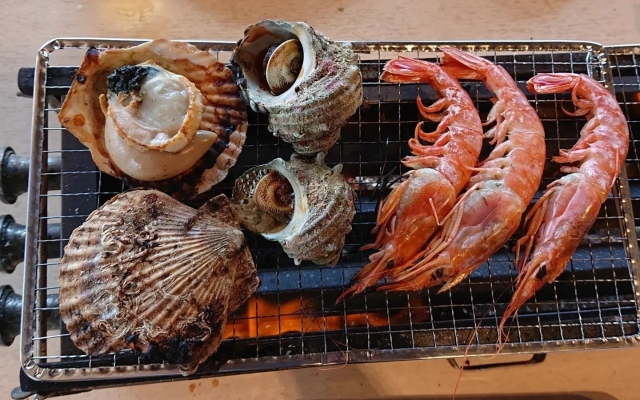
Nobu: Let me explain some of the differences between yakiniku and Hamayaki restaurants.
First, Hamayaki restaurants specialize in seafood. They often offer fresh seafood, and some allow customers to grill it at their tables. This means you can enjoy the seafood cooked to your preferred level of doneness.
Kelly: What do you mean by the preferred level of doneness? Don’t you have to cook seafood thoroughly before eating it?
Nobu: Not necessarily. It depends on the restaurant and the menu. Some seafood actually becomes less delicious if you cook it for too long. Of course, you should follow the restaurant’s instructions regarding how to cook each item.
Kelly: I see.
Nobu: Now, let me explain some of the differences in more detail.
Menu Selection
Nobu: First, let’s look at the menu. Yakiniku restaurants generally have a relatively limited selection of seafood. Shrimp and squid are common examples, and some restaurants also offer shellfish. Depending on the restaurant, some seafood may already be partially cooked.
John: That sounds about right.
Nobu: Hamayaki restaurants, on the other hand, can offer a much wider variety. In addition to shrimp and squid, many restaurants serve scallops, oysters, turban shells, and other types of shellfish.
Some restaurants even serve whole squid rather than small portions.
The selection can be quite different, both in terms of quality and presentation.
Kelly: What about freshness?
Nobu: That depends on the restaurant, but some establishments source seafood caught locally on the same morning.
Kelly: That sounds wonderful!
Seasoning
Nobu: Next, let’s talk about seasoning. Yakiniku restaurants generally offer dipping sauces designed for grilled meat, as well as salt.
John: That’s what I would expect. Of course, the sauces vary from restaurant to restaurant.
Nobu: That’s right. Hamayaki restaurants, on the other hand, often use simpler seasonings. Soy sauce is a particularly common choice.
Mike: Doesn’t that make the food a little less interesting?
Nobu: Not at all! One of the attractions of Hamayaki is that it allows the flavor and aroma of soy sauce to complement the seafood.
For example, when grilling a turban shell, you can pour a little soy sauce into the shell while it is cooking. The resulting aroma is incredibly appetizing.
That’s an experience you might not get at a typical yakiniku restaurant.
John: I see what you mean.
Differences in Freshness
Nobu: As I mentioned earlier, freshness is another important consideration. This is particularly true for shellfish.
Some shellfish deteriorate quickly when they are not handled and stored properly. In some cases, simply heating them will not restore their original quality.
Kelly: That makes sense. Is that why some restaurants serve seafood that has already been cooked?
Nobu: That can be one reason. However, some Hamayaki restaurants obtain fresh seafood directly from local suppliers or fishing areas.
When the seafood is properly handled and fresh, it can make a big difference to the eating experience.
Different Side Dishes
Nobu: There are also differences in the side dishes, although this may seem like a relatively minor point.
Naturally, the dishes that go well with grilled meat are not necessarily the same as those that complement seafood.
John: That makes sense.
Nobu: A good example is the selection of Korean-style dishes commonly found at yakiniku restaurants, such as cold noodles and gukbap, a Korean-style rice soup.
Hamayaki restaurants generally have a different selection of side dishes to complement their seafood.
Mike: I would expect that.
Location and Where to Find Good Seafood
Nobu: I also think there can be differences in where you can find particularly good restaurants.
For yakiniku restaurants, the quality of the food often depends more on the individual restaurant, its management, and its suppliers than on its location.
For example, you can find excellent high-end yakiniku restaurants in both Tokyo and regional cities.
Kelly: That’s true. There are high-end restaurants in both urban and rural areas.
Nobu: Hamayaki restaurants can be different because their location may have a greater influence on the seafood they offer.
This is partly related to distribution routes and access to local fishing areas.
For example, restaurants in Tokyo may obtain their seafood through major markets such as Toyosu. In contrast, restaurants in coastal towns may be able to source seafood locally without sending it through large markets in major cities.
This difference can be quite significant.
John: What difference does that make?
Nobu: Shellfish, in particular, can be sensitive to freshness and handling conditions, which can affect their flavor and quality.
John: I see. That makes sense, too.
Mike: So, if we really want to enjoy seafood, we should choose a restaurant that specializes in it rather than simply going to a yakiniku restaurant.
Nobu: Exactly. I would generally recommend a seafood specialty restaurant.
The End
From My Personal Experience
Based on my personal experience, I think coastal towns are among the best places to enjoy seafood.
And it’s not just about the taste. The surrounding environment and atmosphere can also make a big difference.
For example, when you eat at a yakiniku restaurant, the surrounding area is filled with the smell of grilled meat.
A seafood specialty restaurant, on the other hand, offers a completely different atmosphere. Everything revolves around seafood.
In coastal areas, you can also enjoy the distinctive atmosphere of being near the sea. The ocean views and the smell of the sea air make the experience different.
That’s why I recommend enjoying seafood at a seafood restaurant, preferably somewhere close to the coast.
Conclusion
In this article, we have compared the seafood served at yakiniku restaurants with the seafood offered at Hamayaki restaurants.
I hope you now have a better understanding of the differences between the two.
If you were planning to visit a yakiniku restaurant specifically to enjoy seafood, you might want to reconsider your plans!
In any case, if you want to enjoy seafood, a restaurant specializing in seafood is generally a better choice.
Why not give it a try?

