Japanese is sometimes considered a rather unusual language compared with other languages around the world. For example, a single kanji character can have several different readings, such as on-yomi (Chinese-derived readings) and kun-yomi (native Japanese readings).
Japanese also has a way of combining multiple words to create new meanings.
One good example from Japanese cuisine is tonkatsu.
Tonkatsu is a very popular Japanese dish, so it is worth understanding what its name actually means.
In this article, let’s take a closer look at the origins of the word tonkatsu and how it is related to other Japanese dishes.
Characters
Mike: A 12-year-old American boy who is interested in Japan.
John: Mike’s father. He sometimes travels to Japan on business.
Kelly: Mike’s mother. She is good at cooking.
Nobu: A Japanese exchange student.
Prologue
Mike is interested in Japanese culture, but he has one problem that never seems to go away: the language barrier.
He especially struggles with kanji because the same character can have different readings depending on the situation.
One day, Kelly comes over and starts talking about tonkatsu. As they talk, Mike suddenly wonders:
“Is there a difference between tonkatsu and katsu?”
Just as he is thinking about this question, Nobu appears.
Nobu: Hello!
Mike: You’re just in time! I was having trouble understanding something about Japanese.
Nobu: What were you thinking about?
Mike: Well, it’s about tonkatsu. There are similar dishes, such as chicken katsu and menchi katsu. They all have the word “katsu” in their names. So I guess the word “tonkatsu” is made by combining two different words.
Nobu: That’s a good observation! But let me explain it in a little more detail.
Mike: Please do!
What Does Tonkatsu Mean?
Nobu: First, let’s look at the meaning of the word “tonkatsu.”
Tonkatsu Is Made Up of “Ton” and “Katsu”
Nobu: As you just noticed, the word “tonkatsu” consists of two parts: “ton” and “katsu.”
“Ton” means pork, while “katsu” refers to a dish made by coating meat with breadcrumbs and deep-frying it.
Kelly: So “ton” means pork! And what about “katsu”? I think the word comes from a European dish called a cutlet, doesn’t it?
Nobu: That’s right. The word “katsu” is related to the word “cutlet.” The dish was introduced to Japan and became known as katsuretsu. Over time, the word was shortened to katsu.
So, you can think of tonkatsu as a combination of “ton” (pork) and “katsu” (cutlet).
Kelly: I see!
The Special Meaning Behind “Katsu”
Nobu: There is another interesting point about the word “katsu.” Japanese people sometimes associate it with a special meaning.
John: What kind of special meaning?
Nobu: It is related to victory.
In Japanese, the verb katsu (勝つ) means “to win.” It has exactly the same pronunciation as katsu in tonkatsu.
Because of this, people sometimes associate eating katsu dishes with winning or achieving success. It is a way of bringing good luck!
John: I see! So it has a connection with victory. I can understand why people would like that idea!
Other Meanings of “Katsu”
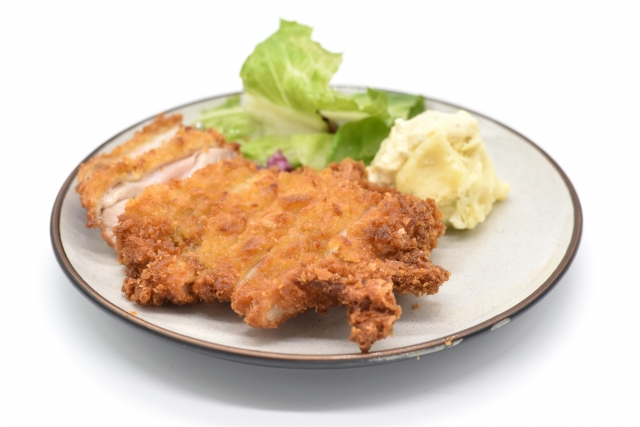
Kelly: By the way, there are other dishes with “katsu” in their names, aren’t there?
Nobu: Yes, there are! Some examples include chicken katsu, beef katsu, menchi katsu, and mille-feuille katsu. Let me explain each one.
Chicken Katsu and Beef Katsu
Nobu: Let’s start with chicken katsu. Just like tonkatsu, its name is made by combining two words: “chicken” and “katsu.”
Tonkatsu is made by coating pork with breadcrumbs and deep-frying it. In the same way, chicken katsu is made by coating chicken with breadcrumbs and deep-frying it.
Kelly: That makes sense. The word “chicken” makes it easy to understand!
Nobu: Next is beef katsu. As you might expect, it is made by coating beef with breadcrumbs and deep-frying it.
Menchi Katsu
Nobu: Next is menchi katsu. This one is a little different from chicken katsu and beef katsu.
Rather than referring to the type of meat, the word “menchi” describes the form of the meat.
In Japanese, minced meat is sometimes called minchi. The word “menchi” is believed to have developed from the English expression “minced meat.”
Menchi katsu is made using minced meat, which explains the name.
Kelly: So this name refers to how the meat is prepared. I see!
Mille-Feuille Katsu
Nobu: Finally, there is mille-feuille katsu.
This name is also made by combining two words: “mille-feuille” and “katsu.”
However, “mille-feuille” does not refer to the type of meat or how it is processed. Instead, it describes the appearance and preparation of the dish.
If you try it, you will understand what I mean. Mille-feuille katsu is made by stacking several thin slices of meat on top of one another and then deep-frying them.
The layers of meat look similar to the layers of a French mille-feuille pastry. That is where the name comes from.
Kelly: So the name comes from a cake-like pastry!
Nobu: Exactly. Japanese food names can be quite complicated, can’t they?
The End
Conclusion
In this article, we have looked at how the word “tonkatsu” is formed and how it relates to other Japanese food names.
Incidentally, I came up with the idea for this article after noticing that someone somewhere in the world had searched for the question, “What is the difference between tonkatsu and katsu?”
That made me realize that combinations of Japanese words can be confusing for people from other countries. That is why I decided to write this article.
There are probably many other Japanese dishes with interesting names like these.
Perhaps the best way to learn such words is to hear and use them in everyday life.
Of course, learning the words is important, but I think learning the taste of Japanese food is just as important!
So, when you visit Japan, why not try some delicious tonkatsu? You might discover something interesting about both Japanese food and the Japanese language!
Related Article
In this article, we explained the meanings of “tonkatsu” and “katsu.”
However, we did not go into much detail about tonkatsu itself.
In the next article, we take a closer look at tonkatsu, explaining not only what the name means but also the different tonkatsu dishes and menu options available.
Read the article →

