Japan has a long history of adapting foreign cultures and developing them in its own unique way. This tendency is particularly noticeable in Japanese food culture.
For example, curry originated in India, while tonkatsu is believed to have European roots. Both have evolved into dishes that are now distinctly Japanese.
This tendency can also be seen in restaurant styles, not just in the food itself. One good example is a type of restaurant known as Machi-Chuka (町中華).
So, what exactly is Machi-Chuka? Let’s take a closer look.
Characters
Mike: A 12-year-old American boy who is interested in Japan.
John: Mike’s father. He sometimes travels to Japan on business.
Kelly: Mike’s mother. She is good at cooking.
Nobu: A Japanese exchange student.
Prologue
Mike is interested in Japanese culture and often watches Japanese videos. Sometimes, he comes across unfamiliar aspects of Japanese culture and tries to learn more about them. However, finding the answers is not always easy.
This time, while watching a Japanese video, he noticed something strange. A Chinese restaurant was serving not only ramen and fried rice but also curry, tonkatsu, and oyakodon (chicken and egg rice bowls).
Curry originated in India, so why was a Chinese restaurant serving it?
Just then, Nobu appeared.
Nobu: Hello!
Mike: Oh, hello! I actually have something I’d like to ask you.
Nobu: What is it?
Mike: I was watching a video, and there was a Chinese restaurant in it. But besides ramen and fried rice, the restaurant was also serving dishes like curry, tonkatsu, and oyakodon. I thought Chinese restaurants were supposed to serve Chinese food. Why would they offer dishes like curry?
John: That’s a good point. Japanese people are quite good at adapting foreign cultures to their own tastes, but this seems to take things a little too far!
Kelly: I agree. Watching that video made me wonder whether there are Chinese restaurants in Japan that actually have a Chinese atmosphere and serve Chinese dishes.
Nobu: I can understand why you would find that confusing. There’s actually a reason for this.
Mike: What do you mean?
Nobu: The answer lies in the type of restaurant. In Japan, restaurants that serve dishes like curry alongside Chinese-style food are often called Machi-Chuka.
John: Machi-Chuka? I’d like to hear more about that.
Nobu: Certainly!
What Is Machi-Chuka?
Nobu: To understand Machi-Chuka, it helps to look at the history of Chinese restaurants in Japan.
Some of the early Chinese restaurants in Japan were established by people who came from China. Others were started by people who returned to Japan from mainland Asia after the war or by cooks who had developed their skills through working in the restaurant industry.
John: How far back does this history go?
Nobu: Chinese restaurants of this kind are thought to have appeared as early as the Taisho and Showa periods, roughly a century ago.
Mike: That’s quite a long history!
Nobu: After the Pacific War, more of these restaurants began opening in shopping streets and residential neighborhoods. During Japan’s period of rapid economic growth in the 1960s and 1970s, they developed into popular, affordable places where office workers and other local residents could enjoy a meal.
John: I see. So Machi-Chuka has a long history as part of everyday Japanese life.
The Atmosphere of Machi-Chuka
Nobu: Another difference between Machi-Chuka and restaurants specializing in Chinese cuisine is their atmosphere.
Restaurants specializing in Chinese cuisine often incorporate Chinese-style decorations and interior designs. Machi-Chuka restaurants, on the other hand, generally do not emphasize a Chinese atmosphere.
Instead, they tend to have simple tables and chairs, and some even have a small television in the corner. Customers might sit down, watch television, and enjoy a bowl of ramen.
Mike: But they serve ramen, right? That sounds great!
Nobu: Yes, but there’s something you should know. The ramen served at Machi-Chuka is generally different from the elaborate dishes offered at specialized ramen restaurants.
Many Machi-Chuka restaurants serve relatively simple ramen. You shouldn’t necessarily expect elaborate styles like Jiro-style ramen, which is known for its large portions and generous toppings.
John: I see. So simplicity is an important characteristic.
Differences in the Menus
Kelly: What about the menus? Are they different, too?
Nobu: Absolutely. Machi-Chuka is a style of Chinese-influenced food culture that developed in Japan, so you’ll find many dishes that have been adapted to Japanese tastes.
Kelly: That’s exactly what I’d like to know!
Nobu: All right. Let’s compare the menus.
Restaurants Specializing in Chinese Cuisine
Nobu: First, let’s look at restaurants specializing in Chinese cuisine. Their menus generally focus on Chinese dishes.
Even the noodles can be quite different from what you might find at an ordinary Japanese Chinese-style restaurant.
One good example is Dao Xiao Mian (刀削麺), or knife-cut noodles. These noodles are made by shaving pieces of dough directly into boiling water. They are a distinctive dish that you are less likely to find at a typical Machi-Chuka restaurant.
John: So the differences can be seen in the noodle dishes, too.
Nobu: Exactly. There are also differences in dishes such as gyoza (Chinese dumplings).
At restaurants specializing in Chinese cuisine, you may find both pan-fried gyoza and boiled gyoza. However, boiled gyoza are less commonly found at Machi-Chuka restaurants, where pan-fried gyoza are more typical.
John: That’s interesting.
Machi-Chuka
Nobu: Now let’s look at Machi-Chuka.
These restaurants serve Chinese-style dishes, but they also offer many foods that have developed independently in Japan. In other words, not everything on the menu is necessarily Chinese cuisine.
John: So the key point is that the food isn’t limited to Chinese dishes.
Nobu: That’s right. For example, some Machi-Chuka restaurants serve Japanese curry and katsudon (pork cutlet rice bowls).
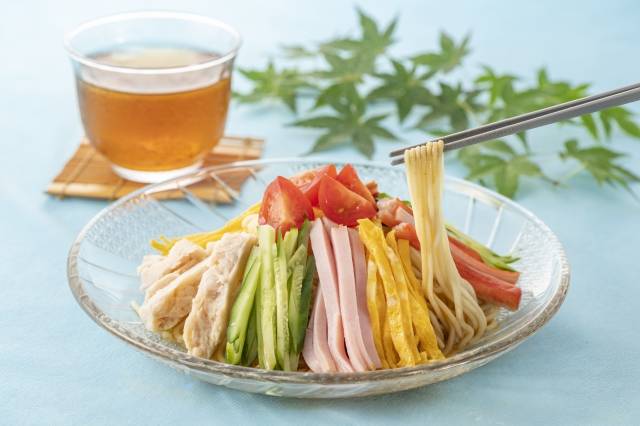
They may also serve Hiyashi Chuka (冷やし中華), a chilled noodle dish that was developed in Japan rather than originating in traditional Chinese cuisine.
John: So Hiyashi Chuka is actually a Japanese creation?
Nobu: Yes. There are quite a few dishes that were created in Japan, even though their names or ingredients might suggest foreign origins.
For example, Japanese Western-style cuisine includes dishes such as omurice (omelet rice) and doria (a rice dish topped with a creamy sauce and baked with cheese).
Kelly: That’s surprising! Japan really does have a way of adapting foreign food cultures and making them its own.
How Much Does Machi-Chuka Cost?
Mike: So, how much does a meal at Machi-Chuka usually cost?
Nobu: Many Machi-Chuka restaurants offer relatively inexpensive meals. You can often find dishes priced at around 1,000 yen or less, although prices vary depending on the restaurant and location.
These restaurants generally have a casual atmosphere rather than the setting of a restaurant intended for parties or formal gatherings. That also makes them convenient places for families and local residents to enjoy an everyday meal without spending too much.
Kelly: So they’re simple, casual, and affordable.
Nobu: Exactly.
By contrast, restaurants specializing in Chinese cuisine may offer more elaborate menus and accommodate group dining or special occasions. Their prices also tend to be higher than those at many Machi-Chuka restaurants.
Kelly: So restaurants specializing in Chinese cuisine are often positioned at a somewhat higher price level.
Nobu: That’s generally the case.
The End
My Personal Experience
There are both Japanese-run Machi-Chuka restaurants and Chinese-run restaurants specializing in Chinese cuisine in my neighborhood. As you might expect, their menus are quite different.
For example, the Machi-Chuka restaurants I visit do not serve dishes such as knife-cut noodles, Peking duck, or Sichuan-style spicy chicken (Yóu Pō Ji). However, they do offer dishes like katsudon and katsu curry.
I often order katsu curry when I visit Machi-Chuka.
Incidentally, the curry served at my favorite Machi-Chuka restaurant is also different from the curry you would find at a specialized curry restaurant. You could almost call it a unique style of curry found at Machi-Chuka restaurants.
Conclusion
In this article, we have explored Machi-Chuka and how it differs from restaurants specializing in Chinese cuisine.
As you have seen, Machi-Chuka is a distinctive style of restaurant that has developed as part of Japanese food culture.
Some people might still wonder why a Chinese-style restaurant would serve dishes that have nothing to do with Chinese cuisine.
Well, I can understand that reaction. But this is simply one example of how Japan has adapted foreign food cultures and made them its own.
Machi-Chuka is also an interesting part of Japan’s everyday food culture. Visiting a specialized ramen restaurant is certainly a good experience, but why not try a Machi-Chuka restaurant and enjoy this uniquely Japanese take on Chinese-style food?

