Japan is surrounded by the sea, and the country has many coastal towns and cities. Because these places are close to the ocean, they are often exposed to salt carried by sea breezes.
One of the major problems caused by salt is metal corrosion. Many buildings, for example, use metal for their exterior walls, roofs, and other components. These parts can be exposed to salt in the air, making them more susceptible to rust.
In some cases, corrosion can weaken metal components and even lead to serious accidents.
To prevent this, metal parts are often treated with protective coatings, such as paint or metal plating. However, these treatments must also be tested to determine how well they protect against corrosion.
One method used for this purpose is called the Salt Spray Test.
In this article, we introduce the salt spray test used in Japan and explain how it helps manufacturers check the corrosion resistance of metal parts.
Characters
Mike: A 12-year-old American boy who is interested in Japan.
John: Mike’s father. He sometimes travels to Japan on business.
Kelly: Mike’s mother. She is good at cooking.
Nobu: A Japanese exchange student.
Prologue
John is a businessman who frequently visits Japan. From time to time, he also works as a buyer, importing Japanese industrial products into his home country.
However, importing products from Japan can sometimes be challenging. Japanese products are often manufactured according to Japanese standards, which do not always match the standards used in the United States.
Recently, John came across an unfamiliar technical term in a document.
It said that a certain metal product had “Passed a 1,000-hour Salt Spray Test.”
He could imagine what the test involved, but he did not understand exactly how it worked or what the result meant.
Just then, Nobu appeared.
John decided to ask him about it.
Nobu: Hello!
John: Hey, you’re just the person I wanted to see. I have a question about Japanese industrial products.
Nobu: What is it?
John: I’m importing some metal products from Japan, and the documentation says they have “Passed a 1,000-hour Salt Spray Test.” I understand the general idea, but I don’t really know what that means.
Nobu: I see. You’re asking about the Salt Spray Test. It may take a little explanation.
John: Please explain it to me.
Nobu: All right!
What Is a Salt Spray Test?
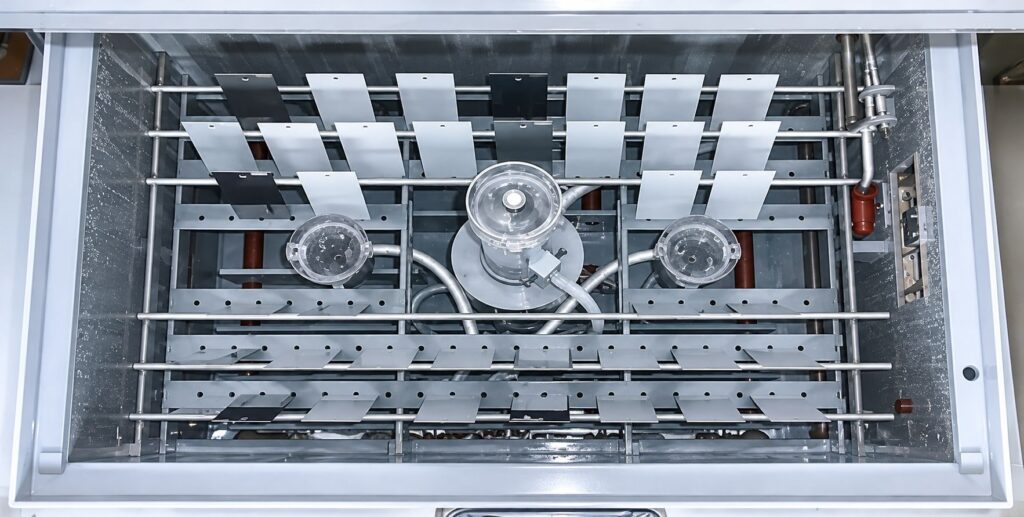
Nobu: First, let me explain what a salt spray test is and why manufacturers use it.
Why Is a Salt Spray Test Necessary?
Nobu: As you probably know, Japan is surrounded by the sea. As a result, many areas are exposed to salt carried through the air.
One major problem caused by salt is the corrosion of metal components.
For example, when steel parts corrode over time, the damage can become severe enough to create large holes. This affects not only their appearance but also their strength.
That can become a serious problem.
Mike: That’s true. If a metal handrail becomes badly corroded, it might break when someone leans on it. Imagine what could happen if that person were holding on to it when it broke!
Nobu: Exactly. That’s why manufacturers need to evaluate how resistant their products are to corrosion.
One way to do this is to place metal parts in an environment where salt water is sprayed onto them and then observe how corrosion develops.
Mike: So, if a part can withstand that corrosive environment, does that mean it’s safe to use?
Nobu: That’s the basic idea. However, the actual judgment depends on the requirements for each product.
How Is the Salt Spray Test Conducted?
Kelly: I understand why the test is necessary, but what actually happens during the test?
Nobu: The test method is also described in JIS, the Japanese Industrial Standards.
In a typical neutral salt spray test, a neutral salt solution is sprayed as a fine mist onto the test specimens inside a special chamber. The temperature and other conditions inside the chamber are carefully controlled.
The specimens are then exposed to this environment for a specified period.
Kelly: And what happens to the metal parts?
Nobu: Simply put, parts with poor corrosion resistance may begin to rust relatively quickly. On the other hand, parts with good corrosion resistance may show little corrosion even after a long period of exposure.
Kelly: So, the test duration is an important part of the evaluation?
Nobu: That’s right. The length of the test is one of the important factors, although the actual results and acceptance criteria also matter.
How Long Does the Test Last?
Mike: Then how long does a salt spray test usually take?
Nobu: It depends on the product and the requirements.
Some products need to withstand severe corrosive conditions, while others are used in environments where salt exposure is less of a concern. The required test conditions can therefore differ.
Mike: Can you give me an example?
Nobu: For example, 800 hours or 1,000 hours may be specified for certain products.
A 1,000-hour test involves a longer exposure than an 800-hour test, so the specimen is subjected to the test environment for a longer period.
However, the required duration is not determined simply by how close a product will be to the sea. It depends on the applicable product specifications and the requirements agreed upon by the parties involved.
Mike: I see. So, 1,000 hours means a longer test than 800 hours, but it doesn’t automatically tell us how many years the product will last outdoors.
Nobu: Exactly. That’s an important point. A salt spray test is a controlled laboratory test. Its results cannot be directly converted into the number of years a product will last in an actual outdoor environment.
How Are the Test Results Evaluated?
John: So, how do manufacturers judge the results of the test?
Nobu: This also depends on the product. Let me give you a few examples to help you understand.
Products with Paint Coatings
Nobu: First, let’s look at painted metal products.
Their appearance is often important, so manufacturers check for changes in the painted surface, such as discoloration, blistering, or peeling.
They may also deliberately make a scratch in the coating before the test. For example, a cutting tool can be used to expose the metal underneath the paint.
John: What happens around the scratched area?
Nobu: The exposed metal may begin to rust. Depending on the product and coating, the paint may peel away, or rust may spread from the damaged area.
In some cases, rust may also be washed away with the water, making the damage less obvious.
In any case, corrosion can affect the appearance of the product.
John: So, if the protective coating remains in good condition and there is little visible damage, that would be considered a good result?
Nobu: That’s right. The actual acceptance criteria depend on the product specifications, but maintaining the appearance and protective performance of the coating is important.
Metal-Plated Products
Nobu: Next, let’s consider metal parts, especially steel parts that have been zinc-plated.
Zinc plating is an interesting method of corrosion protection. Zinc can corrode more readily than iron, so it protects the underlying steel by corroding first. This is known as sacrificial protection.
John: Wait a minute. Does that mean the plated surface is supposed to rust?
Nobu: In a sense, yes. With zinc plating, the zinc layer gradually corrodes and helps protect the steel underneath.
Therefore, depending on the product requirements, corrosion of the zinc layer may be acceptable as long as the underlying steel remains protected.
John: I see. So, even if the surface changes, the important thing is whether the steel underneath is still protected.
Nobu: Exactly. Of course, the acceptable amount and type of corrosion depend on the product specifications.
John: By the way, what methods are used to improve the corrosion resistance of plated parts?
Nobu: There are several approaches.
One is to change the thickness of the plating layer. Generally, a thicker zinc coating provides a greater amount of protective material.
Another approach is to change the composition of the coating. For example, some zinc-based alloy coatings containing aluminum and magnesium can offer improved corrosion resistance, depending on their composition and application.
John: That makes sense.
Other Types of Products
Nobu: There are also other ways to evaluate test results.
For example, consider a metal component that has moving parts.
In some cases, its appearance may not be particularly important. What matters most is whether it can still move properly after exposure to the salt spray environment.
In such cases, the component is tested for the specified period and then checked to see whether it still performs the required movement.
If it works as required, it passes the functional evaluation. If it no longer works properly, it fails.
Mike: So, the focus is on whether it still works!
Nobu: Exactly. There are many different ways to evaluate corrosion resistance, depending on the component and the environment in which it will be used.
The End
My Personal Experience
I have also been involved in salt spray testing through my work.
In actual testing, exposure periods can be as long as 800 or 1,000 hours. A 1,000-hour test lasts for more than 40 days, so the testing equipment must keep operating throughout that period.
One particularly troublesome part of the work was preparing the salt solution.
The salt concentration had to be carefully adjusted, and the solution had to be kept within the required neutral pH range. This was more complicated than I had initially expected.
Even though the solution was sprayed as a fine mist, a considerable amount was needed to keep the test running for more than 40 days.
Looking back, I sometimes wonder how I managed to do all that work!
Conclusion
In this article, we have introduced the salt spray test and explained how it is used to evaluate the corrosion resistance of metal parts.
I hope you now have a better idea of how manufacturers test products with paint coatings and metal plating.
You may also have gained some appreciation for the effort engineers put into preventing corrosion in Japanese industrial products.
Many industrial products manufactured in Japan undergo various tests like these before they reach the market.
The next time you see a Japanese metal product, I hope you will remember the careful testing and behind-the-scenes work that may have gone into making it.