When learning a foreign language, a dictionary is essential. However, when a word has several meanings, it can be difficult to know which meaning to use. This becomes even more confusing when the word is used in a special way.
Japanese curry has become a national favorite in Japan, and Japanese curry products are exported to countries around the world. Many people outside Japan may already be familiar with its taste.
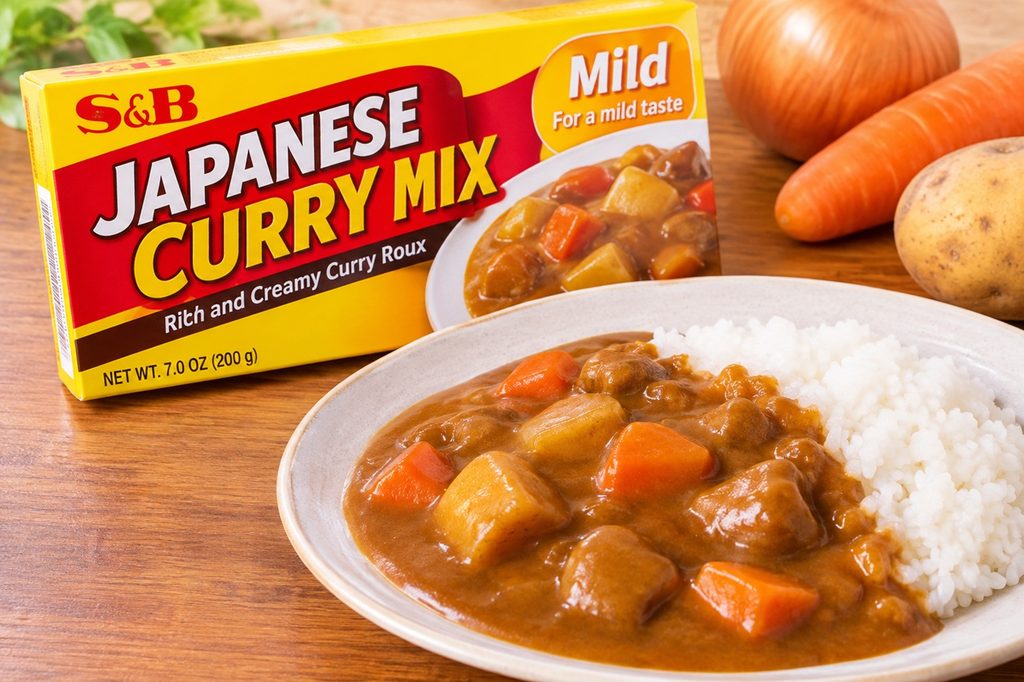
However, when you look at the packaging of Japanese curry, you may find a Japanese expression that is a little confusing. It is the word “amakuchi” (甘口), which is used to describe a type of curry. Let me explain this unusual expression.
Characters
Mike: A 12-year-old American boy who is interested in Japan.
John: Mike’s father. He sometimes travels to Japan on business.
Kelly: Mike’s mother. She is good at cooking.
Nobu: A Japanese exchange student.
Prologue
Kelly is interested in Japanese food, and recently she has become fond of ordering Japanese food products from overseas. She cannot read Japanese, but she enjoys the feeling of getting a little closer to Japan through its products.
One day, she finds a package of Japanese curry. Japanese curry products are also sold in nearby stores, but she thinks that products made in Japan might be different. Naturally, she wants to try one.
However, she notices an unusual label: “甘口” (amakuchi).
John takes a look at the label and explains that the character “甘” is associated with sweetness.
Curry as sweet as cake? Or chocolate? Kelly is even more confused.
Just then, Nobu arrives.
Japanese Curry Packaging
Nobu: Hello!
Kelly: Oh, you came at just the right time. I was looking at some Japanese curry.
John: Curry? Sounds good. Curry is very popular in Japan, from children to adults.
Kelly: I see. So it is sweet because children eat it. But I cannot imagine eating curry that tastes as sweet as cake or chocolate.
Mike: I can hardly imagine pouring something that tastes like cake or chocolate over rice, either.
Nobu: Wait a minute. There is no curry that tastes as sweet as cake or chocolate just because it is labeled “amakuchi.”
John: But the package says “甘口.” Doesn’t the character “甘” mean sweet? Like cake or chocolate?
Nobu: I think I need to explain this from the beginning.
How Spicy Is Japanese Curry?
Nobu: First, let me explain how the spiciness of Japanese curry is described. Curry products commonly sold in Japan are generally divided into three levels: “karakuchi” (辛口), “chukara” (中辛), and “amakuchi” (甘口).
There are also products that are much hotter, such as curry advertised as having ten times the usual spiciness. However, these are a more unusual category.
Kelly: I see. Three levels: karakuchi, chukara, and amakuchi.
Nobu: Here is the important point: “amakuchi” does not mean that the curry tastes sweet. It means that the spiciness is mild.
John: So karakuchi is the hottest, chukara comes next, and amakuchi is the least spicy?
Nobu: Exactly. In this context, “amakuchi” does not mean sweet in the way that a dessert is sweet. It means that the curry is less spicy, or mild.
Kelly: By the way, I remember seeing pictures of fruit on some Japanese curry packages. Does that mean the curry tastes like fruit?
Nobu: Some curry products may contain fruit, but that does not mean they taste like fruit. Think of it as an ingredient used to add flavor in the background.
How Are Curry Products Classified by Spiciness?
Mike: By the way, how do manufacturers decide how spicy a curry is?
John: What do you mean?
Mike: For weight and length, we have units of measurement. Is there a unit for spiciness, too?
John: That is a good question. Is there a standard level of spiciness? Also, there are many curry manufacturers, so I wonder whether their products differ in how spicy they are.
Nobu: The spiciness can vary depending on the manufacturer and the product series. For example, the mild version of one curry series might be as spicy as the hot version of another product.
Kelly: So we should not judge a curry just by whether it says mild or hot?
Nobu: I would not go that far, but there are curry series designed for adults who prefer relatively spicy food, as well as series that are suitable for both children and adults. If an adult eats a mild curry designed for children, they might find it not spicy enough.
Kelly: In that case, it would be better to learn about the different curry series, too?
Nobu: Yes. It is a good idea to learn about the characteristics of each manufacturer’s products. If you have the chance, try comparing several kinds of curry.
Curry for Young Children
Nobu: There is one more thing worth knowing: curry made especially for young children.
Kelly: Young children?
Nobu: Yes. There are curry products made for children as young as around two years old.
Kelly: Wait a minute. Isn’t spicy food unsuitable for small children?
Nobu: That is why these products exist. When the rest of the family is eating curry, a small child may want to eat the same food, too.
Mike: That makes sense.
Nobu: Exactly. There are curry roux products for young children, as well as ready-to-eat curry sold in pouches. This makes it possible for the whole family to enjoy curry together.
John: Are there products that are even hotter than ordinary karakuchi curry?
Nobu: There certainly are very spicy products. But if you use one to make a whole pot of curry, the entire pot will be spicy.
Some families may prepare separate pots of curry, but considering the number of burners on a kitchen stove, it may be more practical to sprinkle extra spices over the curry on each person’s plate.
Kelly: That is true. I would hate to have to prepare a separate pot of curry for every member of the family!
Nobu: I can understand that.
The End
A Personal Note
Curry is an extremely popular dish in Japan. Some people even say that curry is “contagious.” What they mean is that when people smell curry coming from a house on their way home in the evening, they may suddenly decide to make curry for dinner themselves.
However, its popularity can also lead to a few problems. Here are two stories based on things I have personally seen or heard.
The Husband Who Made His Family Cook Two Pots of Curry
One day at work, a conversation started among my colleagues about what kind of curry they ate at home.
As the conversation continued, two groups emerged. One group mainly ate hot curry, while the other mainly ate mild curry.
When I listened to their stories, I found that the households that mainly ate hot curry tended to be those with only adults, such as couples or families whose children had grown up. The households that mainly ate mild curry had young children.
When children are small, families often have little choice but to serve milder curry. That is understandable.
Then someone said that his family ate both kinds. In other words, he prepared two pots of curry: mild curry for the children and hot curry for the adults.
Some colleagues were impressed, saying that it was amazing. Others felt sorry for his wife, who had to do all that extra work.
Whatever the case, he was quite a character.
When You Can No Longer Enjoy Spicy Curry
When a young couple is expecting a baby, the husband sometimes hears an unexpected comment from people around him.
Of course, people congratulate him. But sometimes they also say, “That’s too bad.” Why? Because he may no longer be able to enjoy spicy curry as often as he used to.
Once a baby arrives, family life tends to revolve around the child. Meals are no exception, and curry may end up being mild most of the time.
Some people might say, “Why not just sprinkle some spices over the mild curry?” But even then, the taste is not quite the same.
So a man may look forward to the birth of his child while feeling just a little sad about giving up his favorite spicy curry.
However, once the baby arrives, sharing meals with the child is so enjoyable that he seems to forget all about the curry!
Conclusion
Today, we looked at the Japanese curry label “amakuchi.” As we have seen, it means that the curry is mild, not that it tastes sweet like a dessert.
I have also shared a couple of personal stories about curry in Japan. Perhaps they have made you a little more interested in Japanese curry.
In any case, curry is one of Japan’s most popular dishes. Japanese curry is different from the curries found in India and other parts of the world.
Why not give Japanese curry a try? Different products have different flavors, so comparing several kinds can be an enjoyable experience.
Related Article
This article introduces mild Japanese curry.
Did you know that Japanese curry can be prepared in a relatively short time?
If you are interested in how to make Japanese curry quickly and easily, check out our article below.
Read the article →