Japan is well known as a country where earthquakes occur frequently. Yet, despite experiencing so many earthquakes, many Japanese homes remain standing. This is often regarded as a testament to the country’s advanced construction technology.
However, sophisticated construction techniques alone are not enough. They also depend on the development and quality of many other technologies.
One example is something surprisingly small: the nail.
Although nails are tiny components, they play an important role in building construction. But did you know that they can also have a significant influence on a house’s earthquake resistance?
Let’s take a closer look at the earthquake resistance of Japanese homes and explore why something as small as a nail matters so much.
Characters
Mike: A 12-year-old American boy who is interested in Japan.
John: Mike’s father. He sometimes travels to Japan on business.
Kelly: Mike’s mother. She is good at cooking.
Nobu: A Japanese exchange student.
Prologue
One day, Mike was researching Japan and came across information about the country’s frequent minor earthquakes.
He had often heard news reports about major earthquakes in Japan, but he was surprised to discover just how many smaller earthquakes also occur.
He was also surprised to learn that minor earthquakes are sometimes so commonplace that they do not even make the news.
At the same time, he noticed something else. News about houses collapsing because of earthquakes did not seem to appear very often.
“Does that mean Japanese houses are particularly resistant to earthquakes?” he wondered.
Just then, Nobu appeared.
Nobu: “Hello.”
Mike: “Hi. I was just thinking about something. Even when Japan experiences a fairly large earthquake, it doesn’t always make international news. Is that right?”
Nobu: “Well, earthquake alerts are often broadcast on television, but unless an earthquake is particularly significant, it may not receive much attention in the news.”
Mike: “Does that mean there isn’t much damage to buildings, so it doesn’t become a major news story?”
Nobu: “That may be part of the reason. But perhaps I should explain a little more about the earthquake resistance of Japanese houses.”
Mike: “Please do!”
The Walls That Support a House
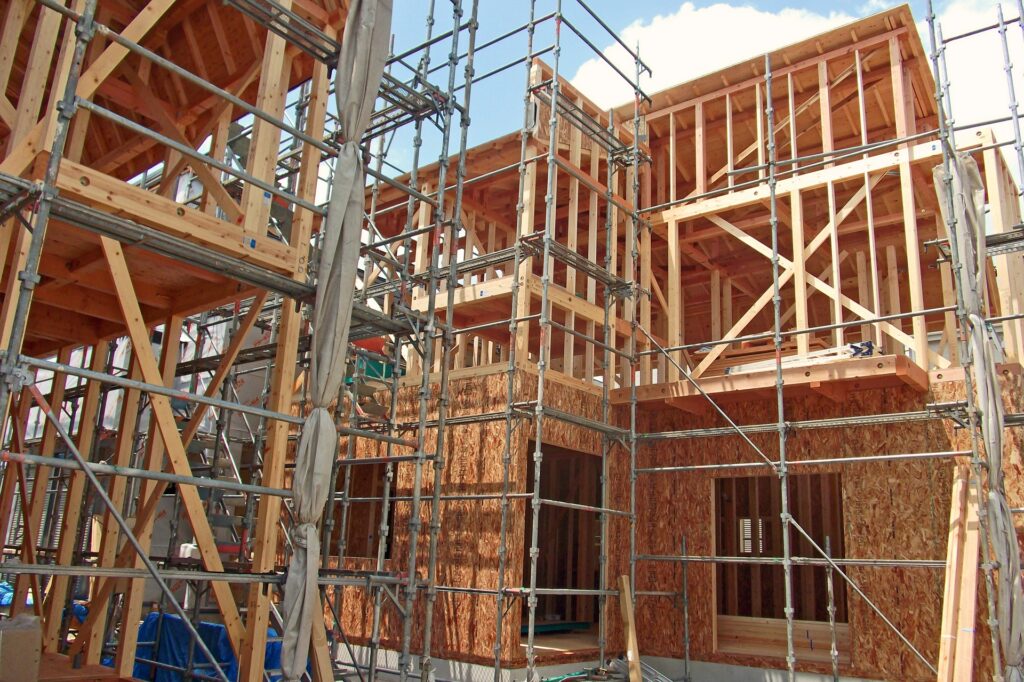
Nobu: “Many houses in Japan are built using timber. Basically, a wooden frame is assembled using structural members such as posts and beams. Other materials, such as insulation and interior finishing materials, are then added.”
Mike: “So, you’re talking about the basic structural components, such as columns and beams.”
Nobu: “Exactly. Now, among these structural components, can you guess which ones play an especially important role during an earthquake?”
Kelly: “What could they be? I suppose it’s not just the columns and beams…”
John: “Wouldn’t it be the columns? There’s even a Japanese expression, daikokubashira, meaning the main pillar of a house.”
Nobu: “Columns and beams are certainly important. They help support the building and maintain its overall structure. However, when it comes to resisting horizontal forces caused by earthquakes, other elements are also essential. These include diagonal braces and structural walls, often called shear walls.”
Kelly: “I see! So the walls are important too. That’s interesting.”
Nobu: “That’s right. But there is something else we must not overlook: the individual components used to construct those walls. In particular, nails play a very important role.”
Mike: “So it really does come down to nails!”
Nobu: “In many timber houses, structural walls are made by attaching plywood or other structural panels to the wooden frame. A large number of nails are used to fasten these panels securely.”
John: “Now I understand why you’re talking about nails. But how exactly do they help a house withstand an earthquake?”
Nobu: “To understand that, we first need to look at how nails help maintain the strength of a structural wall.”
How Nails Help Maintain Wall Strength
Nobu: “The basic principle is quite simple. However, it is essential to use the specified number of nails.”
Kelly: “What happens if you run out of nails halfway through the job? Surely using fewer nails would be dangerous.”
Nobu: “Exactly. If the number of nails is reduced, the remaining nails may have to carry a greater share of the load. This increases the risk of damage or failure. Also, if the nails are not the specified diameter and length, they may not have sufficient strength, and they could even break.”
John: “So the number of nails really matters.”
Nobu: “It does. There are also standards governing where the nails should be placed. Their spacing and position are important too. If they are placed too far from the specified locations, the wall’s performance may be affected.”
John: “What about the strength of the nails themselves?”
Nobu: “Nails also have requirements regarding their mechanical properties. They need to be strong enough, but they also need an appropriate degree of toughness. In other words, simply being hard is not enough. Their ability to withstand deformation without suddenly breaking is important too.”
Mike: “So the material itself is important as well.”
Why Nail Quality Control Matters
Nobu: “This brings us to the quality of the nails themselves. Imagine an earthquake occurring in a house where plywood panels are attached to the wooden frame with nails. The force generated by the earthquake is transmitted through the structural components and eventually reaches the walls. The nails help transfer the forces between the panels and the frame.”
John: “So, are there specifications for the nails used in these structural walls?”
Nobu: “Yes. Nails used for fastening structural plywood are subject to specifications. In Japan, nails are covered by industrial standards, and the steel used to manufacture them also needs to meet appropriate quality requirements.”
John: “What kind of strength requirements are involved?”
Nobu: “Japanese Industrial Standards, known as JIS, specify requirements for various types of nails. Depending on the product, properties such as tensile strength and other mechanical characteristics are controlled. These standards help ensure that nails have consistent and reliable quality.”
Mike: “What would happen if someone bought nails without checking their specifications and used them in a house?”
Nobu: “If the nails were weaker than required, they could become a weak point in the structure. For example, they might break under the forces generated by an earthquake.”
Kelly: “And we already discussed what happens if there aren’t enough nails.”
Nobu: “That’s right. When there are fewer nails, each remaining nail may have to carry a greater load.”
For example, imagine a simplified situation in which a force of 100 kilograms is distributed equally among five nails. Each nail would carry the equivalent of 20 kilograms of force. If the number of nails were reduced to four, each would have to carry 25 kilograms instead.
Of course, actual forces in a structural wall are not always distributed equally among all the nails. However, this example illustrates why using fewer nails than specified can increase the risk of failure.
John: “What if the nails were thinner than they should be?”
Nobu: “That could cause serious problems too. If the diameter is smaller than specified, the nail may not have the required strength. Using nails with the correct dimensions is essential.”
Nails and Screws: What’s the Difference?
Nobu: “Another thing that people sometimes confuse is the difference between nails and screws. There are screws designed specifically for wood, and power tools make them quite convenient to use.”
John: “But nails and screws aren’t the same thing, are they?”
Nobu: “No, they have different characteristics. One major difference is their resistance to being pulled out. Screws are driven into the material by turning them, and their threads help them grip the wood. Nails, on the other hand, are driven straight into the material.”
Kelly: “So screws generally have an advantage when it comes to resisting pull-out forces.”
Nobu: “That’s right. However, when we consider resistance to breaking under sideways forces, nails can sometimes have an advantage. For example, even if a screw has the same outer diameter as a nail, the screw may break at the narrower section around its threads.”
Of course, the actual performance depends on the type and specifications of the fastener and how it is used. Neither is automatically better in every situation.
Mike: “I see. So they each have their own strengths and weaknesses.”
Proper Materials and Installation Make All the Difference
Nobu: “We’ve talked a lot about nails, but the plywood panels themselves also have specifications that must be followed. After all, if the plywood breaks, the structural wall can lose its ability to resist earthquake forces. Depending on the situation, this could also cause serious damage to the house as a whole.”
Kelly: “So, to achieve the intended strength, you need to use the right materials and components and install them correctly.”
Nobu: “Exactly.”
The End
Conclusion
We’ve looked at the relationship between the earthquake resistance of houses and the nails used in their construction.
Nails may be small, but we hope you now have a better idea of how these seemingly insignificant components can help protect a house during an earthquake.
We’ve also seen why choosing nails carelessly can be dangerous. Their dimensions, mechanical properties, number, and installation positions all matter.
Ultimately, maintaining the earthquake resistance of a house requires appropriate materials and components to be used and installed correctly. Japanese industrial standards and construction requirements help support this process.
Perhaps this gives you a glimpse of the high level of quality control behind Japanese construction technology. Even something as small as a single nail can make a difference when it comes to building a safe and reliable home.