Japan has a long history, and over the centuries it has produced many famous cultural traditions and historical figures.
One of the most fascinating is the culture of haiku. Poetry exists all over the world, but haiku is rather unique. With its traditional 5-7-5 structure, it expresses a scene, a feeling, or even a whole moment in just 17 Japanese syllables.
One of the most famous people in the history of haiku appeared during the Edo period. His name was Matsuo Basho.
Basho is particularly famous for The Narrow Road to the Deep North, a travel journal in which he describes his journey through northeastern Japan and the haiku he composed along the way.
But there is an interesting legend surrounding Matsuo Basho.
Was he actually a ninja?
What was behind this strange legend about one of Japan’s most famous poets?
Characters
Mike: A 12-year-old American boy who is interested in Japan.
John: Mike’s father. He sometimes travels to Japan on business.
Kelly: Mike’s mother. She is good at cooking.
Nobu: A Japanese exchange student.
Matsuo Basho and The Narrow Road to the Deep North (奥の細道 Oku-no-hosomichi)
Kelly: “Japan has so many beautiful forms of poetry. But some of them are really unusual.”
John: “That’s true. There’s tanka and haiku, for example. Haiku is especially interesting because so much is expressed in just 17 syllables.”
Kelly: “Speaking of haiku, there was a famous person named Matsuo Basho, wasn’t there?”
John: “Yes. He was the man who wrote The Narrow Road to the Deep North (奥の細道 Oku-no-hosomichi). I heard that he traveled around northeastern Japan while composing haiku.”
Mike: “That sounds like an incredible journey. Looking at a map, I can see that he covered a huge area.”
John: “By the way, Basho didn’t travel completely alone. He had a disciple named Sora. They eventually went their separate ways, but Sora was also a talented haiku poet.”
Mike: “So when was this written?”
John: “During the Edo period. It was a time when Japan had become relatively peaceful after the Battle of Sekigahara, when the Tokugawa family established its shogunate.”
Mike: “I see.”
The Legend of Matsuo Basho
Nobu: “Hello.”
Kelly: “Oh, hello. We were just talking about haiku.”
Nobu: “Haiku? Then we can’t forget Matsuo Basho and The Narrow Road to the Deep North.”
John: “Exactly. We were talking about what a wonderful travel journal it is.”
Nobu: “By the way, did you know that there is a little mystery surrounding Matsuo Basho?”
Mike: “A legend? That sounds interesting.”
Nobu: “It is very interesting. There is actually a legend that Matsuo Basho may have been a ninja.”
John: “A ninja???”
The Narrow Road to the Deep North and the Historical Background
Nobu: “To understand this legend, we need to know something about the historical background of the time when The Narrow Road to the Deep North was written.”
John: “That’s easy. Japan was peaceful, and Basho traveled around writing haiku, right?”
Nobu: “Actually, there was more to it than that. There was an important political background.”
John: “What kind of background?”
The Tokugawa Shogunate and the Tozama Daimyo
Nobu: “The Tokugawa shogunate was established after the Battle of Sekigahara. It was a huge conflict between the Eastern Army and the Western Army. The Eastern Army, led by Tokugawa Ieyasu, won, while the Western Army was placed in a disadvantaged position after its defeat.”
Mike: “What do you mean by a disadvantaged position?”
Nobu: “The daimyo, or feudal lords, were broadly divided into two groups. Those who had supported the Tokugawa side before and during the battle were known as fudai daimyo.”
Mike: “And what happened to the losing side?”
Nobu: “Many of those who had not been closely connected to the Tokugawa family became tozama daimyo, or ‘outside lords.’”
Mike: “So there were different ranks among the daimyo?”
Nobu: “Yes. One important difference was where they were placed. Fudai daimyo tended to be placed in areas closer to the political center, while many tozama daimyo were assigned territories farther away.
Some well-known examples were the Mori clan in what is now Yamaguchi Prefecture and the Date clan in northeastern Japan.”
Mike: “So being a tozama daimyo didn’t necessarily mean that you were weak?”
Nobu: “Exactly. A daimyo’s political status and actual power were not always the same thing.
One common way of measuring a daimyo’s economic strength was the amount of rice their territory could produce. Some tozama daimyo controlled very productive territories and became extremely powerful.
The Date clan is a good example.”
The Threat of Powerful Tozama Daimyo
John: “So the Date clan could potentially become a serious concern for the Tokugawa.”
Nobu: “That’s right. And distance was also important.
The Date territory was relatively close to Edo, the political center of the Tokugawa shogunate. You can get an idea of the distance by comparing modern travel times.
Sendai, in the former Date territory, is only about two hours from Tokyo by bullet train. Yamaguchi, where the Mori clan was based, takes roughly six hours by train from Tokyo.
That difference is quite significant.
From a geopolitical point of view, the Date clan was something the Tokugawa could not simply ignore.”
John: “But wasn’t Edo protected by defensive barriers?”
Nobu: “It was. One of them was the rivers.
There were several major rivers around Edo, and they could make it difficult for a cavalry force to advance.
But if you put yourself in the Tokugawa government’s position, you might still have been nervous. You would want to know what a powerful daimyo like Date was doing.
You would want information.”
John: “I can understand that. If something suspicious was happening in a distant region, and it turned out to be preparations for war or even an alliance between several tozama daimyo, that could become a serious threat.”
Matsuo Basho and The Narrow Road to the Deep North
Nobu: “Matsuo Basho lived and traveled during this period.
At first glance, Japan appears to have been enjoying an era of peace. But that doesn’t mean there was no political tension between the daimyo.
Of course, the Tokugawa government would have wanted information about potentially powerful rivals.
In other words, you could imagine that information gatherers—or even spies—would have been useful.”
Mike: “So is there any evidence that Matsuo Basho was actually a ninja?”
Nobu: “It’s only a legend and a theory. But if we really wanted to force the evidence a little, there are a few things that might look suspicious.”
Mike: “I want to hear them.”
Nobu: “All right.”
The Land Where Matsuo Basho Was Born: Iga
Nobu: “First of all, do you know a place famous for ninjas?”
Mike: “Sure. The Koka area in Shiga Prefecture and the Iga area in Mie Prefecture.”
Nobu: “Exactly.
And Iga was the birthplace of Matsuo Basho.
So, if he had some kind of connection with the ninja tradition, it wouldn’t be completely impossible.”
Kelly: “But that’s pretty weak evidence, isn’t it? Not everyone born in Iga was a ninja.”
Nobu: “Exactly.
That is why I called it ‘evidence’ with quotation marks. I’m really stretching the argument here.”
The Speed of The Narrow Road to the Deep North
Nobu: “The next thing is the speed of his journey.
When you look at The Narrow Road to the Deep North, you realize that Basho traveled at a surprisingly fast pace.”
Mike: “But isn’t northeastern Japan relatively close?”
Nobu: “That might be true if you’re only thinking about the plains around Sendai.
But Basho traveled much farther north. And many of the roads in those areas were certainly not easy or flat.
In other words, he traveled through difficult terrain at a surprisingly steady pace.
That is one of the things that makes the legend interesting.”
Mike: “I guess it does sound a little suspicious, especially considering that Basho was no longer a young man when he made the journey.”
Parting Ways with His Disciple, Sora
Nobu: “There is another interesting point in The Narrow Road to the Deep North. Basho eventually went separate ways from his disciple, Sora.”
Mike: “I don’t see why that’s such a big deal.”
Nobu: “But remember what was around them.
Kyoto was home to the Imperial Court. And to the south of Kyoto was the Kishu domain, which was also a powerful domain.”
Mike: “Why was Kishu so powerful?”
Nobu: “Because the lord of Kishu was a member of the Tokugawa family.”
Mike: “Really?”
Nobu: “Yes.
Tokugawa Ieyasu, the founder of the Edo shogunate, had several sons and close relatives who became connected to three important domains: Mito, Owari, and Kishu.
These domains were strategically important.
One possible interpretation is that Mito could help keep an eye on the Date territory, while Owari and Kishu could help keep an eye on the Imperial Court and the powerful western domains, including the Mori.”
Mike: “I see. If that’s the case, it doesn’t sound so strange that Sora might have gone somewhere separately to gather information.”
Nobu: “Exactly.”
Kelly: “But doesn’t that whole theory have a problem?”
Nobu: “It does. But that’s unavoidable.
Remember, we’re examining a legend, not proving a historical fact.”
Kelly: “I see. So it’s just a legend.”
Nobu: “Exactly.”
Kelly: “Good. That’s a relief.”
The End
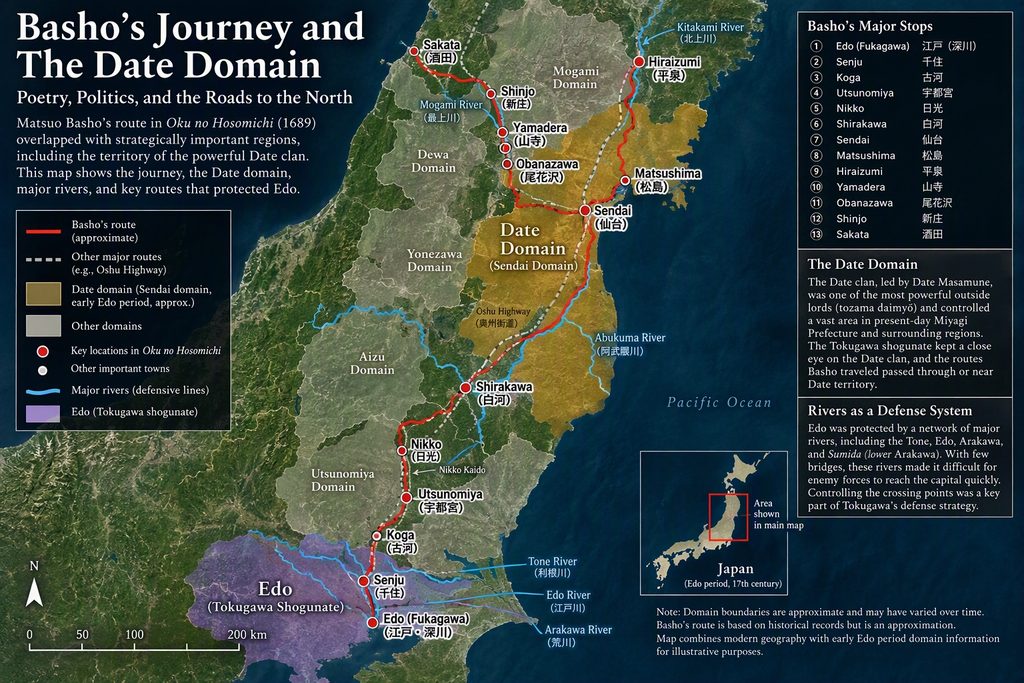
This map shows the route taken by Matsuo Basho. As you can see, it passes through the territory of the Date domain.
A Journey Following the Footsteps of Matsuo Basho
We’ve looked at the legend surrounding Matsuo Basho.
When you look back at his life and travels, he really was a fascinating and somewhat mysterious person.
It is fun to imagine what might have been happening behind the scenes.
So, here is a travel idea.
Why not follow the route described in The Narrow Road to the Deep North?
If you read Basho’s travel journal, you will discover many beautiful places throughout Japan. Some of them have since become popular tourist destinations.
Traveling along Basho’s route while imagining the scenery and circumstances that inspired his haiku could be a wonderful way to experience Japanese history.
And there is another possibility.
Why not stop at a hot spring along the way?
Northern Japan, especially the more remote areas of the Tohoku region, is home to hot springs sometimes described as hito, or secluded “secret” hot springs.
Relaxing in a hot spring while thinking about a haiku might be a very Japanese way to enjoy the journey.
Conclusion
I remember reading a history book when I was a child that said something like this:
“If decisive new evidence is discovered, the conventional understanding of history could be turned upside down.”
For example, imagine if dinosaur bones were discovered inside an Egyptian pyramid.
We might suddenly have to ask an unbelievable question:
“Did dinosaurs actually live in ancient Egypt?”
The legend of Matsuo Basho is similar.
If decisive evidence were ever discovered, perhaps we would learn that Basho had another side to his life that we know nothing about today.
Of course, we should remember that there is currently no decisive evidence proving that Matsuo Basho was a ninja or a spy.
But history is full of mysteries.
So, if you are interested in Japan, why not explore not only the well-known historical facts, but also some of the mysteries and legends surrounding them?
Sometimes, the unanswered questions are what make history the most interesting.