Many foreign visitors probably think that Japanese train stations provide a high level of service. Trains run remarkably close to schedule, and stations have various safety features. Leaving aside how crowded trains can get during rush hour, many people would give Japan’s railways high marks.
But let’s look at things from a different perspective. How well do Japanese train stations accommodate passengers with visual impairments?
In fact, Japanese stations have various measures in place to help people who are blind or have low vision. So, what exactly are these measures?
Characters
Mike: A 12-year-old American boy who is interested in Japan.
John: Mike’s father. He sometimes travels to Japan on business.
Kelly: Mike’s mother. She is good at cooking.
Nobu: A Japanese exchange student.
Prologue
John is a businessman who visits Japan frequently. Every time he returns, he has an interesting story about Japan to share with his family.
This time, he has a story about something that surprised him while traveling by train in Tokyo. He was impressed by the platform gates installed at a station.
John had always traveled by car from the airport, so seeing these gates at a Japanese railway station was a new experience for him.
Platform Gates on Japanese Railways
John: “Something surprised me on my latest trip to Japan. In the past, local staff would pick me up by car, but this time I had a chance to travel by train. I was amazed by what I saw at Japanese stations.”
Kelly: “That sounds interesting. What was it like?”
John: “I’d heard that Japanese trains arrive on time, but there was more to it than that. I was especially impressed by the level of attention paid to safety.”
Kelly: “Safety measures? What kind of measures?”
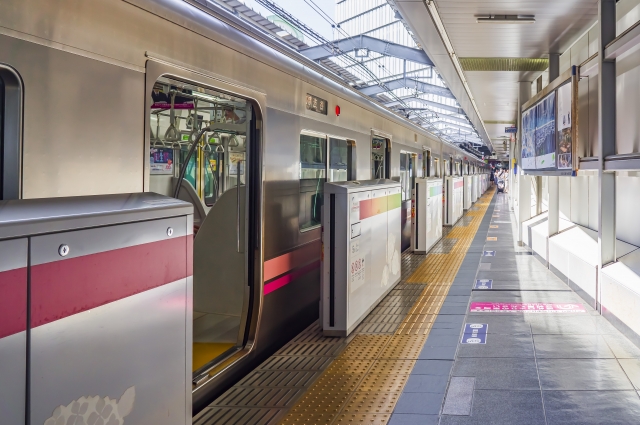
John: “The platform gates, above all. There are barrier-like gates along the platform to help prevent people from falling onto the tracks. When a train arrives, only the sections in front of the train doors open. I thought it was impressive how this system helps prevent people from falling off the platform.”
Mike: “Wow! That’s amazing.”
John: “I’d heard that Japanese trains stop at remarkably precise positions. But I hadn’t realized that this precision was also important for the gates. The train doors have to line up with the openings in the platform gates, or passengers wouldn’t be able to board.”
Why Platform Gates Matter for Passengers with Visual Impairments
Nobu: “Hello!”
Kelly: “Hi, Nobu. We were just talking about platform gates on Japanese railways. John was surprised when he saw them at a station.”
Nobu: “I see. Platform gates are extremely important for safety.”
John: “I couldn’t agree more. They help keep people from falling onto the tracks.”
Nobu: “Exactly. Station platforms can get very crowded in the morning, too. I think these gates help protect a great many people. But I don’t think commuters in the morning rush are the only people who benefit from them.”
John: “Who else benefits?”
Nobu: “I’d say passengers with visual impairments, especially.”
Kelly: “That makes sense. A station platform must be extremely dangerous for someone who can’t see. If they misjudge where the platform ends while trying to board a train, the consequences could be serious.”
Nobu: “That’s right. We have to do everything we can to prevent people from falling off platforms. People with visual impairments need particular consideration. That’s one reason platform gates are so important.”
Kelly: “I can see that.”
How Japanese Train Stations Help Passengers with Visual Impairments
Nobu: “I think it’s clear now why platform gates are important for safety. But they’re not the only measure Japanese stations use to help passengers with visual impairments. Stations have several features designed to help these passengers move around more safely and confidently.”
Mike: “What kinds of features?”
Tactile Paving to Guide Passengers
Nobu: “First, there’s tactile paving. People who use white canes can feel the raised patterns underfoot or with their canes and use them as a guide when deciding which direction to walk.”
John: “Hold on. Tactile paving exists in many countries.”
Nobu: “That’s true, but it originated in Japan. It was first developed in Okayama Prefecture.”
John: “I see. Could it be something that grew out of Japanese people’s concern for others?”
Nobu: “You could say that.”
Announcements on the Platform
Nobu: “Station announcements may seem like a minor detail, but they’re also extremely important.”
John: “That makes sense. Platforms have all kinds of signs, but someone who can’t see can’t read them.”
Nobu: “Exactly. For example, announcements provide information such as the train’s destination shortly before it arrives. Tokyo’s railway network is particularly complicated, so I imagine these announcements are a great help to many passengers.”
Mike: “Right. Even if the destination is written on the train, you can’t tell where it’s going if you can’t see the display.”
Nobu: “Exactly.”
Braille Signs
Nobu: “Braille signs inside stations are another important feature. People who are completely blind can’t rely on their eyesight, so they need to obtain information through touch. Tactile paving can provide some information through the sensations they feel with their white canes, but that information is quite limited.”
John: “That’s true. Knowing which direction to walk isn’t enough.”
Nobu: “That’s where Braille signs can help. They won’t tell someone everything about their surroundings, of course, but they provide additional clues that can help them understand where they are and what they need to do.”
Mike: “I see.”
Assistance from Station Staff
Nobu: “Station staff can also provide assistance. If tactile paving alone isn’t enough to help someone find their way, staff can guide them through the station.”
Kelly: “Having someone there to help must be reassuring.”
Guide Dogs
Nobu: “You may also see passengers traveling with guide dogs. These dogs can be a great help when navigating railway stations, too.”
John: “Absolutely. Guide dogs play an important role.”
What About Assistance for Foreign Visitors?
Mike: “Now I understand. Japanese stations have all these measures in place. That should make it easier for everyone to enjoy traveling around Japan.”
Nobu: “Japan also provides assistance for foreign visitors. For example, in addition to tactile paving, announcements are sometimes provided in English.”
John: “Announcements in English? That’s certainly important.”
Mike: “But don’t all stations have announcements?”
John: “I think they’re particularly important in Japan. Japanese signs often contain a lot of kanji, which can be difficult for foreign visitors to understand. English announcements make it easier for us to find our way, too.”
Mike: “I always thought announcements were just a normal part of using a station. But I guess they can become much more important when you’re in another country.”
John: “Exactly.”
The End
What More Could Be Done to Make Japanese Stations Accessible to Foreign Visitors?
As we’ve seen, Japanese railway stations have various measures in place to accommodate passengers with visual impairments. However, I personally feel that there are still areas where more could be done.
These are services I’d like to see improved in the future. Let’s look at a few examples.
Providing Information in More Languages
I live in Tokyo, so I frequently encounter foreign visitors. I haven’t personally encountered a foreign visitor with a visual impairment, but there have been plenty of occasions when I’ve thought that more consideration could be given to people who don’t speak Japanese.
One particularly important area, in my view, is providing information in more languages.
As mentioned earlier, English is the main foreign language used in many railway announcements. This can leave people who don’t speak English at a disadvantage.
For example, English announcements are available in some situations, but providing equivalent assistance in languages such as Russian, French, and Spanish can be more difficult.
Smartphones and translation technology have changed the situation considerably, but I still wonder whether the available support is sufficient. This could be particularly important for passengers with visual impairments, who may depend more heavily on spoken information.
I’d like to see further improvements in the future.
Better Guidance Inside Stations
One problem with Japanese railway stations is that they can be complicated and difficult to navigate.
Major subway stations, in particular, can be confusing. It’s not unusual to see signs indicating that a destination is several hundred meters away. Such information may be useful for passengers who can read the signs and follow the directions, but it doesn’t necessarily provide enough guidance for someone who can’t see.
This can make navigating a large station particularly difficult for passengers with visual impairments.
Perhaps more sophisticated guidance systems will be introduced in the future to help passengers find their way around stations. I’d like to see progress in this area.
Support at Regional Stations
The measures I’ve discussed so far are primarily based on the situation in major urban areas. In regional areas, passengers may find that assistance and facilities are less readily available.
If you’re planning to visit a regional destination, you may need to research the local situation in advance.
For example, although the installation of platform gates is being promoted, they are not as widespread at regional stations as they are in major urban areas.
There may also be fewer staff members who can assist passengers in English. This can make the language barrier even more difficult to overcome.
Translation devices and apps could become even more important in these situations. Careful research and preparation before traveling would therefore be advisable.
Some Problems Still Remain
Although Japanese railways have various measures to accommodate passengers with disabilities, it’s also true that some structural problems remain.
These are issues that may need to be addressed more fully in the future.
Japan’s Railway Network Can Be Overly Complicated
Japan’s railway network is extremely convenient, but one disadvantage of having such an extensive network is that it can become complicated.
For example, Shinjuku Station in Tokyo is served by JR trains as well as several private railway companies. Depending on the route, passengers may even need to leave one station area and go outside before entering another.
Understanding how everything fits together can be difficult if you’re unfamiliar with the system. For foreign visitors, navigating these connections can be particularly challenging. And for passengers with visual impairments, the difficulties could be even greater.
Incidentally, tickets and passes are not necessarily interchangeable between railway companies. For example, the Japan Rail Pass, issued for eligible international visitors, cannot be used on every railway line. Some private railway services are outside its coverage.
It’s worth checking which railway companies operate the routes you plan to use before setting out.
Stations with the Same or Similar Names
In Japan, place names are often distinguished by their written kanji characters.
For example, there is an Asahi Station in Chiba Prefecture and another in Kochi Prefecture. There are also stations with the same pronunciation but different kanji, such as Asahi and Asahi, written with different characters.
Some station names also look very similar when written in Japanese. For example, Ueda in Nagano Prefecture and Ueda, written with different kanji, in Fukushima Prefecture are a case in point.
If you search for a route using only the pronunciation of a station name, you could end up traveling in the wrong direction.
This can be a troublesome problem for foreign visitors. And for passengers with visual impairments, who may rely heavily on spoken information, distinguishing between similar-sounding station names could be particularly difficult.
Having Accessible Facilities Doesn’t Always Mean They Can Be Used Easily
Even when the necessary infrastructure is in place, another question remains: can passengers actually make full use of it?
For example, helping a foreign visitor with a visual impairment use a ticket machine isn’t necessarily straightforward.
Some stations also have help points or intercoms that passengers can use to contact staff. However, a foreign visitor with a visual impairment may not find these systems easy to use, especially if they cannot communicate in Japanese.
There is also the problem of chronic staff shortages, and it may not always be possible to find a staff member who speaks the passenger’s language.
These may be structural problems, but I don’t think that means they are impossible to address. I’d like to see further improvements in the future.
What About Tipping?
In some countries, people give tips to show their appreciation for a service. Japan, however, does not have the same tipping culture.
This also applies at railway stations. Even if a station employee provides you with special assistance, you do not need to give them a tip.
If you try to offer a tip after receiving assistance and the employee returns the money, please understand that this is not necessarily a rejection of your gratitude. It is simply a reflection of Japanese customs and the fact that tips are not normally accepted for this kind of service.
However, station staff often provide assistance as part of their work and out of a desire to help passengers. A simple word of thanks would therefore be much appreciated.
Who knows? The next time you visit, the same employee might even remember you!
Conclusion
Starting with platform gates, we’ve looked at some of the ways Japanese railway stations accommodate passengers with visual impairments.
I hope this has given you a general idea of the measures available, as well as some of the areas where further improvements could be made.
Platform gates are an extremely useful safety feature. However, passengers with visual impairments, especially those visiting Japan from overseas, may still need to make additional preparations before traveling.
To make your trip as enjoyable and stress-free as possible, I recommend researching your route and the facilities available at the stations you plan to use in advance.