Many people around the world are fascinated by the Japanese tea ceremony, known as sadō or chadō. It is one of Japan’s traditional cultural practices and has a very long history.
By the way, matcha is becoming popular overseas as well. You can find many foods made with matcha, including matcha ice cream.
But while many people may know about the Japanese tea ceremony, how many people know about the fascinating world of the tea bowls used in it?
Probably not very many.
So, in this article, let’s take a closer look at the tea bowls used in the Japanese tea ceremony.
Characters
Mike: A 12-year-old American boy who is interested in Japan.
John: Mike’s father. He sometimes travels to Japan on business.
Kelly: Mike’s mother. She is good at cooking.
Nobu: A Japanese exchange student.
Prologue
The Japanese tea ceremony is one of Japan’s best-known traditional cultural practices. It is said to have developed during the Sengoku period, so its history goes back roughly 600 years.
Every culture around the world has its own rules and manners for eating and drinking. But I don’t think there are many traditions that go beyond manners and incorporate utensils, architecture, space, and even the atmosphere surrounding the experience as part of an art form.
Now, let’s look at the tea bowl.
A tea bowl is not simply a piece of tableware. It reflects an old Japanese sense of beauty.
So how would an American like John see it?
The Appeal of Japanese Tea Bowls
John: “Hmm. These tea bowls used in the tea ceremony are much more than ordinary tableware.”
Kelly: “Oh? What are you looking at?”
John: “You know about the Japanese tea ceremony, right? I was looking into the tea bowls used in it.”
Kelly: “Aren’t tea bowls just ordinary dishes?”
John: “Apparently not. Traditional Japanese aesthetics included concepts such as wabi and sabi. Instead of making something flashy or elaborately decorated, the idea was sometimes to deliberately keep it simple and understated.”
Kelly: “I see. There was also an appreciation for a kind of quiet, subdued beauty.”
John: “Exactly. These tea bowls seem to express that kind of beauty. Take red tea bowls, for example. The red isn’t like paint that has simply been applied to the surface. Instead, it can come from the natural color and effects created by firing clay in a kiln.
That’s completely different from the elaborate coffee and tea sets once used by the British aristocracy.”
Kelly: “I see. So you’re comparing it with the British upper classes. Interesting. Both are old cultural traditions, but they seem to be heading in completely different directions.”
John: “Exactly.”
A Different Sense of Beauty
Nobu: “Hello!”
John: “Oh, Nobu. Hello.”
Kelly: “You came at just the right time. We wanted to ask you something about Japanese tea.”
John: “Actually, we’re talking about the tea bowls used in the tea ceremony.”
Nobu: “Tea bowls? You’ve found a really interesting part of Japanese culture.”
John: “That’s what I thought. It’s not just about beauty. There seems to be a depth to them that I had never experienced before.”
Nobu: “That’s true. The aesthetic of wabi and sabi can be considered one of the distinctive aspects of Japanese culture. People from other countries might be surprised by this very different sense of beauty.”
Kelly: “That’s exactly what I find so interesting.”
Nobu: “By the way, there’s more to tea bowls than just their beauty and practicality.”
Kelly: “What do you mean?”
Nobu: “How do you think this tea bowl was made?”
Kelly: “In a factory, I suppose. Japanese factories can make things like this pretty easily, can’t they?”
Nobu: “Actually, this is a craft object. It isn’t simply mass-produced in a factory. A craftsman makes it by hand in a workshop.”
Kelly: “That’s even more impressive.”
Tea Bowls Favored in the Japanese Tea Ceremony
Nobu: “Let me explain a little about how these tea bowls are made. Modern pottery is made by shaping clay and firing it in a kiln. That basic process hasn’t changed much from the past.
But in the past, there weren’t machines controlling the process like there are today. Craftsmen had to do almost everything themselves.”
Kelly: “What has changed the most?”
Nobu: “Probably the kiln.”
John: “The kiln? That makes sense. I imagine modern kilns can be electric.”
Nobu: “That’s right. Some modern kilns are electric, but electricity didn’t exist in the past. Potters used wood-fired kilns.”
John: “Of course.”
Nobu: “But wood-fired kilns have their own special appeal.”
John: “What kind of appeal?”
Nobu: “Chance.”
John: “Chance? Are you saying that the beauty is created by accident?”
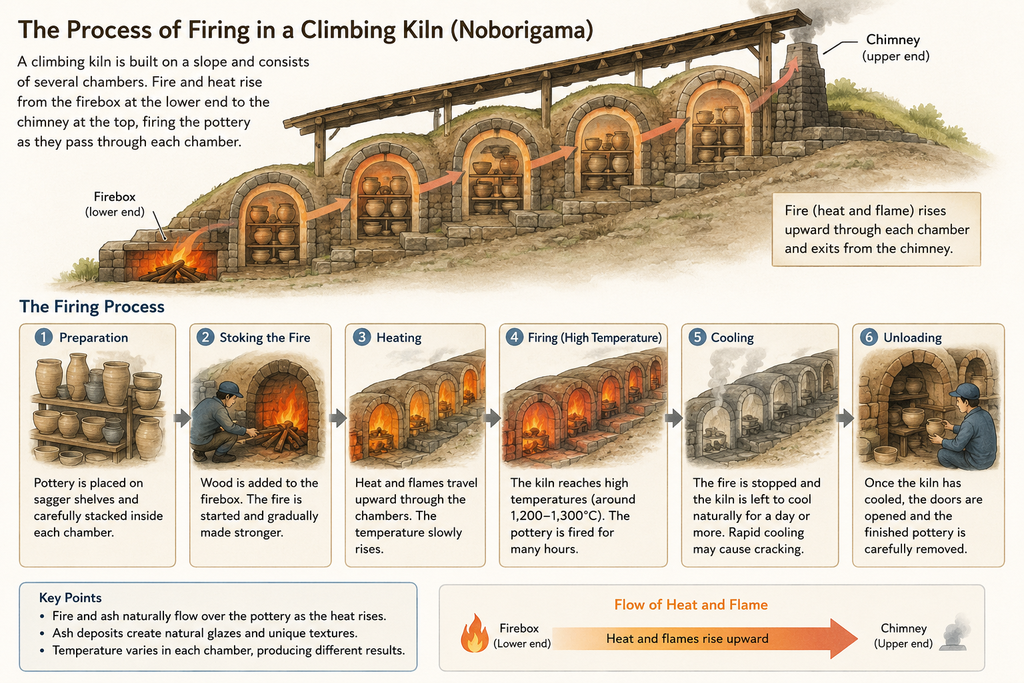
Nobu: “Not entirely, but things such as the colors and surface effects are influenced considerably by chance. When you burn firewood, ash and smoke are produced.”
John: “Of course. Burning wood produces smoke and ash.”
Nobu: “So what do you think happens when that smoke and ash interact with the tea bowl?”
John: “Are you talking about a chemical reaction? Hmm… I would have thought most of the smoke just escapes through the chimney.”
Nobu: “Some of it does. But some of the ash and other materials can react with the glaze and create distinctive colors and surface effects.
Also, depending on the oxygen concentration inside the kiln, oxidation can occur in some areas while reduction occurs in others. The temperature isn’t necessarily the same throughout the kiln, either. It can vary depending on where the bowl is placed.”
John: “So you’re saying that the smoke and ash can react with the glaze in different ways, while the conditions inside the kiln also vary. That means the final result can be different depending on where the bowl was placed?”
Nobu: “Exactly. And that’s what makes it so fascinating.”
John: “I see. That really is interesting.”
The Phrase “Ichi-Raku, Ni-Hagi, San-Karatsu”
Kelly: “Okay, let’s put the complicated stuff aside for a moment. Can you tell us something more practical?”
Nobu: “Oh, sorry about that.”
Kelly: “So here’s my question. What kinds of tea bowls are traditionally favored in the tea ceremony?”
Nobu: “Preferences differ from person to person, but there is a traditional phrase in the world of tea: Ichi-Raku, Ni-Hagi, San-Karatsu.
It refers to three types of tea bowls that have long been highly valued by tea ceremony enthusiasts. I think it’s a good way to introduce some of the appeal of Japanese tea bowls.”
Kelly: “Then let’s go through them in that order.”
Raku-yaki
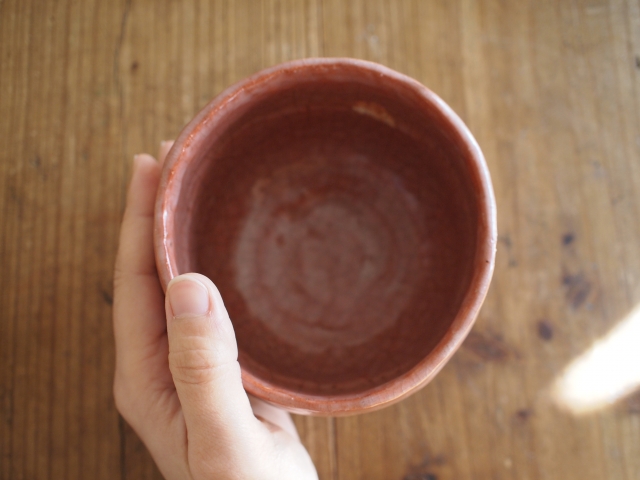
Nobu: “First is Raku, as in Ichi-Raku, or Raku ware. It originated in Kyoto and is traditionally said to have begun under the guidance of Sen no Rikyū, the famous tea master.
One of its distinctive features is that the bowls are shaped by hand rather than on a potter’s wheel. As a result, the forms are not perfectly symmetrical or sharply defined. They often have a rough, substantial appearance.”
Kelly: “This bowl is actually unevenly shaped.”
Nobu: “Exactly. That irregularity, along with the variations in color, is part of its appeal.”
Kelly: “Oh, I see.”
Nobu: “By the way, there is a surprisingly common misunderstanding about the name. Some people think ‘Raku-yaki’ means pottery that is ‘easy’ to fire because raku can mean ‘easy’ or ‘comfortable’ in Japanese.
But that’s not the origin of the name. It is associated with the Raku family, which has traditionally produced this type of pottery.”
Hagi-yaki
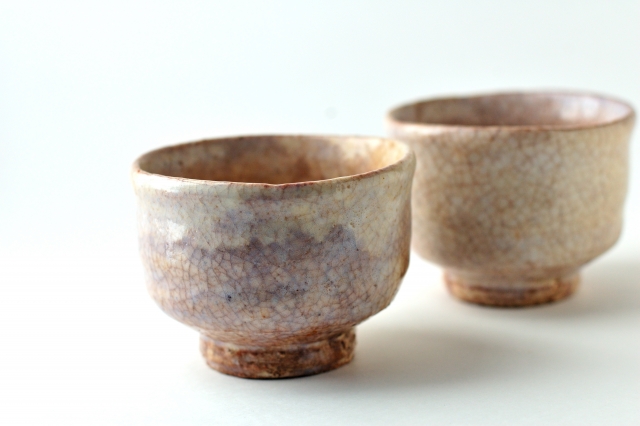
Nobu: “Next is Hagi ware. It is made in and around Hagi, a city in Yamaguchi Prefecture.
Hagi-yaki is known for its distinctive glaze. The glaze is the glass-like surface layer on pottery, and Hagi ware often has a network of very fine cracks in this glaze.
As the bowl is used for many years, tea can gradually penetrate these tiny cracks, creating a distinctive appearance and character.”
Kelly: “When you say ‘distinctive appearance,’ you don’t mean something flashy and beautiful, do you?”
Nobu: “Not really. It could be described as another example of that understated, subdued beauty.”
Karatsu-yaki
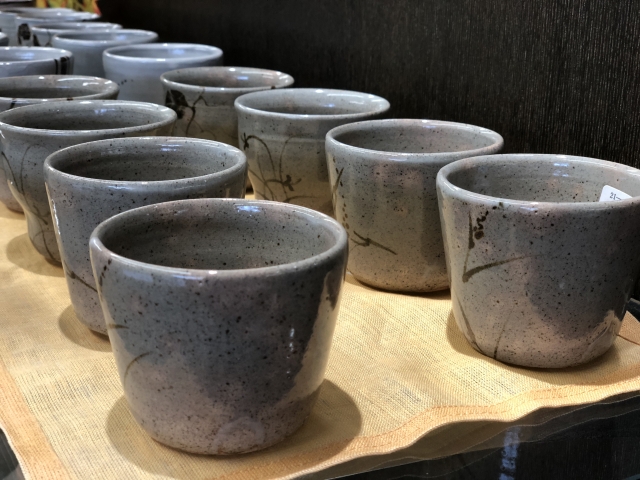
Nobu: “Karatsu-yaki is pottery traditionally made around Karatsu, a city in Saga Prefecture.
One of its characteristics is that it is fired at high temperatures. It has a simple, rustic appearance and a distinctive understated beauty.”
John: “I see. There’s that understated quality again. Maybe that’s one of the characteristics of traditional Japanese crafts.”
Nobu: “Karatsu-yaki is also said to have been influenced by pottery from the Asian mainland.”
John: “The mainland?”
Nobu: “China and Korea. They’re geographically close to Japan.”
John: “I see.”
The Kiln
Nobu: “When you look at Japanese pottery, I really recommend seeing where it is made. Some places even offer visitors the opportunity to try making pottery on a potter’s wheel, so if you get the chance, you should give it a try.”
John: “That sounds interesting.”
Nobu: “But I’d also like you to see the kilns. In particular, noborigama, or climbing kilns, which are built along a slope, are spectacular.
The structure of these kilns was designed with the movement of smoke and ash in mind. You may be able to see the ingenuity and technical skills of craftsmen from centuries ago in their design.”
A Journey to the Pottery Towns
John: “Thanks, Nobu. That was really fascinating. I didn’t know about this culture or this sense of beauty. I completely lost track of time listening to you.”
Nobu: “I’m glad you enjoyed it. Oh, by the way…”
John: “By the way?”
Nobu: “These three places are surprisingly accessible as part of one trip. If you allow yourself enough time, you might be able to visit all three.”
John: “How?”
Nobu: “First, travel from Tokyo to Kyoto. You can take the Shinkansen. After seeing Raku ware in Kyoto, you could travel to Hagi. You can see Hagi ware there and stay overnight. Finally, you could head south to Kyushu and visit Karatsu.”
John: “I see. Would a week be enough?”
Nobu: “I think that would probably be enough. But…”
John: “But…?”
Nobu: “Well, there are also Arita and Imari near Karatsu, both of which are famous for their pottery. And between Kyoto and Yamaguchi is Okayama Prefecture, which is famous for Bizen ware. If you go as far as Nagasaki, you can also enjoy traditional glass crafts…”
John: “Whoa, at this rate, I’d never have enough vacation time!”
The End
What I Think About the Culture of Japanese Tea Bowls
I am neither an expert in art nor a professor of history. But I have been Japanese for more than 50 years, so I think I can at least offer my own perspective on Japanese pottery.
Here are some of my thoughts about it.
Different Aesthetic Values
Pottery is used all over the world, but I believe Japanese pottery has a distinctive cultural character.
The reason is that the atmosphere and feeling it tries to express seem different from those found in pottery from other parts of the world. I think this may also apply to other forms of traditional Japanese culture.
Take Japanese gardens, for example.
Modern Japanese architecture has certainly adopted many aspects of Western lifestyles and design. But when you look at a traditional Japanese garden, the atmosphere it seeks to create seems quite different.
In many Western styles, there is a strong emphasis on beauty, visual interest, or impressive design. In Japan, I feel that traditional aesthetics often place greater value on things such as tranquility, simplicity, and a sense of inner calm.
I think the same can be seen in pottery.
The appeal of a perfectly ordered, sharp, and symmetrical form is very different from the rustic beauty of a piece that retains the natural character of the clay.
Tea bowls are a perfect example.
A simple, handmade bowl, deliberately made without using a potter’s wheel, has a character that I believe is uniquely Japanese.
The Beauty of Chance and Appreciating Japanese Culture
As I mentioned earlier in the story, I don’t think it is an exaggeration to call pottery an “art of the kiln.”
Controlling the chemical reactions that take place inside a kiln is difficult even for an experienced craftsman.
What type of wood is best for fuel? When should more firewood be added? How should the temperature of the fire be controlled?
All of these decisions, combined with the individual skills and character of the craftsman, come together to create a single tea bowl.
The kilns used in pottery also have their own history. I imagine that reaching the kilns we have today was the result of a very long journey of technological development and experimentation.
In this way, even a single tea bowl can reveal traces of history stretching back through generations.
And I believe that this is what it means to appreciate Japanese culture.
Conclusion
We’ve taken a look at the tea bowls used in the Japanese tea ceremony.
Perhaps you have discovered the Japanese sense of beauty behind these bowls, as well as the techniques that have been passed down through generations.
You may even be able to feel hundreds of years of history in a single tea bowl.
In any case, the best way to appreciate a tea bowl is to see and hold one for yourself.
When you visit Japan, why not take your time looking at some tea bowls, and then enjoy a delicious bowl of matcha along with some traditional Japanese sweets?
You may discover a whole new side of Japan.