Yakiniku is a very popular Japanese dish. Many people from overseas are probably interested in trying it, too.
However, something that may not be widely known is that yakiniku can taste different depending on the equipment used to cook it.
Two common types of equipment are the traditional Japanese shichirin charcoal grill and the gas roaster. They use different fuels and have different characteristics, which affect how the meat is cooked.
In this article, let’s take a look at the differences between yakiniku cooked on a shichirin and yakiniku cooked on a gas roaster.
Characters
Mike: A 12-year-old American boy who is interested in Japan.
John: Mike’s father. He sometimes travels to Japan on business.
Kelly: Mike’s mother. She is good at cooking.
Nobu: A Japanese exchange student.
Prologue
One day, Kelly found an online article about yakiniku restaurants in Japan.
She had been interested in yakiniku restaurants for some time, so she started reading various articles online.
As she read, she discovered that Japanese yakiniku restaurants used two types of cooking equipment: shichirin charcoal grills and gas roasters.
However, Kelly did not really understand what a Japanese shichirin was.
She could imagine what a roaster might look like from its name, but she was not entirely sure about that, either.
Just then, Nobu appeared.
Yakiniku Restaurants with Shichirin Grills and Gas Roasters
Nobu: “Hello!”
Kelly: “Oh, you’re just in time! I was reading an online article about Japanese yakiniku restaurants, but there were some things I didn’t understand. Could you explain them to me?”
Nobu: “Yakiniku restaurants? What would you like to know?”
Kelly: “It seems that Japanese yakiniku restaurants use either shichirin grills or gas roasters. I have a general idea of what a roaster is, but I don’t understand what shichirin yakiniku means.”
Nobu: “I see. Shichirin yakiniku? That might be a little difficult to explain.
“A shichirin is a traditional Japanese cooking tool that uses charcoal. It is made from a type of earth and has been used in Japan for a very long time. It seems that it became popular around the Edo period.”
John: “Since the Edo period? That’s a pretty old cooking tool.”
Nobu: “That’s right. Originally, shichirin were made of pottery, but the type made from diatomaceous earth, which is common today, became popular after the Meiji period.”
Mike: “What about roasters?”
Nobu: “They are cooking devices that use gas as fuel to grill yakiniku. They have different characteristics from shichirin.”
Mike: “What kind of characteristics?”
Characteristics of Shichirin
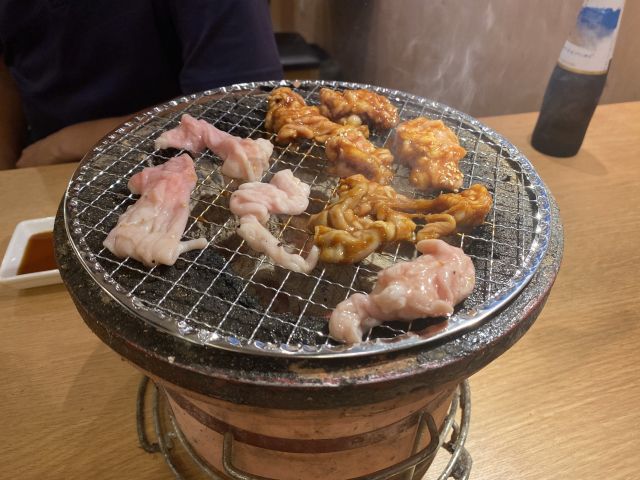
Nobu: “Well, let’s start by looking at the characteristics of shichirin.”
John: “You said they use charcoal, right?”
They Use Charcoal
Nobu: “As I mentioned earlier, shichirin are traditional cooking tools that use charcoal.
“They are made using a material called diatomaceous earth. This material does not burn easily and is relatively lightweight.
“Because shichirin use charcoal, they can grill meat until it is nicely browned while helping to keep its juices inside.
“That’s one reason why they are very popular in Japan.”
John: “If they use charcoal, are there other cooking tools that work the same way?”
Nobu: “There probably are. Depending on the situation, people might even be able to make their own convenient cooking equipment.
“However, shichirin have been used in Japan for a long time. Perhaps people feel a certain nostalgia for them, and that may be one reason why they remain popular.
“I think that is part of the appeal of using a shichirin.”
John: “I see. If it’s a cooking tool unique to Japan, I can understand why people would like it.”
Controlling the Heat Is Difficult
Nobu: “However, shichirin also have some disadvantages.
“One of them is that controlling the heat is not easy.
“For example, when the heat becomes weaker, you have to add more charcoal.
“You cannot do that easily while sitting at the table, so you have to call a staff member.
“On the other hand, if the heat is too strong, it is also difficult to reduce it.
“Sometimes, restaurants provide ice to deal with flames that rise from the grill, but controlling the fire is still not easy.”
Kelly: “So you have to be careful not to overcook the meat.”
Nobu: “That’s right. In some situations, you might find yourself rushing to eat because you think you have to finish before the meat gets overcooked.
“By the way, some Japanese yakiniku restaurants also serve seafood.
“Seafood can become tough if it is overcooked. It might not taste very good, either.”
Kelly: “That would be a problem.”
They Give Meat a Distinctive Smoky Flavor
Nobu: “However, charcoal used in shichirin gives yakiniku a distinctive smoky flavor.
“When the fat from the meat drips onto the charcoal, the smoke produced during cooking seems to add that characteristic flavor.
“Many people like this particular taste.”
Kelly: “That sounds like one of the advantages of charcoal grilling.
“Some people also prefer charcoal when they have a barbecue, and I think this is one of the reasons.”
Smoke Is Removed Through Ducts
Nobu: “Another thing about shichirin is that charcoal produces smoke.
“Restaurants have large ducts installed to remove it.”
John: “That means the ducts must be pretty large.”
Nobu: “That’s right.
“However, ducts have their limits. If too much smoke is produced, they may not be able to remove all of it.
“The restaurant probably won’t become completely filled with smoke, but some people may still find it bothersome.”
Mike: “So smoke can be a problem. Some people might not like it.”
Characteristics of Gas Roasters
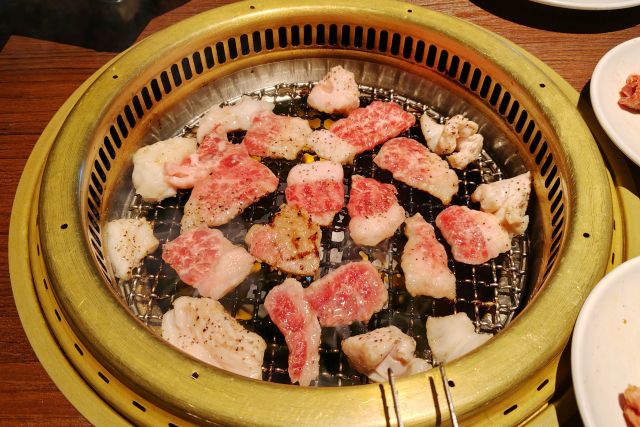
Nobu: “Next, let’s talk about gas roasters.”
Kelly: “Those are the cooking devices that use gas, right?”
They Use Gas
Nobu: “That’s right. Gas roasters grill meat by burning gas.
“Because of this, the way they cook meat is different from shichirin.
“For example, gas roasters generally do not give meat the same distinctive smoky flavor that you get from a shichirin.
“Some people consider this a disadvantage.”
Kelly: “Does that mean gas roasters are less popular?”
Nobu: “It depends on personal preference.
“However, there is a general tendency for people to think that charcoal-grilled food tastes good.”
The Heat Can Be Adjusted
Nobu: “Another advantage of gas is that you can adjust the heat.
“Depending on the restaurant, it is often possible to change the heat to around three different levels.
“For example, after you have finished eating for a while, you can turn the heat down.
“Some people consider this a useful feature.”
Mike: “Being able to adjust the heat is important, isn’t it?”
Nobu: “Some people might change the heat depending on what they are grilling.
“It may also be easier to adjust the cooking temperature to suit your personal preferences.”
Mike: “I see.”
Some Roasters Produce Almost No Smoke
Nobu: “Nowadays, there are also roasters that produce very little smoke.”
John: “How do they prevent smoke from being produced?”
Nobu: “Some types are designed to prevent fat dripping from the meat from coming into contact with the flame.
“Others absorb smoke and oil to reduce the amount of smoke produced.
“Shichirin restaurants use ducts to remove smoke, but gas roasters often have an advantage when it comes to smoke control.”
Some Types Help Prevent the Smell from Sticking to Clothes
Nobu: “When people think of yakiniku restaurants, some of them dislike the smoke because it can leave a smell on their clothes.
“Roasters that produce little smoke can help prevent this problem.”
John: “The smell of yakiniku on your clothes? That could be a problem.”
Nobu: “That’s right.
“For example, some people say that you should avoid taking a woman to a yakiniku restaurant on a first date.
“This is because she might not want the smell of yakiniku to get on her clothes.
“It is a matter of consideration for the other person.”
John: “I see. That makes sense when you are taking a woman out.”
Which Should You Choose?
Kelly: “So, which one should I choose?”
Nobu: “I’m sorry, but it is difficult to say which one is better.
“That’s because it depends on personal preference.
“Some people prefer shichirin, while others prefer gas roasters. So it is difficult to choose one over the other.
“There are also many other factors that influence people’s choice of yakiniku restaurant.
“For example, some people prefer restaurants that serve high-quality meat.
“Others care more about the price.
“Some people might choose a restaurant where they can enjoy themselves and make a lot of noise.
“Because of all these factors, it is very difficult to decide which restaurant is best.”
John: “Well, I suppose that makes sense.”
The End
From My Personal Experience
I often go to yakiniku restaurants by myself.
When I do, I usually choose restaurants that use shichirin.
The reason is that I enjoy the relaxed atmosphere.
Gas roasters are fine, too, but somehow I feel as though I am being rushed when I use them.
It is difficult to enjoy the meal at my own pace.
Needless to say, I only go out to enjoy yakiniku by myself when I have a day off from work.
I don’t want to feel rushed when I am away from work, either.
Conclusion
We have compared yakiniku cooked on shichirin charcoal grills with yakiniku cooked on gas roasters.
Regardless of which one you prefer, I hope you now have a better understanding of the advantages and disadvantages of each type.
You may also have realized that it is difficult to decide which one is better.
In the end, I think the best way to find out is to visit a restaurant and try it for yourself.
In any case, whether you choose shichirin or a gas roaster, both are good ways to experience Japanese yakiniku culture.
If you have the opportunity, why not visit a yakiniku restaurant in Japan and give it a try?

