Japanese yakiniku restaurants are well known overseas. Many people may have searched online to find out what kinds of dishes they serve.
However, some people may be surprised to learn that Japanese yakiniku restaurants do not serve only meat. They also offer other ingredients.
Among them, seafood may be particularly surprising. Some people might even think, “Well, Japan is surrounded by the sea, after all!”
In this article, let’s take a look at the main types of seafood served at Japanese yakiniku restaurants.
Characters
Mike: A 12-year-old American boy who is interested in Japan.
John: Mike’s father. He sometimes travels to Japan on business.
Kelly: Mike’s mother. She is good at cooking.
Nobu: A Japanese exchange student.
Prologue
Kelly is interested in Japanese yakiniku culture.
Recently, she has been learning about the different cuts of meat served at yakiniku restaurants. She was excited to discover that some restaurants even offer cuts that she had never expected.
One day, however, she heard something that surprised her even more.
Apparently, Japanese yakiniku restaurants sometimes serve seafood, too.
She couldn’t help thinking, “Aren’t yakiniku restaurants supposed to be places where people eat meat?”
Just as she was wondering about this, Nobu appeared.
Nobu: “Hello!”
Kelly: “Oh, you’re just the person I wanted to see! I was hoping to learn more about Japanese yakiniku restaurants.”
Nobu: “Yakiniku restaurants? I love them, too! What would you like to know?”
Kelly: “It seems that Japanese yakiniku restaurants serve seafood as well as meat. Don’t people usually just grill meat there?”
Nobu: “That’s right. Some restaurants do serve seafood, too. Let me explain.”
Japanese Yakiniku Restaurants Sometimes Serve Seafood
Nobu: “You’re right. Not every restaurant serves seafood, but many Japanese yakiniku restaurants offer it.
“The selection is usually limited, but you can enjoy seafood together with your meat.”
John: “Seafood alongside yakiniku? That sounds pretty good.”
Nobu: “It certainly can be.
“For example, even people who aren’t particularly fond of meat can enjoy seafood at these restaurants.
“Yakiniku restaurants are also places where people get together and socialize. However, not everyone in a group necessarily likes meat.”
Kelly: “Also, some people might be concerned about calories when eating meat.”
Nobu: “That’s true. Some people may choose seafood not simply because of their preferences, but also because they are thinking about their health.
“Seafood and meat have different calorie contents, after all.”
John: “I see. So it’s a matter of personal preference and calories.”
Main Types of Seafood Served at Yakiniku Restaurants
Mike: “So, what kinds of seafood do they serve?”
Nobu: “There are some common types.
“However, yakiniku restaurants are different from sushi restaurants, so you won’t find sashimi on the menu.”
Kelly: “That makes sense. It would be a problem if they served sashimi and then expected us to grill it!”
Nobu: “Anyway, let me introduce some of the seafood you can find at yakiniku restaurants.”
Squid
Nobu: “The first item is squid.
“However, squid comes in various sizes, and the size served depends on the restaurant. Some restaurants offer large pieces of squid, while others serve smaller ones.
“Also, squid served at yakiniku restaurants is often partially cooked beforehand.”
Mike: “Partially cooked?”
Nobu: “That’s right.
“Although many people associate seafood with raw food, some seafood is intended to be cooked before eating.
“If you go to a Japanese supermarket, you’ll often see packages labeled nama-shokuyō (for raw consumption) or sashimi-yō (for sashimi). These labels indicate that the products are suitable for eating raw.”
John: “I suppose that’s also a way of helping customers eat safely.”
Shrimp
Nobu: “Shrimp is another common item. Along with squid, it is one of the standard seafood choices at yakiniku restaurants.”
Mike: “Shrimp? But they come in all sizes, from small ones to really large ones, don’t they?”
Nobu: “That’s true.
“However, yakiniku restaurants are not seafood specialists, so you shouldn’t expect them to serve particularly large or impressive shrimp.
“I can’t speak for high-end yakiniku restaurants, but ordinary restaurants generally serve medium-sized shrimp.”
Kelly: “It sounds like the size can vary quite a bit.”
Nobu: “However, restaurants sometimes serve whole shrimp with their heads still attached.
“Grilling a whole shrimp and then removing its head before eating it can be quite enjoyable.”
Octopus
Nobu: “Some restaurants also serve octopus.”
Mike: “Do you mean takoyaki?”
Nobu: “No, it’s completely different from takoyaki.
“Takoyaki is a Japanese dish made by putting pieces of octopus into a wheat-flour batter and cooking it into small round balls.
“Of course, there are some regional dishes where large octopus legs are grilled and called takoyaki, but that’s different from what you find at yakiniku restaurants.”
Mike: “Then what kind of octopus do they serve?”
Nobu: “One type you may often come across is iidako, a small octopus.
“It tastes delicious when grilled over charcoal.”
John: “I see. Charcoal-grilled octopus! That sounds delicious.”
Scallops
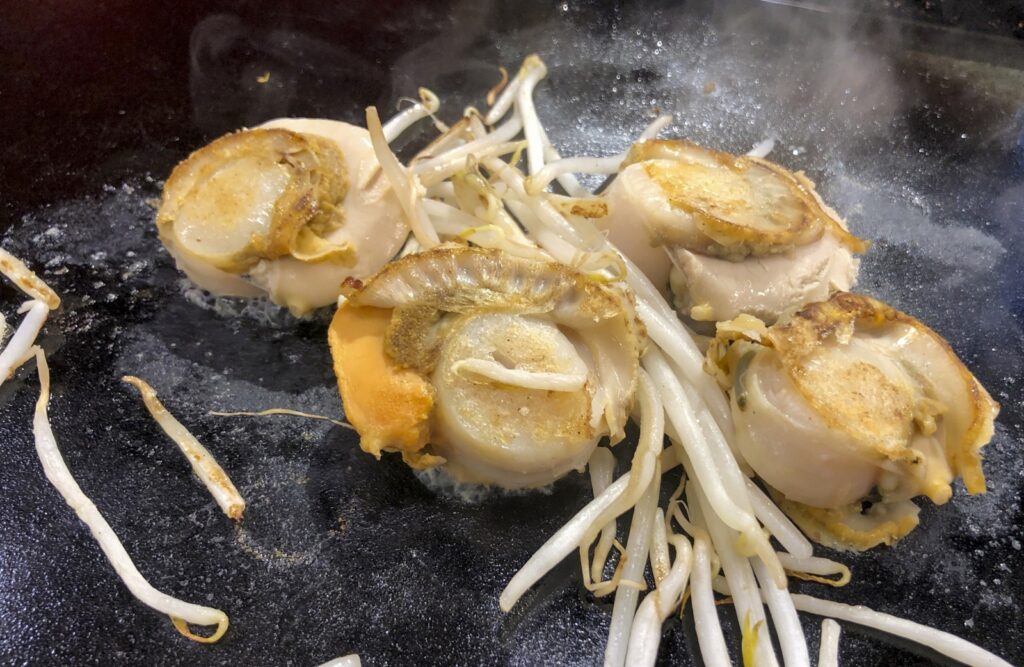
Nobu: “Another item you may find is scallops.”
Kelly: “They serve scallops, too?”
Nobu: “Scallops are very popular seafood in Japan.
“However, the scallops served at yakiniku restaurants tend to be relatively small.”
Kelly: “Don’t they serve large ones?”
Nobu: “Well, these are yakiniku restaurants, after all. I think scallops are more of a supporting dish on their menus.”
Kelly: “I see.”
Nobu: “By the way, I don’t think scallops are usually served in their shells at yakiniku restaurants. They are more commonly served as shelled scallop meat.”
Yakiniku Restaurants Are Different from Hamayaki Restaurants
Nobu: “There is one thing I’d like you to understand so that you don’t get the wrong idea.
“Yakiniku restaurants are different from hamayaki restaurants.”
John: “What exactly is a hamayaki restaurant?”
Nobu: “Hamayaki refers to restaurants where seafood, especially shellfish, is grilled and served.
“Unlike yakiniku restaurants, these places specialize in seafood rather than meat.
“They generally offer a wider variety of seafood, and the scallops are often much larger.
“Some restaurants also serve oysters.”
Kelly: “I see. They really are seafood specialists!”
Nobu: “Exactly.
“So, if you want to enjoy seafood, I would recommend going to a seafood restaurant that specializes in hamayaki rather than a yakiniku restaurant.”
Mike: “But they’re both places where you can eat seafood, aren’t they?”
Nobu: “Not quite. The freshness of the seafood and other factors can make a difference in the taste.
“In particular, some port towns have restaurants specializing in hamayaki. These restaurants often serve excellent seafood.
“If seafood is what you really want to enjoy, those places would probably be a better choice.”
John: “I see. That makes sense.”
The End
From My Personal Experience
I often go to yakiniku restaurants.
I usually choose restaurants that use traditional shichirin charcoal grills. Even these restaurants serve seafood, and I sometimes order it.
My impression is that the seafood is certainly good enough to enjoy as part of a yakiniku meal. However, it is not quite enough if you really want to enjoy seafood to the fullest.
The reason is simple: the quality and experience are different from what you get at a hamayaki restaurant.
At a hamayaki restaurant, you can grill fresh seafood right at your table.
For example, you can grill fresh scallops yourself. This allows you to enjoy their natural, juicy flavor without losing too much of their moisture during cooking.
Some restaurants also serve oysters in their shells, which is another great way to enjoy them.
When it comes to seafood, I think hamayaki restaurants definitely have the advantage.
For this reason, if you really want to enjoy seafood, I recommend visiting a restaurant that specializes in seafood, such as a hamayaki restaurant.
You can think of the seafood served at yakiniku restaurants as more of a supporting attraction rather than the main event.
However, there is another point to consider: the prices of seafood at hamayaki restaurants and yakiniku restaurants can be quite different.
Many restaurants publish their menus on their websites, so it is a good idea to check them before visiting.
Conclusion
You probably already have an idea of what a yakiniku restaurant is: a place where you grill and enjoy meat.
However, some people may be surprised to learn that you can also enjoy seafood there.
If you are planning to visit Japan, perhaps knowing this will give you even more reasons to look forward to eating at a yakiniku restaurant.
In any case, Japanese yakiniku restaurants offer more than just meat.
Ordering both meat and seafood together is also a great way to enjoy your meal.
We hope you have a wonderful experience at a Japanese yakiniku restaurant!
Related Article
In this article, we discussed how yakiniku restaurants sometimes serve seafood alongside meat. However, there are restaurants that specialize in seafood. These are known as hamayaki restaurants.
By the way, soy sauce is considered the best seasoning for hamayaki. But why does it go so well with grilled seafood? In the next article, we will explore the reasons why soy sauce is such a perfect match for hamayaki.
Read the article