Japan is surrounded by the sea, and seafood has long been an important part of the Japanese diet. In particular, shellfish have been enjoyed by people in Japan since ancient times.
Have you ever heard of a Japanese dish called hama-yaki?
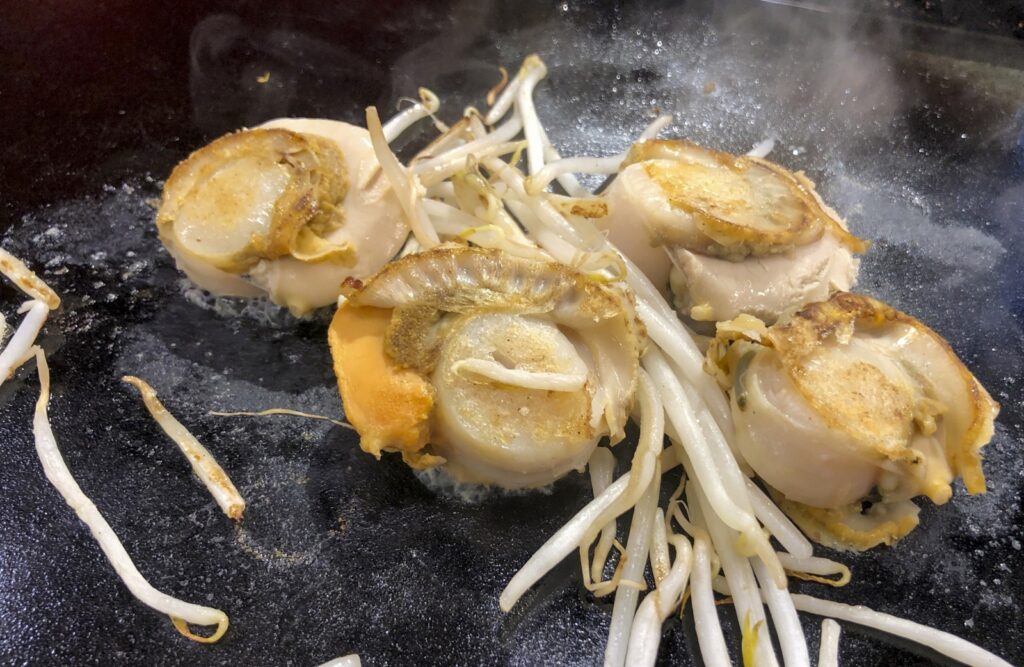
It may not be very familiar to people outside Japan, but it is a style of Japanese seafood cooking that allows you to enjoy a variety of shellfish. The preparation is quite simple: shellfish and other seafood are grilled over a fire and served.
But here is a question: What is the best way to season hama-yaki?
In this article, I would like to introduce my personal recommendation. It may be a matter of individual taste, but I hope you will read on and give it a try.
Characters
Mike: A 12-year-old American boy who is interested in Japan.
John: Mike’s father. He sometimes travels to Japan on business.
Kelly: Mike’s mother. She is good at cooking.
Nobu: A Japanese exchange student.
Prologue
Kelly is doing some research on Japanese cuisine again today. She is browsing various online articles about seafood dishes.
Meanwhile, Mike is studying Japanese history. Today, he is looking into the period before civilization developed in Japan.
During his research, Mike comes across something interesting called a kaizuka, or shell midden. These were places where people in prehistoric Japan discarded shells after eating shellfish. Today, archaeologists can learn about the eating habits of ancient Japanese people by studying these sites.
Mike is fascinated by what he reads.
At the same time, Kelly discovers an interesting article about a Japanese dish called hama-yaki. It is a simple dish in which shellfish and other seafood are grilled and served. Perhaps it is precisely because of its simplicity that she finds it so interesting.
Mike tells Kelly about the shell middens, and Kelly introduces him to hama-yaki.
The two of them begin imagining how delicious this seafood dish must be.
Just then, Nobu appears.
Nobu: Hello!
Mike: Hi! There is something I would like to ask you. It seems that people in ancient Japan ate a lot of shellfish. There are even archaeological sites called shell middens that remain today. I guess people in Japan have enjoyed delicious seafood for a very long time!
Kelly: That’s right. I also came across a dish called hama-yaki. It seems to be prepared simply by grilling seafood, but I imagine there is a special kind of deliciousness that comes from keeping things simple.
Mike: Exactly. I’d like to learn more about hama-yaki.
Nobu: Sure. Let me explain.
What Is Hama-yaki?
Nobu: First, let’s review what hama-yaki is. Basically, it is a dish in which shellfish and other seafood are grilled and served. The cooking method is very simple because you mainly just grill the ingredients.
However, seafood, especially shellfish, can deteriorate relatively quickly. Proper handling and temperature control are important. Even seafood that looks fresh can contain bacteria or viruses that cause food poisoning. That’s why it is important to eat seafood that has been properly handled and prepared.
John: Food poisoning? Is it really that risky?
Nobu: It can be. Shellfish, in particular, require careful handling. When eating seafood, you should make sure it has been stored and prepared appropriately. Cooking it thoroughly is also an important way to reduce the risk of food poisoning.
Of course, seafood sold in supermarkets is handled in different ways depending on the product. Some products are sold fresh under refrigeration, while others are frozen or already cooked. It is important to follow the instructions on the packaging.
Kelly: That explains why hama-yaki is often associated with places where fresh seafood is readily available. But where exactly are those places?
Nobu: They are usually towns along the coast where fishing is an important industry. However, you can also enjoy hama-yaki in large cities such as Tokyo. Fresh seafood from different regions is transported to major cities quite quickly.
John: In that case, maybe I should try it when I visit Tokyo.
Nobu: But Tokyo isn’t necessarily my first recommendation. I think coastal towns are a better choice. Sometimes you can enjoy seafood that was caught that very morning. And eating while looking out at the sea is a wonderful experience, too.
That’s why I recommend trying hama-yaki in a port town.
There are also some relatively nearby coastal areas where you can enjoy it without traveling too far from Tokyo. The Shonan area in Kanagawa Prefecture, south of Tokyo, is one convenient option.
What Is the Best Seasoning?
Kelly: Now I understand what hama-yaki is. But how do you season it? Do you squeeze some lemon over the seafood?
Nobu: Actually, I think soy sauce is the best seasoning for hama-yaki.
Mike: Do you use soy sauce even when grilling shellfish?
Nobu: Yes. Take scallops, for example. As they cook, their shells may gradually open. When that happens, you can pour a little soy sauce directly into the shell.
The soy sauce sizzles as it hits the hot surface, and some of it begins to caramelize. The aroma is wonderful!
John: Wait a minute. Don’t you dip the shellfish in soy sauce, just like you do with sashimi?
Nobu: You can certainly dip it in soy sauce if you like. However, you won’t get to enjoy that wonderful aroma of soy sauce being heated and slightly caramelized.
This is just my personal opinion, but I recommend pouring the soy sauce directly into the shell.
Kelly: How much soy sauce should you use?
Nobu: That depends on your taste, but I recommend adding it little by little until the aroma starts to rise.
If you use too much, the seafood will become overly salty. That would be a shame because it could spoil the natural flavor of the seafood.
Kelly: I see. So the trick is to use just the right amount. It sounds simple, although getting the amount right might take a little practice!
Bivalves and Sea Snails
Nobu: Depending on the region, hama-yaki may also include sea snails such as sazae (Japanese turban shells). When it comes to these spiral-shaped shellfish, getting the amount of soy sauce right can be a little tricky.
Kelly: Why is it more difficult to use soy sauce with sea snails?
Nobu: One reason is that bivalves and sea snails behave differently when they are grilled.
With bivalves such as scallops, you can sometimes slightly tilt the shell to let excess soy sauce flow out.
However, I wouldn’t recommend doing that because you might lose some of the delicious juices from the shellfish as well. It’s better to get the amount right from the beginning.
Kelly: Then what happens with sea snails?
Nobu: With sea snails, the soy sauce collects inside the shell. Once it gets in there, it won’t come out unless you turn the shell upside down.
That makes it easy to misjudge how much soy sauce you have added. Naturally, if you pour in too much, the result will be too salty.
That would be a little disappointing, wouldn’t it?
Kelly: I see. That makes sense!
It Can Be Fun to Experiment with Different Soy Sauces
Nobu: Another interesting idea is to pay attention to the type of soy sauce you use.
John: Hold on. What do you mean by paying attention to soy sauce? Isn’t soy sauce just soy sauce?
Nobu: Well, it is all soy sauce, of course. But the taste and aroma can actually differ quite a bit depending on the brewery that produces it.
Some soy sauces have a noticeable sweetness, while others have a stronger aroma.
Not many households go out of their way to distinguish between different soy sauces, but I think trying a different variety can be a nice little luxury.
John: I see. It might be interesting to discover how the aroma of freshly grilled seafood matches the aroma of different soy sauces.
Nobu: Exactly. Hama-yaki is a simple dish, but there is more depth to it than you might expect.
The End
From My Personal Experience
This happened about 30 years ago, but the town where I lived was close to the sea and often attracted tourists.
Seafood was popular among visitors, so I remember seeing it served quite frequently.
However, it was not always served in the traditional hama-yaki style. Instead, it was more like food from a street stall.
Under a small tent, shellfish were grilled on portable gas burners. The vendors would add a little soy sauce and serve them to customers.
It was incredibly simple.
Nevertheless, I remember how surprised people from mountainous inland areas were when they saw this kind of food. Some of them were only familiar with frozen seafood sold in supermarkets.
For those people, eating freshly grilled shellfish like this must have been quite an impressive experience.
Perhaps people from overseas, especially those who come from inland regions without easy access to the sea, might find it just as impressive.
Conclusion
In this article, we have explored hama-yaki, a simple but delicious way of enjoying Japanese seafood.
I hope some of you have become interested in this aspect of Japanese food culture. We have also looked at how to season hama-yaki, and perhaps you have rediscovered the appeal of Japanese soy sauce along the way.
In any case, hama-yaki offers a different side of Japanese seafood culture from sushi and sashimi.
When you visit Japan, why not take a trip to a coastal town and enjoy some freshly grilled seafood?
It could become a memorable part of your trip!
Related Article
In this article, we introduced soy sauce as a seasoning for hamayaki (Japanese grilled seafood). However, there are several types of soy sauce in Japan.
First, we will look at the differences between soy sauce in eastern and western Japan. Then, we will compare regular soy sauce with reduced-sodium soy sauce.
● Differences Between Soy Sauce in Eastern and Western Japan
Read the article →
● Differences Between Regular and Reduced-Sodium Soy Sauce
Read the article →