Rice is a staple food in Japan, and Japanese people have developed many different ways to enjoy it. These methods vary depending on the occasion and purpose. A good example is okayu, a type of rice porridge that is easy on the stomach and is often served to people who are ill.
Because rice is used in so many ways, you may have noticed that some Japanese dishes look quite similar.
Perhaps you have wondered whether onigiri and norimaki are actually the same kind of food. Both are made with rice and often contain fillings wrapped in seaweed. However, there are several important differences.
In this article, we will explain how onigiri and norimaki differ.
Characters
Mike: A 12-year-old American boy who is interested in Japan.
John: Mike’s father. He sometimes travels to Japan on business.
Kelly: Mike’s mother. She is good at cooking.
Nobu: A Japanese exchange student.
Prologue
Kelly is a good cook and has recently become interested in Japanese bento culture. One thing that caught her attention was the variety of ways Japanese people prepare rice.
She was particularly surprised by the different dishes made by wrapping rice in seaweed. After taking a closer look, she noticed that there seemed to be two different types: onigiri and norimaki.
Both dishes contain rice and often have fillings inside, with seaweed wrapped around them. Their shapes are different, but she could not quite understand what else distinguished them.
Just then, Nobu arrived.
Nobu: Hello!
Kelly: Oh, hello! You’re just the person I wanted to see. I was hoping you could tell me something about Japanese rice dishes.
Nobu: What would you like to know?
Kelly: What’s the difference between onigiri and norimaki? They look almost the same to me. Both have fillings inside rice and are wrapped in seaweed.
Nobu: Ah, onigiri and sushi rolls. Yes, they are actually quite different.
Kelly: Then please explain!
Onigiri and Norimaki: Similar in Appearance, Different in Nature
Nobu: Let’s start by looking at onigiri. After that, I’ll explain norimaki.
Kelly: Sounds good!
What Is Onigiri?
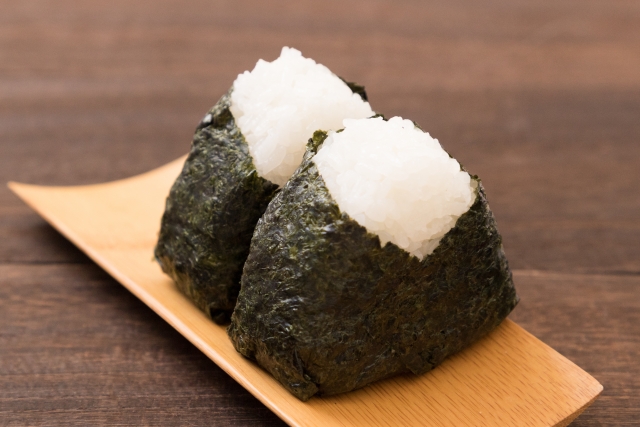
Nobu: First, onigiri is a type of Japanese rice snack or light meal. It is usually made by shaping cooked rice by hand. A filling is often placed in the center, and the rice is sometimes wrapped in seaweed.
Mike: So it’s considered a snack or a light meal? Is that why people often take it in their lunchboxes?
Nobu: Exactly. Onigiri comes in several shapes, including triangles, round shapes, and oval or barrel-like forms. The seaweed can cover the entire rice ball or just part of it.
Mike: So you simply hold it in your hand and take a bite. It looks like a pretty straightforward way to eat rice!
Nobu: That’s right.
Kelly: Are there any other varieties?
Nobu: Of course. Onigiri can also be made with seasoned rice, such as rice cooked with other ingredients. Some people use brown rice or rice mixed with barley and other grains instead of ordinary white rice.
Kelly: What about the fillings?
Nobu: There are countless possibilities. Just look at the selection at a Japanese convenience store. Popular fillings include pickled plums, salmon, and tsukudani, which is food simmered in soy sauce and other seasonings. You can also find varieties containing tuna or grilled meat. In principle, you can use almost anything you like.
Mike: So the size can vary, too?
Nobu: Yes. Even bento shops sell onigiri in different sizes.
What Is Norimaki?
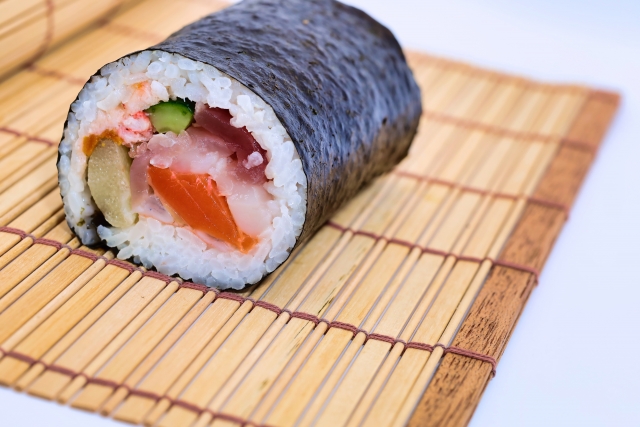
Nobu: Next, let’s talk about norimaki. Unlike onigiri, norimaki is classified as a type of sushi. You can usually find it on the menu at sushi restaurants.
John: That’s true. Sushi restaurants serve norimaki, but they don’t usually serve onigiri. That makes it clear that norimaki belongs to the sushi category.
Nobu: Exactly. There is another important difference that people sometimes misunderstand. Sushi generally uses sumeshi, or vinegared rice, which is seasoned with vinegar, sugar, and other ingredients. Ordinary onigiri, on the other hand, is made with regular cooked rice rather than vinegared rice.
John: I see. So even the rice itself is different.
Nobu: That’s right. The shape and the way the seaweed is used are also different. Norimaki is generally rolled into a cylindrical shape, with seaweed wrapped around the rice and filling. It is then cut into smaller pieces.
In many traditional norimaki rolls, the seaweed becomes soft as it absorbs moisture from the rice. However, some modern products are designed to keep the seaweed crispy until just before eating.
John: There are quite a few differences, then.
Nobu: Another difference is how they are usually eaten. Norimaki is generally cut into bite-sized pieces with a knife. The cross-sections can be quite colorful, depending on the ingredients, making them attractive to look at.
Which One Should You Choose?
Nobu: Now, which one should you choose? I think it depends on where and when you plan to eat it. If your only concern is satisfying your appetite, either one is fine. However, there are some traditional differences in how they are used.
Kelly: I see. So it depends on the occasion.
Nobu: For example, onigiri is often chosen for lunchboxes. Since you can hold it in your hand and take a big bite, it is convenient when you want to eat quickly.
John: So its biggest advantage is that you can simply pick it up and eat it.
Nobu: Exactly. Norimaki, on the other hand, is usually cut into smaller pieces, so it is also suitable for picnics and other outings. It may also be served on special occasions and celebrations. After all, it is a type of sushi, and the individual pieces are easy to share.
Mike: But people sometimes take norimaki in their lunchboxes, too, don’t they?
Nobu: Of course. You can easily buy norimaki at supermarkets and convenience stores. However, making it at home can take more time than making onigiri.
You need to prepare vinegared rice rather than ordinary cooked rice, and you generally need a bamboo rolling mat called a makisu to shape the rolls.
That can be a little inconvenient when you’re busy in the morning. Onigiri, by comparison, can be made simply by shaping rice with your hands.
Kelly: I see. So convenience is another advantage of onigiri.
Nobu: Yes. There is also a modern variation worth mentioning. Some norimaki products sold at convenience stores are designed to be wrapped in seaweed just before eating, much like convenience-store onigiri. This keeps the seaweed crispy, unlike the softer seaweed found in many traditionally prepared sushi rolls.
Kelly: That’s interesting. So even within the same category, there are different ways to enjoy them.
The End
A Personal Perspective: How Convenience Stores Changed Onigiri Culture
Onigiri and norimaki have changed considerably over the years. In my opinion, the spread of convenience stores played an important role in this transformation.
Before convenience stores became widespread, onigiri was generally something people made at home. It was not necessarily something they expected to buy whenever they wanted.
However, convenience stores changed that perception. Onigiri became a readily available product that people could purchase almost anywhere.
There was also a change in how seaweed was used.
Traditionally, seaweed was wrapped directly around the rice when making onigiri. As a result, the seaweed absorbed moisture and became soft.
However, convenience-store onigiri introduced a different approach. In 1978, Seven-Eleven Japan introduced a special packaging method that kept the seaweed separate from the rice until the package was opened. This allowed people to enjoy crispy seaweed by wrapping it around the rice just before eating.
This packaging innovation helped make crispy-seaweed onigiri familiar to people throughout Japan.
I also feel that the variety of sushi products available at convenience stores has expanded over time.
In the early days of convenience stores, I do not remember seeing the same variety of norimaki products that we see today. One possible reason is that some types of sushi, such as tuna rolls, contain raw fish and require careful temperature control.
However, this is my personal recollection rather than a confirmed explanation of when convenience stores first began selling norimaki.
In any case, the arrival of convenience-store onigiri changed Japanese food culture. The subsequent development of a wider selection of ready-to-eat rice and sushi products also changed how people enjoy these foods in everyday life.
Conclusion
We have looked at the differences between onigiri and norimaki.
At first glance, they may appear to be similar dishes. Both use rice, often contain fillings, and can be wrapped in seaweed. However, they are actually quite different in terms of their ingredients, preparation, shape, and place in Japanese food culture.
One particularly interesting difference is that norimaki is a type of sushi, while onigiri is a rice-based snack or light meal.
You may be surprised to learn that these two familiar Japanese foods belong to different categories.
If you visit Japan, why not try both? Supermarkets and convenience stores often sell a variety of onigiri and norimaki, making it easy to compare them for yourself.
Related Article
This article introduced two popular Japanese foods: onigiri (rice balls) and norimaki (sushi rolls).
One thing they have in common is that both are wrapped in nori (dried seaweed).
But what exactly is nori, and how is it made?
In this article, we take a closer look at nori, an essential ingredient in Japanese cuisine.
Read the article →

