I think Japanese udon is an important part of Japan’s noodle culture, alongside soba. Unlike ramen, which developed into its modern form relatively recently, udon has a long history in Japan and can be considered one of the country’s traditional foods.
Because of its long history, Japanese noodles sometimes have unusual names.
Dried udon noodles are commonly sold in supermarkets. They are usually boiled before eating. However, have you ever heard of a type of noodle called “Kanzashi”?
In this article, I will introduce these unusual noodles and explain why they have such an interesting name.
Characters
Mike: A 12-year-old American boy who is interested in Japan.
John: Mike’s father. He sometimes travels to Japan on business.
Kelly: Mike’s mother. She is good at cooking.
Nobu: A Japanese exchange student.
Prologue
Kelly is studying Japanese cuisine. Recently, she has become interested in Japanese noodle dishes and has started researching their traditional forms.
She is particularly interested in soba and udon.
During her research, she came across a word she had never heard before: “Kanzashi.” However, she could not figure out what kind of noodles they were.
Just then, Nobu appeared. Kelly decided to ask him about Kanzashi.
Nobu: Hello!
Kelly: Hello! You’re just the person I wanted to talk to. I have a question about Japanese noodles.
Nobu: What would you like to know?
Kelly: I found something called “Kanzashi” among Japanese noodles, but I don’t know what it is.
Nobu: I see. Kanzashi noodles. They need a little explanation.
Kelly: Please tell me about them!
What Is Kanzashi Udon?
Nobu: To understand Kanzashi noodles, you first need to know how traditional Japanese hand-stretched noodles are made. It also helps to know something about traditional Japanese women’s hairstyles.
Mike: What do hairstyles have to do with noodles?
Nobu: In the past, Japanese women often wore their long hair tied up in elaborate styles. They used ornaments called “kanzashi” to decorate and secure their hair.
John: That sounds like we’re getting into Japanese history.
Nobu: Yes. Today, kanzashi are not commonly used in everyday life, but they are still worn with traditional clothing and on special occasions.
Kelly: I understand the hairstyle part. Now, please tell me about the noodles!
How Are Hand-Stretched Noodles Made?
Nobu: First, let me explain how dried noodles are made. Broadly speaking, there are machine-made noodles and traditionally hand-stretched noodles.
Mike: So there are machine-made noodles and handmade ones.
Nobu: That’s right. The process begins by mixing flour, water, and other ingredients to make dough. The dough is kneaded until it develops elasticity. This elasticity allows it to be stretched into long, thin strands.
Kelly: That makes sense. It sounds like a standard way of making noodles.
Nobu: After that comes the drying process. In traditional hand-stretched noodle production, the long strands are hung over poles or rods and left to dry.
Mike: Poles?
Nobu: Yes, poles! Imagine hanging laundry on a clothesline. The noodles are hung over rods in a similar way and dried.
Why Are They Called Kanzashi?
John: But you still haven’t explained what Kanzashi noodles actually are.
Nobu: You’re right. After hand-stretched noodles have dried, they are usually cut to a standard length and packed for sale. Most ordinary packages contain only the straight sections of the noodles.
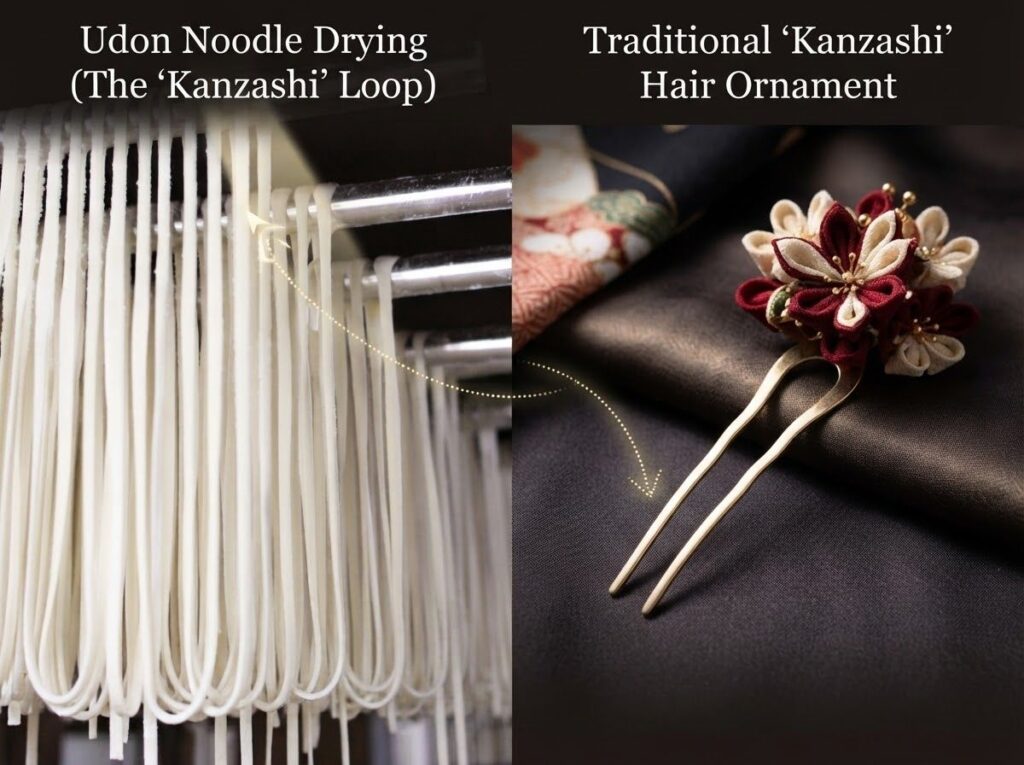
However, the parts that were hanging over the rods retain their U-shaped form even after drying.
These U-shaped sections become a special type of dried noodle.
Kelly: But what does that have to do with hair ornaments?
Nobu: The U-shaped noodles resemble traditional Japanese hair ornaments called “kanzashi.” That’s why they are sometimes called Kanzashi noodles.
Depending on the region and the product, similar noodles may also be called “fushi-men.”
John: By the way, what about the drying process? I imagine the final quality can vary depending on how the noodles are dried.
Nobu: That’s true. In modern commercial production, temperature and humidity are often controlled in drying rooms. So even when the noodles are made using a traditional hand-stretching method, parts of the drying process may be managed with machinery.
A Special Part of Japanese Noodles
John: So, only a small portion of the entire batch can become Kanzashi noodles, right?
Nobu: That’s right. Hand-stretched noodles are made into very long strands, but only a relatively small section is formed around the rods in the U-shape.
However, there is a common misunderstanding about Kanzashi noodles.
Kelly: What kind of misunderstanding?
Nobu: Because they are the end sections of the noodles, some people think they are simply imperfect products or leftovers.
But that’s not necessarily true. Kanzashi noodles are appreciated by noodle lovers for their distinctive shape and pleasantly chewy texture.
Kelly: By the way, how are these noodles usually eaten? They look quite different from ordinary udon.
Nobu: They are often used as the final addition to a Japanese hot pot meal.
Kelly: I see. Hot pot!
John: What about the price? If they are made from a relatively small portion of the noodles, I imagine they might be expensive.
Nobu: Prices vary depending on the product and producer. If you want to try them, buying online can be a convenient option.
Mike: Kanzashi noodles in a hot pot as the final dish? That sounds delicious!
Kelly: It certainly does. I’ll have to try them sometime.
The End
My Personal Experience
I have eaten Kanzashi noodles quite often myself.
I remember that they go particularly well with Japanese hot pot dishes. They absorb the rich flavors of the ingredients and broth, making them a satisfying final dish.
In the past, Japan did not have the same well-developed distribution networks that it has today. As a result, Kanzashi noodles were not always easy to find.
I remember that people thought of them more as a special gift than something they would simply go out and buy for themselves.
More recently, I had an opportunity to visit a noodle factory. Although the noodles I saw were on display rather than being actively produced, I was able to see noodles hanging from rods.
Their appearance was quite different from that of machine-made noodles. Seeing the traditional production method in person made a strong impression on me.
Conclusion
In this article, I introduced Kanzashi noodles and explained their unusual shape and name.
Perhaps some readers were surprised to discover the connection between these noodles and traditional Japanese women’s hairstyles. Others may have become interested in the history of Japanese noodle-making.
In any case, Kanzashi noodles are a distinctive part of Japanese noodle culture. If you have an opportunity to enjoy a Japanese hot pot meal, why not try them as the final dish?

