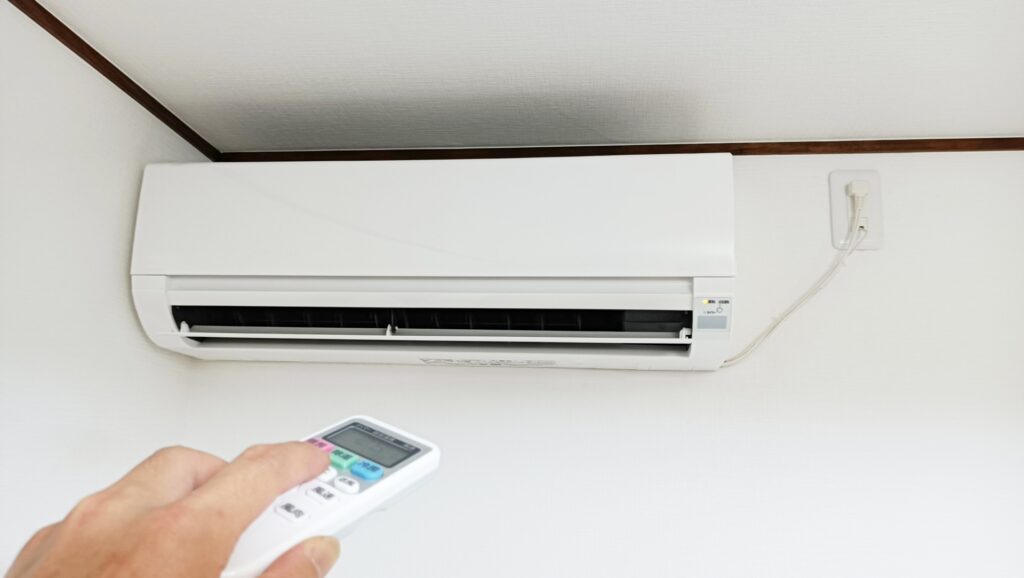
Japan has a humid climate, and temperatures can vary greatly throughout the year. For this reason, many households consider air conditioners essential.
The same is true for foreigners who move to Japan. Some may find the differences between Japan’s climate and that of their home countries surprising. As a result, they may soon start thinking about buying an air conditioner.
However, installing an air conditioner can be expensive. Naturally, many people look for ways to reduce the cost.
One option is to buy a used air conditioner instead of a new one.
However, buying a secondhand air conditioner comes with certain risks.
In this article, we will explain some of the risks you should consider when buying a used air conditioner in Japan.
Characters
Mike: A 12-year-old American boy who is interested in Japan.
John: Mike’s father. He sometimes travels to Japan on business.
Kelly: Mike’s mother. She is good at cooking.
Nobu: A Japanese exchange student.
Prologue
Many of John’s colleagues live in Japan. Some have only recently moved there. As they adjust to their new lives, they sometimes encounter problems and turn to John for advice.
This time, one of his colleagues is planning to buy an air conditioner. However, after discovering how expensive installation can be, the colleague wonders whether there is a way to reduce the overall cost. So, he asks John for advice.
Just then, Nobu appears.
Nobu: Hello!
John: Hi! We were just discussing how to save money when buying an air conditioner in Japan. Could you give us some advice?
Nobu: Of course.
What About Buying a Used Air Conditioner?
Nobu: By the way, did your colleague mention any particular ways to reduce the cost?
John: Well, he said something like, “I don’t care if it’s used or whatever. I just want something cheaper.” He sounded a little desperate.
Nobu: So, he’s considering buying a secondhand air conditioner. That would certainly help reduce the initial cost.
John: But I think there are risks involved. Things are not always as good as they seem.
Nobu: That’s right. To put it simply, used air conditioners do come with risks. Although they can reduce the initial expense, the savings may only be temporary.
John: What do you mean by temporary savings?
Nobu: Let me explain.
Mike: By the way, how much could someone save by buying a used air conditioner?
Nobu: It depends on the model and its condition, but in some cases, a used unit can cost half as much as a new one, or even less.
Mike: So, it could be less than half the price. In that case, perhaps it’s worth buying one, even if there are some risks.
Nobu: That is certainly an option. However, after that, it’s almost like gambling. You never know what might happen, so I wouldn’t recommend making the decision based on price alone.
Mike: I see what you mean.
Used Air Conditioners Come with Risks
Nobu: Anyway, let me explain some of the risks associated with used air conditioners.
1. A Higher Risk of Breakdown
Nobu: First, there is the possibility of a higher risk of breakdown.
Some people believe that household appliances can simply be used until they stop working. They might even say that an air conditioner can keep working for more than 20 years.
However, this way of thinking ignores the risks associated with aging equipment.
Kelly: What do you mean?
Nobu: Household appliances have an expected service life. The exact period varies depending on the product, but many air conditioner manufacturers use approximately 10 years as the standard design life for their products.
This does not mean that an air conditioner will stop working after 10 years. Some units continue to operate for much longer. However, as equipment ages, the possibility of breakdowns generally increases.
Kelly: I see. Even if we are talking about used air conditioners, some might be only two or three years old, while others could have been used for nearly 10 years.
Nobu: Exactly. Naturally, a unit that has been used for a longer period may be at a disadvantage. Another problem is that you may not know how many hours the previous owner actually used it.
2. Electricity Bills May Be Higher
Nobu: Another concern is electricity costs.
Modern air conditioners have become increasingly energy-efficient. Manufacturers have made considerable improvements in reducing electricity consumption, and newer models generally have an advantage over older ones.
Kelly: That makes sense. A newer model may consume less electricity than one released three years ago.
Nobu: Exactly. The difference in energy efficiency can directly affect your electricity bill.
For example, when comparing an older model with a newer one, the cost of running them may be different, even if they are used under similar conditions.
Kelly: I see. But how much difference could there be?
Nobu: That depends on several factors.
For example, the condition of the air conditioner is important. The outdoor unit is installed outside, where it is exposed to harsh environmental conditions. It may be affected by summer sunlight, high temperatures, rain, and winter cold.
Kelly: That’s true. Some outdoor units are installed in sunny locations, while others are placed in the shade.
Nobu: Exactly. These differences can affect how quickly the equipment deteriorates. Its condition may also influence its performance and electricity consumption.
Therefore, it is difficult to estimate the actual electricity costs without knowing the model and its condition.
Kelly: It sounds complicated.
3. Warranty Issues
Nobu: Another issue is the warranty.
Kelly: You mean the manufacturer’s warranty? That gives us peace of mind when buying a new appliance.
Nobu: That’s right. In addition, some retailers provide their own warranties. When both types of warranty are available, buyers may receive fairly comprehensive protection.
Kelly: What about used air conditioners?
Nobu: Some retailers do offer warranties for used units. However, the coverage is not necessarily the same as that offered for new products. In many cases, the warranty period is shorter, and the conditions may be more limited.
Also, you should not assume that the original manufacturer’s warranty is still valid.
For older models, there is another possible problem: replacement parts may become difficult to obtain, making repairs more challenging.
Kelly: That could put buyers at a disadvantage.
4. It Can Be Difficult to Choose the Right Model for Your Room
Nobu: Another issue is that it may be harder to choose an air conditioner that is suitable for your room.
Kelly: What do you mean by suitable for the room?
Nobu: If you visit an electronics store in Japan, you will notice that air conditioners are often labeled according to room size. For example, one model may be recommended for a six-tatami-mat room, while another may be suitable for an eight-tatami-mat room.
These recommendations give customers a useful starting point when choosing a model. Selecting an air conditioner with the appropriate capacity can help it operate effectively.
Kelly: What about used models?
Nobu: A retailer may be able to provide some guidance, but it can be more difficult to make an accurate assessment.
For example, the model’s original cooling and heating capacity may be known, but its actual performance could have declined due to aging or wear.
Ideally, buyers should consider not only the original specifications but also the current condition of the unit.
However, it can be difficult to evaluate all these factors accurately when purchasing a used air conditioner.
Kelly: I see. That does make things more complicated.
John: There certainly seem to be several risks. I’ll explain these points to my colleague before he makes a decision.
The End
My Personal Experience
This is based on something I studied in the past: the probability of household appliances breaking down.
From that perspective, I would like to explain a little more about appliance failures.
There are generally two types of breakdowns.
The first is an early failure, which occurs relatively soon after a product begins operating.
The second is a failure caused by wear and deterioration after the product has been used for a certain period.
The operating environment also affects how quickly a product deteriorates. For example, the location where an appliance is installed and the conditions under which it operates can influence its lifespan.
Manufacturers take the expected operating period into consideration when designing their products. However, they may also assume that failures caused by wear and deterioration toward the end of the product’s service life will be handled through repairs.
With a used air conditioner, the previous operating environment is often unknown.
As a result, it is difficult to predict when deterioration-related failures might occur. This is one reason why buying a used air conditioner can involve a higher risk of breakdown.
Conclusion
We have looked at some of the risks associated with buying used air conditioners.
People in other countries may also be accustomed to buying and using secondhand household appliances. Foreigners moving to Japan may naturally have the same attitude toward used products.
However, the situation can differ from country to country.
Some people may think that Japanese products are highly reliable and that there is little reason to worry. While Japanese manufacturers do have a strong reputation for quality, this does not guarantee that every used air conditioner will be trouble-free.
If you are considering buying a used air conditioner in Japan, make sure you understand the risks discussed in this article before making your decision.
Related Article
In this article, we focused mainly on the risks of buying a used air conditioner.
But are there any other points you should keep in mind when purchasing an air conditioner?
In the next article, I will share some things I personally learned and noticed when buying an air conditioner.
Read the article →