Japan gets a fair amount of rain throughout the year. There is the rainy season in early summer, and the autumn rain front also brings wet weather. And, of course, typhoons sometimes hit Japan. In recent years, sudden, extremely heavy downpours have also become a concern.
Even when it rains, however, people generally continue their daily routines, going to work or school unless the weather is particularly severe. They simply take their umbrellas and get on with their day.
But umbrellas can cause a small problem. When people carry wet umbrellas indoors, rainwater drips onto the floor. This can make floors slippery and dirty, and it may even damage merchandise.
So, how do people in Japan deal with this problem?
Characters
Mike: A 12-year-old American boy who is interested in Japan.
John: Mike’s father. He sometimes travels to Japan on business.
Kelly: Mike’s mother. She is good at cooking.
Nobu: A Japanese exchange student.
Prologue
One rainy day, Kelly returned from a trip to the supermarket in a bad mood. Looking more closely, John noticed that the back of her clothes was wet. Apparently, she had fallen backward.
Fortunately, she was not injured, but her back was soaked with rainwater.
According to Kelly, the floor inside the supermarket was wet, and she had slipped and fallen. She was angry because she felt that the wet floor had made the accident more likely.
Just then, Nobu arrived.
Umbrella Etiquette on Rainy Days
Nobu: Hello!
Kelly: Oh, you’re just the person I wanted to see! Listen to this. The floor inside the supermarket was soaking wet. I slipped and fell, and look at the state I’m in! What a nuisance!
John: Floors can certainly get wet on rainy days. We have to watch where we step.
Mike: It must be especially dangerous for older people. A fall could even result in a broken bone.
John: That makes me wonder. Do people in Japan also have accidents because of rainwater on floors?
Nobu: Of course, accidents can happen in Japan, too. But there are ways to reduce the amount of rainwater brought into stores. People are expected to handle their wet umbrellas with consideration for others.
Kelly: There is etiquette for handling umbrellas?
Nobu: Yes, there is.
Use an Umbrella Stand
Nobu: One option is to use an umbrella stand. You can find them at the entrances of various shops. People leave their wet umbrellas in the stand before entering the store. This helps prevent rainwater from dripping onto the floor.
That way, customers can shop without having to worry as much about slipping on a wet floor.
Mike: That sounds safer, especially for older people.
Nobu: Exactly. It also helps protect merchandise from getting wet. After all, customers probably don’t want to buy products that have been splashed with dirty rainwater.
John: So it helps the store, too.
Nobu: That’s right. Of course, there are always people who ignore these simple courtesies. Some people don’t seem to care if their actions inconvenience others. Fortunately, they are not the only kind of customer.
Kelly: That’s a shame. It isn’t that difficult to be considerate.
Use a Disposable Umbrella Bag
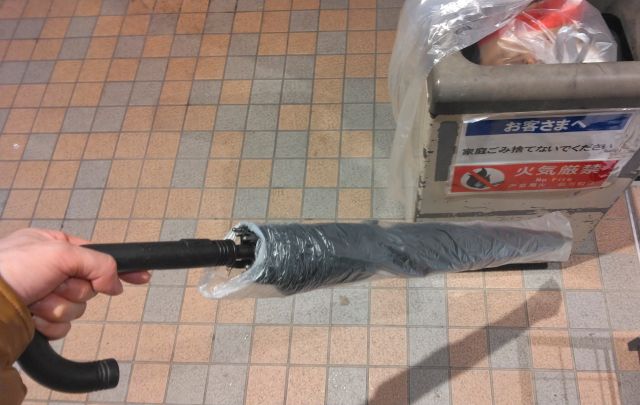
Nobu: Another option is to use an umbrella bag.
John: An umbrella bag? What is that?
Nobu: It’s a plastic bag designed to hold a wet umbrella. These bags are often provided near store entrances. Customers put their wet umbrellas inside the bags before carrying them into the store.
The bags help prevent rainwater from dripping onto the floor or merchandise. After shopping, customers can usually dispose of the used bags in a designated trash bin near the exit.
John: I see. The bag keeps the water contained. That makes sense.
Nobu: You’ll often see umbrella bags at supermarkets and shopping centers, although practices vary from store to store. Places with many customers may find bags more convenient than umbrella stands alone.
Kelly: So the best solution depends partly on how many people visit the store.
Nobu: Exactly. However, some stores are also trying to reduce their use of disposable umbrella bags.
John: Why is that?
Nobu: Because these bags are usually made of plastic and are used only once. Throwing away so many plastic bags creates an environmental problem.
John: That’s understandable. Using so much plastic for something that is used only briefly seems wasteful.
Nobu: Some stores use alternatives, such as absorbent mats that soak up water from wet umbrellas. These can help reduce the amount of disposable plastic used.
John: That’s a good idea.
Being Considerate of Others Matters
Kelly: I think I understand how stores can deal with wet umbrellas now. The important thing is not to walk into a store with a dripping wet umbrella without taking any precautions.
Nobu: That’s right. Being considerate of others is important. Whether you use an umbrella stand or an umbrella bag, the idea is the same. We should think not only about ourselves but also about the people around us.
Kelly: You’re right. If more people paid attention to these things, perhaps fewer people would slip and fall in stores.
Nobu: I hope so, too.
The End
A Personal Experience: Wet Umbrellas on Trains
So far, I’ve explained how people can handle wet umbrellas when entering stores. However, there are situations in which dealing with a wet umbrella is not so easy.
One example is using public transportation, such as trains and buses.
Large numbers of people travel on trains and buses, and they get off at different stops. Unlike a store, a train or bus cannot simply collect everyone’s umbrellas in one place. It would be impractical to distribute umbrella bags to passengers and collect them again every time someone got on or off.
As a result, passengers often have to stand close to people carrying wet umbrellas. Rainwater can drip onto other passengers’ clothes, making an already crowded journey even less comfortable.
One day, I noticed a passenger carrying a folding umbrella on a train.
After closing and folding the umbrella, the person put it into a plastic bag they had brought along and then placed it directly into their bag.
This was a simple but clever idea. The plastic bag helped prevent rainwater from soaking the inside of the person’s bag.
I remember thinking, “That’s a good idea!”
I was also impressed by the person’s consideration for others. It was the first time I had seen someone bring their own plastic bag specifically for a wet umbrella.
I thought that if more people did the same thing, traveling by train on rainy days might become more comfortable for everyone.
Water-Repellent Spray Can Help Maintain an Umbrella
As an umbrella gets older, its water-repellent performance may decline. Depending on the material and its condition, the fabric may begin to hold more water instead of allowing it to run off easily.
A wet umbrella can take longer to dry, and the water it carries may drip onto the floor or other people.
One possible solution is to use a water-repellent spray suitable for the umbrella’s material. Such products may help restore some of the umbrella’s water-repellent performance.
However, the effectiveness of these products varies, and the treatment may need to be repeated according to the product instructions.
If you decide to use a water-repellent spray, check that it is suitable for your umbrella and follow all safety instructions. Some sprays can be harmful if inhaled, so never use them casually indoors. Follow the manufacturer’s directions regarding where and how to apply the product.
Taking care of your umbrella can help you use it more comfortably and reduce the amount of water it carries.
Conclusion
We’ve looked at some basic rules of umbrella etiquette in Japan. Hopefully, this has also shown why being considerate of others matters in everyday life.
The example of the passenger carrying a plastic bag for a wet umbrella illustrates how a small personal effort can make public transportation more comfortable for everyone.
Of course, not every store provides umbrella bags or umbrella stands. If you visit a place where neither is available, you may need to find another way to keep your wet umbrella from dripping.
One simple option is to bring your own plastic bag when you go out on a rainy day.
It doesn’t take much effort, but it can help keep your belongings dry and prevent rainwater from bothering the people around you.
Why not give it a try the next time you head out with an umbrella?