When it comes to fishing, you could say that it is a kind of battle of wits between humans and fish.
Whether we use bait attached to a hook or a lure designed to look like food, the idea is basically the same: we try to trick the fish into taking the bait.
At least, that is how many people think of fishing.
But did you know that Japan has an unusual fishing method called tomozuri, or ayu fishing with live decoys?
What makes it so unusual is that anglers do not use conventional bait or artificial lures. Instead, they use a live fish to catch another fish!
How does that work? Let’s take a closer look.
Characters
Mike: A 12-year-old American boy who is interested in Japan.
John: Mike’s father. He sometimes travels to Japan on business.
Kelly: Mike’s mother. She is good at cooking.
Nobu: A Japanese exchange student.
Prologue
One day, John was watching a fishing program when Mike came along and introduced him to a Japanese fishing manga called Tsurikichi Sanpei.
The story follows a talented young boy who catches all kinds of fish using his impressive fishing skills.
John became interested in the manga and started looking through it. Before long, he came across an episode featuring a fishing technique called ayu tomozuri.
He had never heard of it before.
Just then, Nobu arrived.
Nobu: Hello!
John: Hey, perfect timing! I’ve come across something about Japanese fishing that I don’t quite understand.
Nobu: What is it?
Mike: It’s a fishing technique in a Japanese manga called Tsurikichi Sanpei. It’s called ayu tomozuri. Apparently, you don’t use bait or lures, so I’m wondering how on earth it works.
Nobu: Ah, tomozuri! Yes, it is a rather unusual way of fishing.
What Is Ayu Tomozuri?
John: So, how exactly does tomozuri work?
Nobu: First, you need to understand something about the behavior of ayu. This fishing technique takes advantage of their natural instincts.
Mike: What kind of fish are they?
Nobu: Ayu, often called sweetfish in English, are freshwater fish found in Japanese rivers. They feed on algae growing on rocks in the riverbed, especially as they mature.
Kelly: They sound rather peaceful. Almost like herbivores on land!
Nobu: In a way, yes. But ayu have another side to them. They are territorial fish and can become surprisingly aggressive when another ayu enters their territory.
Kelly: Really? I wouldn’t have expected that!
Nobu: Each fish may defend a feeding area around the rocks where it finds food. When another ayu enters that area, the resident fish may attack it by charging into it.
Mike: So they fight over their food supply?
Nobu: Exactly. And that is the secret behind tomozuri.
John: All right, I’m listening. How does the angler take advantage of that?
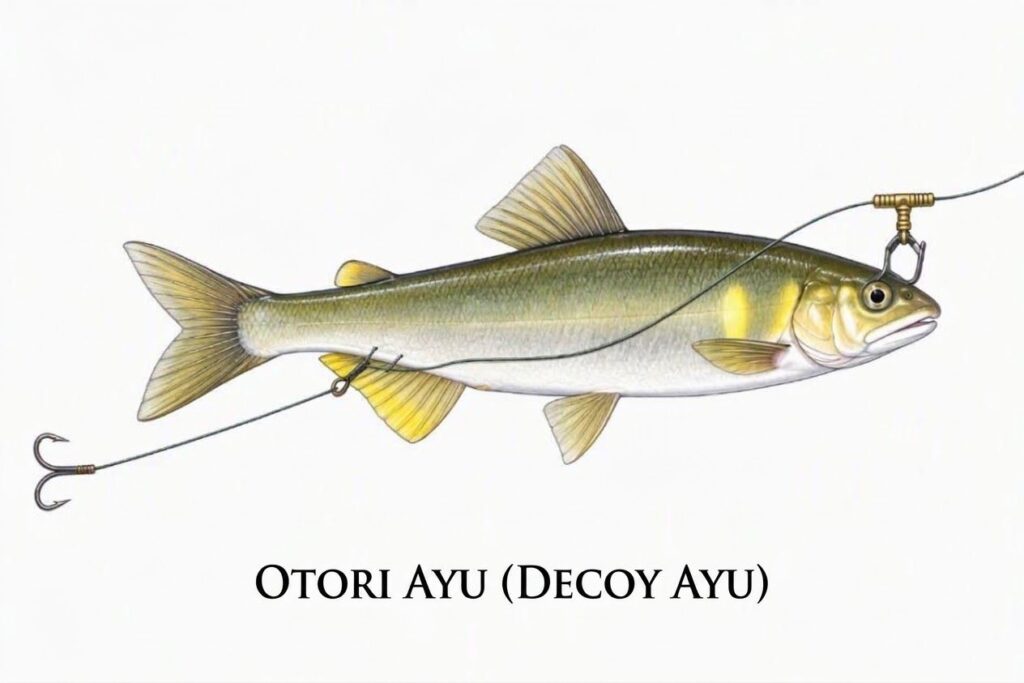
Nobu: The angler attaches a live ayu, called an otori or decoy fish, to the fishing line. A special hook arrangement is positioned near the decoy fish.
The angler then guides the live ayu into the territory of a wild ayu. When the resident fish tries to drive away the intruder, it may collide with the decoy. The hook catches the attacking fish, allowing the angler to bring it in.
Mike: Wait a minute! So the fish isn’t trying to eat anything?
Nobu: That’s right. Unlike ordinary bait fishing, the technique takes advantage of the ayu’s territorial behavior rather than its desire to eat.
John: That’s clever! It’s almost like using one fish to provoke another into making a mistake.
Nobu: You could put it that way!
How Does the Fishing Setup Work?
John: I think I understand the idea now. But could you explain the process step by step?
Nobu: Of course. Let’s simplify it.
- Prepare the fishing rig. A live ayu is attached to the line, with a special hook arrangement positioned near it. No bait is needed on the hook.
- Release the decoy fish into the river. The angler guides the live ayu toward the rocks where wild ayu may be feeding.
- The decoy enters another fish’s territory. A resident ayu may see the intruder as a threat and try to drive it away.
- The resident fish attacks. As it charges at the decoy, it may become caught on the hook positioned behind the live fish.
- The angler brings in the catch. If the hook catches the attacking ayu, the angler can catch it.
That’s the basic idea behind tomozuri.
Why Do Anglers Use Special Fishing Rods?
John: I see! But I suppose you need a special fishing rod for this, too?
Nobu: Yes. The length of the rod is particularly important. Ayu anglers commonly use long rods, often around nine meters in length.
John: Nine meters? That’s a lot longer than the fishing rods I’m used to!
Nobu: It certainly is. The long rod allows the angler to guide the decoy fish through the river without having to stand right next to the spot where the fish are feeding.
Mike: But wouldn’t a long rod make it difficult to control the fish?
Nobu: That’s why the rod’s flexibility and the angler’s technique matter, too. The angler needs to control the decoy carefully, allow it to swim naturally, and maintain control of the line in the current.
John: So taking an ordinary rod designed for lure fishing probably wouldn’t be ideal.
Nobu: That’s right. Tomozuri has its own equipment and techniques.
What Happens to the Decoy Fish?
Kelly: I have another question. Doesn’t the decoy fish get tired? It must be stressful to swim around with a fishing line attached to its body.
Nobu: That’s a good point. The decoy needs to remain lively enough to swim naturally, so anglers have to handle it carefully.
John: Where do they get the first decoy fish?
Nobu: They usually buy a live ayu from a shop or a local vendor that sells them to anglers.
Mike: And what happens when they catch a fish? Can they use that one as the next decoy?
Nobu: Yes, provided the fish is in good enough condition to swim as a decoy. Anglers often replace the previous decoy with a newly caught ayu and continue fishing.
John: So the fish they catch can become the next decoy!
Nobu: Exactly. That’s another interesting feature of tomozuri. The process can continue as long as the angler has a suitable live decoy.
Mike: It’s almost like a relay race, with each fish passing the job to the next one!
Nobu: That’s one way to look at it!
Ayu Fishing Has a Season
Kelly: By the way, can you go tomozuri fishing at any time of the year? If so, I’d love to give it a try someday.
Nobu: Unfortunately, no. Ayu fishing has a designated season, and the opening date varies depending on the river and region.
John: When does the season usually begin?
Nobu: Many rivers open for ayu fishing around June, although some open earlier or later. Fishing may continue through the summer and into autumn, depending on the local regulations.
Mike: So we can’t just turn up at a river whenever we feel like fishing?
Nobu: That’s right. You must check the opening date and the local fishing rules before you go. Fishing before the permitted season can be illegal.
John: We’d better check the rules carefully, then.
Nobu: Absolutely. And if you’re wondering when the best time to go is, that also depends on the river, the weather, water conditions, and the behavior of the fish. Summer is a popular time for ayu fishing, but there isn’t one perfect period for every location.
Where Can You Go Ayu Fishing?
John: So where can we try tomozuri?
Nobu: You can find ayu fishing opportunities in rivers throughout Japan. However, not every clear river is suitable. The river needs to support ayu, and fishing must be permitted at that location.
Mike: I suppose the river needs to have the right conditions for the fish to live there.
Nobu: Exactly. Ayu feed on algae attached to rocks, so the river environment and the availability of suitable food are important.
There are also local fishing regulations. Many rivers are managed by fisheries cooperatives, which set rules for recreational fishing.
John: Does that mean we need permission before we start fishing?
Nobu: In many places, you’ll need to purchase a fishing permit, often called a yugyoken, or follow other local requirements. The rules vary from river to river, so it’s best to check with the local fisheries cooperative.
Mike: And what about the live decoy fish? Where do we buy those?
Nobu: Look for a shop or vendor that sells live ayu for fishing. These places are often a useful starting point because the staff may also be able to tell you about local fishing conditions and regulations.
John: That sounds helpful. We could ask them for advice before heading to the river.
Nobu: Exactly. If it’s your first time, getting local advice is a good idea.
How Do You Get to the Fishing Spots?
Kelly: But if ayu live in rivers away from big cities, won’t it be difficult to get to a fishing spot from Tokyo?
Nobu: Some locations are in rural areas, but there are fishing spots within reach of Tokyo, too. You can consider places such as the Akigawa River, or travel to rivers in Yamanashi Prefecture by car.
John: So a day trip might be possible?
Nobu: Depending on the location, yes. However, you should check the access arrangements in advance. Some fishing spots are easier to reach by car, while others may be accessible by public transportation.
Kelly: It sounds like a good way to enjoy the Japanese countryside as well as fishing.
Nobu: I think so. Just remember to check the fishing season, local rules, and the availability of decoy fish before setting off.
The End
Conclusion
Today, we’ve looked at ayu tomozuri, a distinctive Japanese fishing technique that uses a live ayu to catch another ayu.
For people who are used to conventional bait fishing or lure fishing, the idea may sound surprising. Instead of trying to make a fish eat something, the angler takes advantage of its instinct to defend its territory.
It’s a fascinating example of how understanding an animal’s behavior can lead to a very different approach to fishing.
And there’s another reason to give it a try: ayu fishing can take you to some beautiful rivers and rural areas in Japan. Even if you’re not an experienced angler, spending time beside a river and enjoying the surrounding scenery can be a rewarding experience.
So, if you ever have the chance to visit Japan during the ayu fishing season, why not learn more about tomozuri?
Just remember to check the local fishing rules first. You don’t want your fishing adventure to end before it even begins!