Yakiniku (Japanese-style grilled meat) is extremely popular in Japan. Supermarkets have entire sections filled with meat prepared for yakiniku, and yakiniku restaurants are always busy with customers.
When people enjoy yakiniku at home in Japan, an electric griddle is a common choice. At restaurants, charcoal grills are also popular.
So, which is better: yakiniku cooked on an electric griddle at home or yakiniku grilled over charcoal at a restaurant?
Of course, this comparison includes quite a bit of my personal opinion. Nevertheless, I hope you enjoy reading it!
Characters
Mike: A 12-year-old American boy who is interested in Japan.
John: Mike’s father. He sometimes travels to Japan on business.
Kelly: Mike’s mother. She is good at cooking.
Nobu: A Japanese exchange student.
Prologue
Today is Nobu’s birthday. John and his friends have decided to invite him out for yakiniku to celebrate.
However, John and the other Americans are not sure what kind of yakiniku Nobu, who is Japanese, would prefer.
They have two ideas. One is to have a yakiniku party at home, while the other is to take him to a restaurant where they can enjoy charcoal-grilled meat.
Kelly suggested having a party at home, while John preferred going to a charcoal-grilled yakiniku restaurant. Unfortunately, they cannot agree, and the atmosphere is becoming rather unpleasant. Mike can only sigh as he watches them argue.
Just then, Nobu arrives.
Nobu: Hello, everyone!
Kelly: Oh, perfect timing! Since it’s your birthday today, we were thinking of inviting you to have yakiniku. But we’ve been arguing about whether to have a party at home or go to a charcoal-grilled yakiniku restaurant.
Mike: They’re really making a fuss over nothing.
Nobu: Thank you. I really appreciate the invitation. By the way, if we have yakiniku at home, I assume we’ll use an electric griddle. And if we go to a yakiniku restaurant, we’ll probably have charcoal grilling, right?
John: Exactly!
Nobu: Then let’s compare yakiniku cooked on an electric griddle with yakiniku grilled over charcoal.
Electric Griddles vs. Charcoal Grills
Nobu: I think the first step is to compare the characteristics of electric griddles and charcoal grills. Let’s start with electric griddles and then look at charcoal grilling.
Characteristics of Yakiniku Cooked on an Electric Griddle
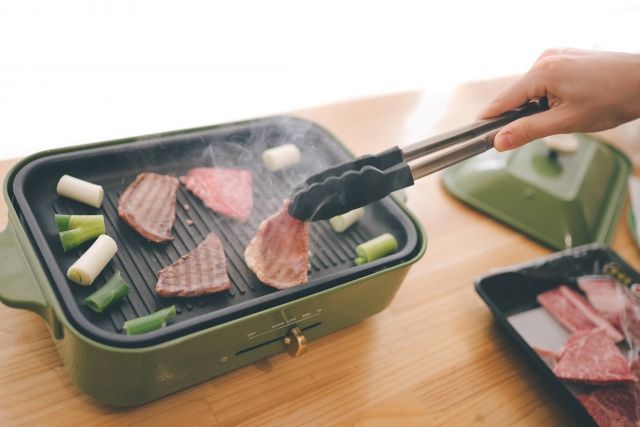
Nobu: First, let’s talk about electric griddles. I think their biggest advantage is convenience. All you have to do is plug one in and turn on the switch. It heats up automatically.
Many electric griddles have a maximum temperature of around 200°C (392°F). Depending on the ingredients and cooking conditions, this relatively moderate temperature can make it easier to avoid burning the food.
Another advantage is that the meat and vegetables can cook in their own juices and oils. When you cook yakiniku, for example, fat from the meat spreads across the cooking surface and can flavor the vegetables. As a result, the vegetables can taste delicious, too.
Kelly: That’s true. It’s convenient, and the food tastes great!
Nobu: However, there’s another side to that. If the fat remains on the cooking surface instead of draining away, more of it may end up in the food we eat. So, people who are concerned about their fat intake might want to keep that in mind.
There’s also the cleanup. The grease left on an electric griddle can be surprisingly difficult to remove, even when you wash it thoroughly. Cleaning up after the meal can be quite a chore.
Kelly: Ah, the cleanup! That’s certainly hard work.
Nobu: On the other hand, when you cook at home, you can relax immediately after eating. You can sit back, watch TV, and enjoy the rest of the evening. That’s one of the great things about eating at home.
Kelly: That’s true. You don’t have to walk home in the cold after dinner!
Characteristics of Charcoal Grilling
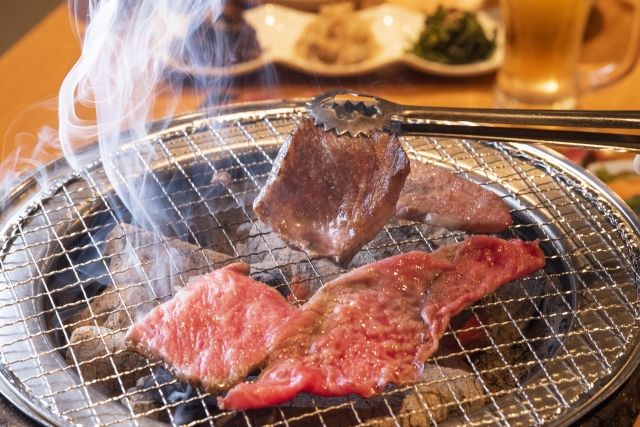
Nobu: Next, let’s look at charcoal grilling.
Charcoal grills cook meat using heat from burning charcoal, including radiant heat and infrared radiation. One characteristic is that the surface of the meat can cook relatively quickly while the inside cooks more gradually. This can help keep the inside juicy and flavorful.
Another advantage is that excess fat can drip away from the meat during cooking, depending on the grill design. The charcoal also gives the meat a distinctive smoky aroma and roasted flavor.
Some people consider charcoal grilling a good option for those who want to reduce the amount of fat they eat, although the actual amount depends on the meat and cooking method.
John: Exactly! I think the best thing about charcoal grilling is that the outside gets nicely browned while the inside stays juicy.
Nobu: However, controlling the heat of a charcoal grill is not always easy. Depending on the grill and the situation, you may need to eat the meat as soon as it is cooked. Otherwise, it might overcook.
That could make you feel a little rushed while eating.
John: I see. So controlling the heat can be an issue.
Nobu: On the other hand, yakiniku restaurants usually offer a much wider selection of meat.
When you buy yakiniku meat at a supermarket, you generally find common cuts. At a restaurant, however, you can choose from many different cuts and types of meat.
For example, when a family visits a yakiniku restaurant, the children can enjoy regular cuts of meat while the parents try horumon (grilled offal).
Mike: It’s nice that everyone can choose what they like.
Nobu: There’s another advantage to eating at a restaurant. You don’t have to wash the dishes or clean the grill afterward. Naturally, the restaurant staff take care of that. All you have to do is pay the bill and leave.
Mike: That’s right. Not having to wash the dishes is a big plus!
Nobu: However, once you leave the restaurant, you still have to get home. Depending on the season, you might have to walk outside in the cold.
Mike: Well, I guess that’s unavoidable.
Which Is Better?
Mike: So, which one is better? After all, Nobu is the guest of honor at this birthday celebration.
Nobu: I’m happy with either option. I’m just grateful that you invited me.
Mike: But those two are still arguing. Each one insists that their preferred option is better.
Nobu: Neither of them is willing to give in. This is getting difficult. But in the end, both options have advantages and disadvantages. It’s impossible to say that one is definitely better than the other.
Mike: Hey, look! They’re playing rock-paper-scissors now. But they keep getting ties, so they can’t decide the winner. Oh, well…
Nobu: Anyway, I’m getting hungry.
Mike: Me too!
The End
From My Personal Experience
Choosing between yakiniku cooked on an electric griddle and charcoal-grilled yakiniku might be an eternal dilemma.
If we compare only the taste, it might not be too difficult to choose. However, once we consider things like washing the dishes and getting home after a meal, the comparison becomes much more complicated.
By the way, there is another factor that we didn’t discuss in the story. Japanese supermarkets often offer special discounts on meat, while some yakiniku restaurants offer all-you-can-eat plans. That makes the decision even harder!
Personally, I prefer going to a charcoal-grilled yakiniku restaurant when I eat alone, but I usually use an electric griddle when eating with my family.
The reason is simple. The restaurant I visit alone has a relaxed atmosphere, with jazz playing in the background. Being able to enjoy charcoal-grilled meat in such a peaceful setting is wonderful.
On the other hand, when I eat with my family, the children are there, too. Things can get quite chaotic! We also eat a lot of meat.
As a result, we usually buy meat on sale at the supermarket and enjoy a lively yakiniku party at home.
In this way, I personally enjoy the advantages of both charcoal grilling and electric griddles. So even I cannot choose one over the other.
How about you? Instead of thinking only about which one tastes better, why not consider the cleanup and the journey home as well?
Conclusion
Writing an article comparing two options like this is surprisingly difficult. Ultimately, the better choice depends on personal preference and the situation. In other words, there is no universal answer.
Just like in our story, the discussion might end with a game of rock-paper-scissors. And if there’s a tie, you simply play again!
Incidentally, in Japan, people sometimes play rock-paper-scissors in several rounds. When they agree to play three rounds, they might call it a best-of-three match.
So, even if someone loses the first round, they might suddenly say, “Actually, let’s make it best of three!” This can turn into a never-ending argument.
Anyway, the most important thing is to enjoy yakiniku together. Whether you decide by voting or by playing rock-paper-scissors, just have fun!
Related Article
● Japanese yakiniku restaurants generally use one of two cooking methods: charcoal grilling with a traditional shichirin grill or gas-powered roasters.
Which type of restaurant do you prefer?
In this article, we compare charcoal-grilled yakiniku cooked on a shichirin with yakiniku cooked on a gas roaster.
Read the article →
● This article compares okonomiyaki, one of the classic dishes cooked on a hot plate, with hot pot. It offers another perspective on how hot plates are used in Japanese cooking.
Read the article →