We are surrounded by all kinds of modern appliances, and they make our daily lives much easier. When it comes to cooking rice, for example, all we have to do is press a button on an electric rice cooker. We can even set a timer so that the rice is ready at a convenient time.
However, some people enjoy outdoor activities such as camping. Naturally, they cannot use an electric rice cooker in the middle of the outdoors. Instead, they need other equipment to prepare their meals.
One traditional piece of equipment used in Japan is called a “hango.” It is a portable metal cooking container designed for cooking rice outdoors.
So, what exactly is a hango, and how is it used?
Characters
Mike: A 12-year-old American boy who is interested in Japan.
John: Mike’s father. He sometimes travels to Japan on business.
Kelly: Mike’s mother. She is good at cooking.
Nobu: A Japanese exchange student.
Prologue
John and his family enjoy outdoor activities, and they sometimes go camping together.
One of the best parts of camping is preparing meals outdoors. Surprisingly, you can make some fairly elaborate dishes at a campsite. John once built an oven out of bricks, and Kelly used it to bake pizza.
One day, while they were getting ready for another camping trip, Mike started thinking about how people prepare meals when camping in Japan.
He had watched videos of Japanese campers and noticed that they cooked rice using a piece of equipment he had never seen before.
Just then, Nobu appeared.
What Do Japanese Campers Use to Cook Rice Outdoors?
Nobu: “Hello!”
Mike: “Oh, hello! Actually, I have something I want to ask you.”
Nobu: “What is it?”
Mike: “I’m planning to go camping soon, and I was watching some videos of Japanese campers preparing their meals. They were cooking rice in a piece of equipment I had never seen before. I wanted to find out what it was.”
Nobu: “Was it black?”
Mike: “Yes, it was black. They were cooking rice directly over a campfire. When they opened the container, there was perfectly cooked rice inside. So, you can actually cook rice in that thing?”
Nobu: “That’s right. It’s called a hango, and it’s a portable cooking container designed for preparing rice outdoors. Its origins are related to the mess tins used by Western armies, but Japan adapted the design to suit its own way of cooking rice.”
John: “Is it black because that helps it absorb heat?”
Nobu: “Not necessarily. Traditional aluminum hangos often become black because soot from campfires sticks to their surfaces. The black appearance doesn’t mean that they were specially designed to collect heat more efficiently. By the way, a traditional hango has an inner lid. It can be used as a small container for side dishes, and it can also help measure rice.”
How to Use a Hango
Kelly: “So, how do you actually use a hango?”
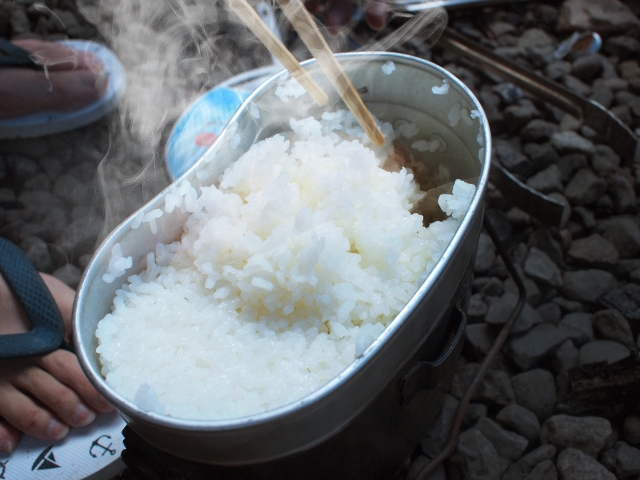
Nobu: “It’s surprisingly simple. You put rice and water inside, heat the container over a fire, and wait for the rice to cook. That’s basically how it works.”
Kelly: “That sounds very easy!”
Nobu: “Well, there is a little more to it. You need to understand what’s happening inside the container if you want to cook the rice properly. For example, you have to know when the water is boiling and when it has been absorbed by the rice.”
Nobu: “One traditional trick is to listen carefully to the sounds coming from the hango. Some people even touch the container with a wooden stick to feel its vibrations. When the water is boiling, you can hear bubbling sounds and sometimes feel the vibrations. As the water is absorbed and the cooking process changes, these sounds and vibrations become weaker.”
Nobu: “However, you shouldn’t rely on vibrations alone. The cooking time and the amount of heat can vary. Once the water has been absorbed and the rice is cooked, you take the hango away from the fire and leave it covered for a while. This final step is called steaming, and it helps the rice finish cooking.”
Kelly: “So, there are some tricks to it after all.”
Nobu: “Yes. Another problem is that the bottom of the hango can easily get scorched. A campfire doesn’t provide a perfectly stable level of heat, and you can’t easily see what’s happening inside the container.”
Kelly: “I think I’ll practice a little before trying it myself.”
Where Are Hangos Commonly Used in Japan?
Mike: “I suppose they must be used in quite a few places, then.”
Nobu: “That’s right. When people in Japan think about cooking rice while camping, a hango is one of the traditional pieces of equipment that comes to mind. It’s been around for a long time, so many people are familiar with it.”
Kelly: “Where are they actually used?”
Nobu: “There are several places, but let me introduce some typical examples.”
Outdoor Activities and Camping
Nobu: “First, there are outdoor activities such as camping. Japan has many people who enjoy camping, and some of them use hangos to cook rice. Some campsites also offer cooking equipment for rent. Not everyone who enjoys camping owns all the necessary equipment.”
John: “Being able to rent equipment is really convenient.”
Nobu: “Some public camping facilities in Japan also provide cooking equipment. There are facilities originally established for youth education and outdoor learning, and some are open to the general public as well. Depending on the facility, you may be able to rent pots and other cooking utensils in addition to hangos.”
Kelly: “Do they provide the ingredients, too?”
Nobu: “Some facilities do. However, Japanese camping meals often have a few familiar favorites, so you might not have a very wide selection.”
Kelly: “What are those typical dishes?”
Nobu: “Japanese curry rice is probably the most familiar example. It’s a popular choice for group cooking at campsites and school outdoor activities.”
Boy Scouts and Similar Organizations
Nobu: “Hangos are also used by organizations such as the Boy Scouts. Camping and other outdoor activities are important parts of their programs, so they sometimes have opportunities to cook rice using this equipment.”
John: “I see. It must be fun for children to try it. Of course, adults need to supervise them, but it seems like something children can learn to do.”
Nobu: “That’s right. However, there are some safety concerns.”
John: “What kind of concerns?”
Nobu: “Boy Scout activities don’t necessarily involve cooking rice alone. Depending on the program, children may also learn how to split firewood and prepare a campfire. They need to be careful not to injure themselves.”
John: “So, they use firewood rather than just solid fuel?”
Nobu: “In some activities, yes. They may use tools such as hatchets to split larger pieces of wood into smaller ones. That’s why the adults supervising these activities have to pay close attention to safety.”
John: “I see. That makes sense.”
Elementary and Junior High School Activities
Nobu: “Another place where hangos are used is during outdoor school activities, such as overnight trips and nature camps.”
Mike: “What exactly are these school trips?”
Nobu: “They are school events in which students spend time outdoors, often staying overnight at a campsite or an outdoor learning facility. For example, they might go hiking during the day, cook rice using hangos in the evening, and enjoy a campfire at night.”
Kelly: “That must be a valuable experience, especially for children who live in cities.”
Nobu: “I think so. At home, children are used to simply pressing a button on an electric rice cooker when they want rice. But when they cook outdoors, they discover that preparing a meal can actually take quite a bit of effort. I think that’s an important experience.”
Kelly: “I can understand that.”
Why Are Outdoor School Activities Important?
Nobu: “I also think that cooking rice together in groups during these school trips has considerable educational value.”
Kelly: “What do you mean?”
Nobu: “For example, some children in urban areas start preparing for entrance examinations at a relatively young age. Some may have fewer opportunities to experience activities outside their studies. Of course, this doesn’t apply to every child, but I think children benefit from having opportunities to learn things that cannot be taught through textbooks alone.”
Kelly: “I can see how that might happen, depending on the circumstances.”
Nobu: “That’s why I think cooking rice together in a group is so meaningful. Schools already have cooking classes in which students work together to prepare food. However, cooking outdoors is different because they have to deal with inconveniences that they don’t normally experience in a classroom or at home.”
Nobu: “They have to cooperate, divide up the work, and find ways to deal with unexpected problems. By deliberately experiencing these inconveniences together, children can learn the importance of helping one another.”
John: “I see. When you look at it that way, these activities have a lot of educational value.”
The End
My Personal Experience
Outdoor school trips are activities that many Japanese schools have incorporated into their programs, and I also took part in one when I was a student.
The meal we prepared was curry rice. It was a classic choice for outdoor cooking.
Making curry rice itself is not particularly difficult. However, cooking rice in a hango can be challenging if you have never done it before. We needed some help from people who had experience with it.
Thanks to their support, we were able to enjoy a delicious meal. I still remember that experience.
However, I also have some less pleasant memories of using a hango. Soot sticks to the outside of the container, and it is surprisingly difficult to remove. I also remember struggling to wash away the rice that had become stuck and burned onto the bottom.
In any case, a hango is a far cry from a modern electric rice cooker. That experience made me appreciate the convenience of modern appliances all over again.
Conclusion
In this article, I have introduced the traditional Japanese method of cooking rice using a hango. I hope you now have a better idea of what this piece of equipment is and how it is used, as well as its connection to outdoor education in Japan.
Some people who enjoy camping may also find it interesting to try cooking rice in a hango and preparing Japanese curry rice outdoors.
A hango may not be as convenient as a modern rice cooker, but that is part of its charm. It allows you to enjoy a different kind of outdoor experience.
If you have a chance to go camping in Japan, why not give it a try?